Biography
Ceferino Namuncurá
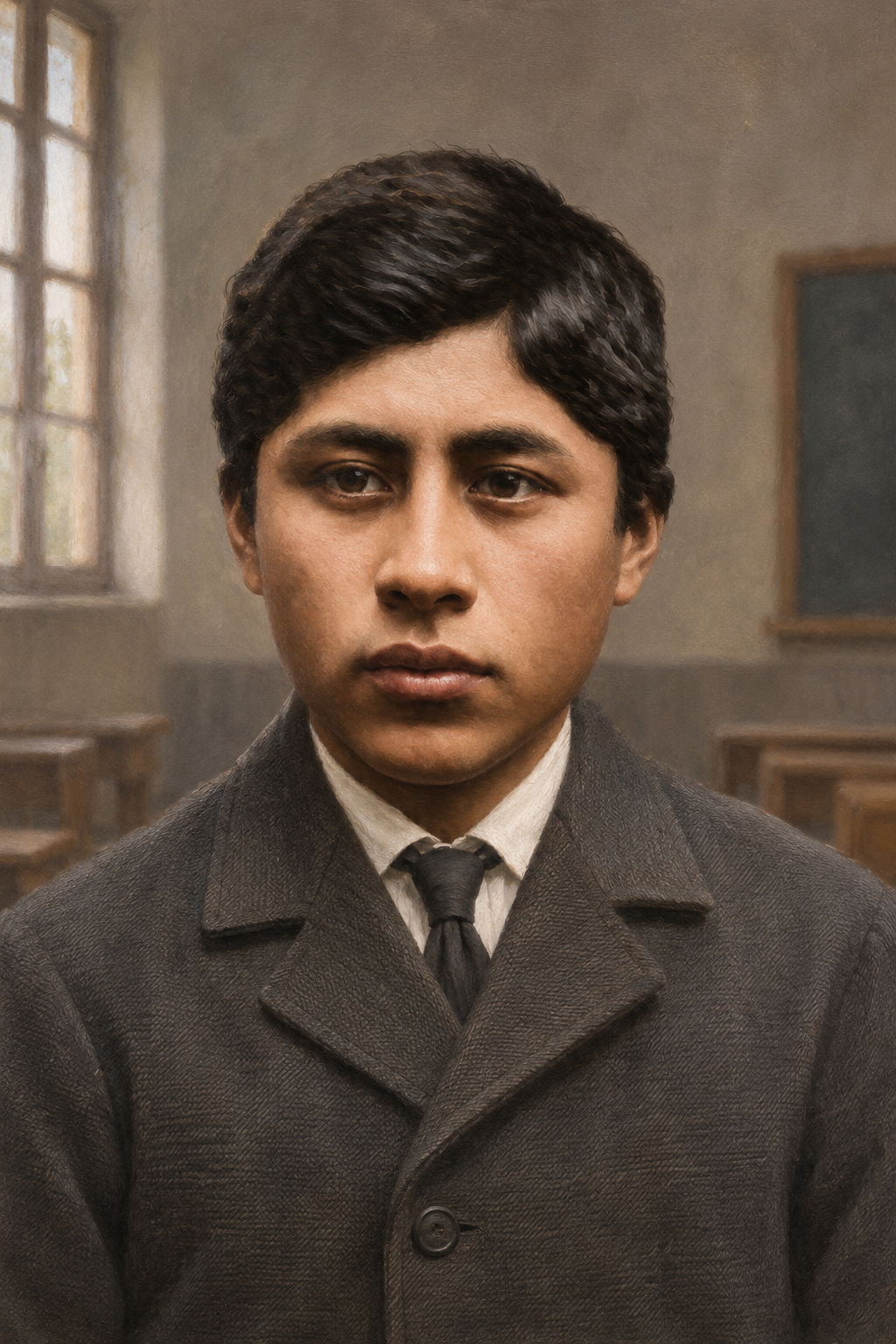
About Ceferino Namuncurá
Ceferino Namuncurá grew up in Patagonia with the hope that education would help him serve his people. He was born at Chimpay, beside the Río Negro, in 1886. His father was the Mapuche leader Manuel Namuncurá. The family’s place in the region had already been profoundly changed by the advance of the Argentine state. Ceferino later entered schools in Buenos Aires and encountered the educational community of the Salesians. His ambition eventually became a religious one: he wanted to become a priest and return to work among his own people.
His mother, Rosario Burgos, was Chilean. The Chilean bishops’ account therefore remembers him within a story that crosses the modern border between Chile and Argentina. It records the Salesian education that shaped his hopes and the illness that prevented him from carrying them out. In that account, he traveled to Italy in 1904 as an aspirant to the congregation, in the hope that his health would improve. He never returned to begin the priestly ministry he had imagined. He died from tuberculosis the following year.
The background to that education should not be reduced to a peaceful exchange between cultures. The Salesians’ British province describes the loss and poverty caused by the military campaign conventionally called the Conquest of the Desert. Within that disrupted world, Ceferino’s father looked toward schooling as a means by which his son might help defend his people’s future. The same account presents the young man’s attraction to Catholic faith alongside this continuing concern for his community. Becoming a student did not erase the history that he and his family carried into the classroom.
The Dicastery’s biography describes an initial government-school placement that did not suit him, followed by his move to the Salesian Pius IX school. There he encountered the example of Dominic Savio and prepared for First Communion. The account associates both experiences with the development of his vocation. He later continued as a Salesian aspirant at Viedma. These stages describe a student still in formation. He was neither an ordained priest nor a professed religious, and his hope of serving others remained a project for the future.
A Salesian centenary profile recounts the attempts to find a setting in which his health might recover. Bishop Giovanni Cagliero arranged moves in Argentina before taking him to Italy with his father’s agreement. The profile places their arrival at Genoa in August 1904. Ceferino visited Turin, where they were welcomed by Michael Rua, and then went to Rome. Later he tried to continue his studies at Villa Sora, the Salesian school at Frascati. The journey combined hopes for treatment with his determination to keep preparing for the vocation he wanted.
At the 2007 beatification, Cardinal Tarcisio Bertone spoke about a student remembered for more than solemn religious practices. His homily recalled Ceferino’s participation in games, his creative enthusiasm during recreation and his help to companions. It also referred to school records showing strong work in Latin at Villa Sora despite the difficulty of learning in Italian. The same address described his willingness to serve as sacristan. The portrait offered at the ceremony was of a young person whose study, friendship and worship belonged together, while his distinctive Mapuche identity remained central.
The illness nevertheless worsened. The Dicastery records his admission to the Fatebenefratelli hospital on Rome’s Tiber Island on 28 March 1905 and his death on 11 May. He was eighteen.
Bertone also repeated a recollection of Ceferino asking a visiting priest to continue caring for another young patient beside him. That episode became one way the Salesian community remembered his concern for others when his own strength was failing.
His memory has also been studied as part of the religious history of Patagonia. Sociologist Eduardo Valenzuela describes a devotion shared by Indigenous and non-Indigenous communities and a changing visual language around Ceferino. Early images often emphasized the exemplary Salesian pupil; later representations gave greater prominence to his Indigenous background. Valenzuela also distinguishes the early return of his remains to Argentina from their later transfer to San Ignacio after beatification. This history concerns how communities have remembered him, and it cannot simply be substituted for evidence about what he himself thought or said. In his account, the later shrine at San Ignacio also reflects the Namuncurá family’s role in caring for that memory.
The Catholic Church beatified him at Chimpay on 11 November 2007. His congregation observes his memory on 26 August, his birthday, with a different date in the Dicastery’s notice. His lasting place in Salesian memory rests on a vocation that illness left unfinished: a young Mapuche student sought the learning and religious formation that he hoped to bring back to his people. The school community remembers him through the ordinary duties of a pupil as well as through the much wider history of his community’s losses and aspirations.
Wondering how to weigh the stories and sources? Learn how to read a saint biography.