Biography
Charles Frederick Menninger
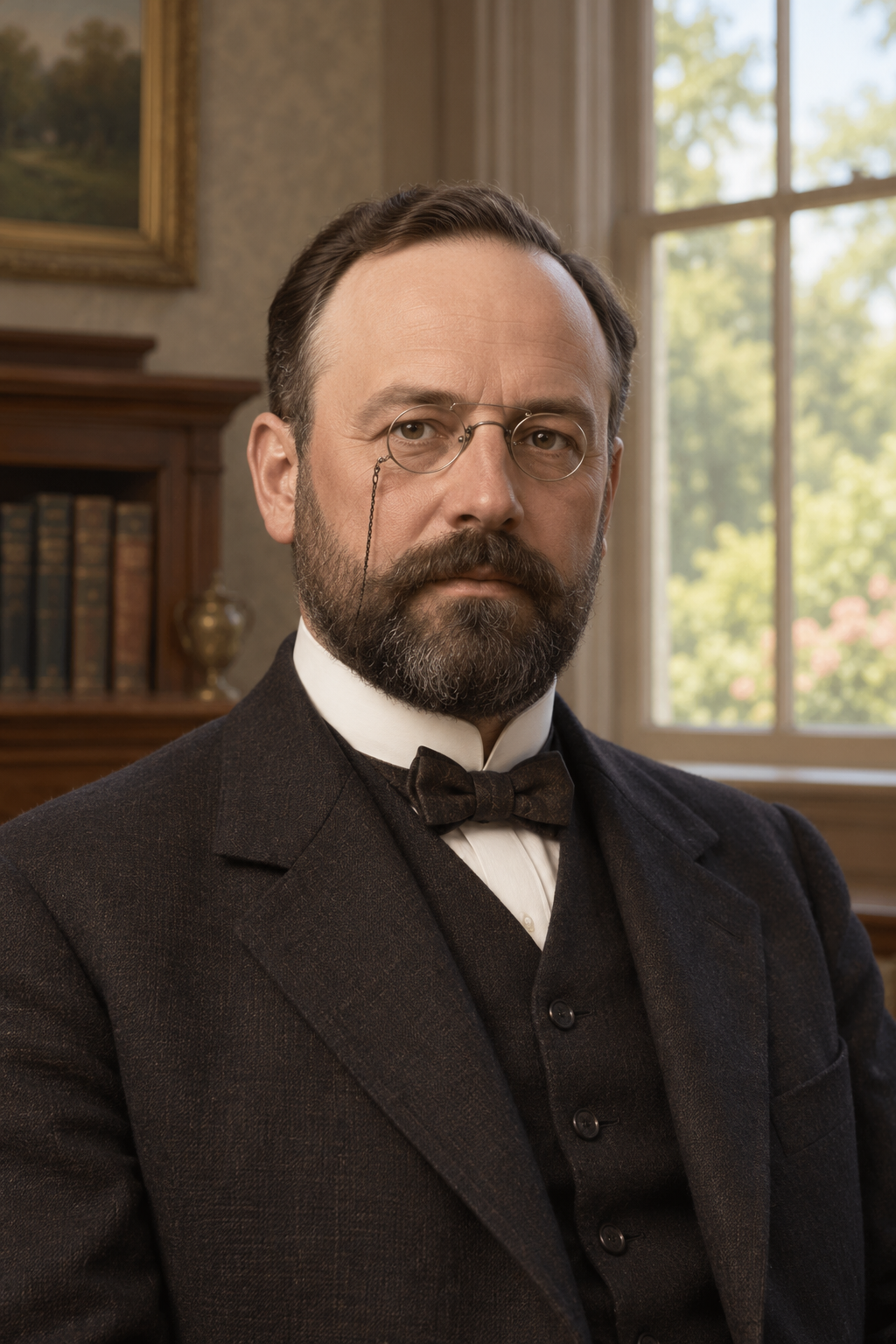
About Charles Frederick Menninger
Charles Frederick Menninger was born in Tell City, Indiana, on July 11, 1862. He was the youngest son in a family of eight children. His later career joined medical practice with an interest in the natural world.
His parents came from Germany. His father worked in the lumber trade and valued the education that his own early circumstances had limited. Charles grew up in a Lutheran household. After graduating from Central Indiana Normal School in 1882, he moved to Kansas to teach at Campbell College in Holton. He remained there for five years. Teaching preceded his medical career, rather than being an activity he took up only after establishing himself as a doctor.
In 1885 he married Flora Vesta Knisely, a teacher who had studied at Campbell College. They had three sons, Karl, Edwin and William. Flora later organized extensive Bible classes for women in Topeka. A contemporary account identifies both parents as members of the city’s First Presbyterian Church. Her teaching had its own place in the community; it should not be reduced to a background detail in the careers of her husband and sons. His community responsibilities also included service as a director of the Topeka City Library and as secretary of the state YMCA board. He had served as president of the Shawnee County Medical Society.
Charles studied at Hahnemann Medical College in Chicago and graduated in 1889. He began practicing in Topeka that year, with particular interests in internal medicine, diabetes and metabolic disorders. The state archives date his graduation from Kansas Medical College and appointment to its faculty to 1906. The state archives also record postgraduate study in Chicago, Michigan and New York. His work developed through continued study after his initial homeopathic training.
His early Topeka office was on Kansas Avenue. German immigrants were among the patients who sought him out. His sons accompanied him on house calls and waited with the horse while he attended patients. Family life included expectations of study and musical practice as well as exposure to medicine. Edwin later recalled the boys’ early-morning practice on their instruments. These recollections place the future clinic within an ordinary household whose children had duties of their own.
In a later recollection, Charles described the strain of being the only physician available to a family during a serious illness. He wanted colleagues with whom he could discuss difficult decisions. A visit to the Mayo Clinic in 1908 gave him a model of cooperative medical practice. He recalled spending additional days with William Mayo and the staff, then returning home with the idea of a clinic in which his sons would join him. This was his retrospective account of the project’s beginnings, preserved in the building’s National Register nomination. It explains the importance he attached to sharing responsibility rather than working alone.
Karl returned to Topeka in 1919 and opened a clinic with his father. Their professional interests differed: Charles concentrated on internal medicine, while Karl focused on psychiatry. The joint practice gradually moved toward psychiatric care. William later joined them. In 1925 the family opened a sanitarium in a farmhouse on the edge of town. The earlier clinic and the later hospital were stages in the development of the same enterprise, not interchangeable founding dates. A children’s program followed in 1926, when Southard School began in a house near the sanitarium.
The partners considered emotional and neurological symptoms alongside physical findings. The nomination describes examinations that included laboratory and X-ray work as well as psychological assessment. It records the purchase and remodeling of the farmhouse for a small psychiatric hospital, with local supporters helping the project through the sale of stock. Their cooperative ambition required both a way of working and a place where patients could receive care. The corporation bought the twenty-acre property in May 1925, with a recorded mortgage helping document the practical scale of this beginning.
The institution sought to involve patients’ families rather than separate treatment entirely from their wider lives. The local library’s history describes its emphasis on the individual person and the aim of returning patients to life in the community. These were the institution’s stated approaches, not proof that every patient recovered or that every historical treatment met present standards. The family’s work became associated with research and professional training as well as direct care.
Charles taught gardening, mineralogy and the study of shells as part of the institution’s adjunctive therapy program. His papers preserve both medical interests and these studies of nature. He remained active until his death on November 28, 1953.
In the 1940s the clinic, sanitarium and related school were brought within the nonprofit Menninger Foundation. After expansion and remodeling, the hospital was named the C.F. Menninger Memorial Hospital in 1954. His name thus remained attached to an institution whose work depended on many people and continued beyond his lifetime.
Wondering how to weigh the stories and sources? Learn how to read a saint biography.