Biography
Clare of Rimini
About Clare of Rimini
Clare of Rimini was a married laywoman and leader of an informal religious community in the politically divided Italian city of Rimini. Modern editors place her birth around 1260 and her death on February 10 in a year between 1324 and 1329. Those estimates differ sharply from the dates 1262–1346 and 1280–1326 repeated in older reference works and devotional accounts. Her surviving Life was probably composed while she was still alive or soon after her death, yet it remains hagiography rather than a neutral civic record. A careful biography can recover a plausible life only by separating the text's historical setting from its visions, moral judgments, and exemplary design.
The textual history explains both what can be known and why later biographies diverged. The Life survives in a single parchment manuscript copied during the second half of the fifteenth century for Clare's community in Rimini. The Rimini diocesan historical archive identifies that manuscript as the source used by Giuseppe Garampi for his study published in 1755. Garampi's work brought the medieval narrative into wider circulation while also beginning a more critical examination of Clare's status. The surviving copy is later than Clare, but the Life itself contains chronological signs that modern editors place in the 1320s. This unusually early vernacular witness is much stronger evidence than the embellished summaries that followed it, though it still requires source criticism.
The Life calls Clare the daughter of Chiarello of Piero of Zacheo and Gaudiana, members of an elite Rimini family. It says her mother died when Clare was seven and that Clare entered a first marriage while still young. After that husband's early death, factional conflict drove her family from Rimini and stripped it of property. The narrative later returns the family to the city, where Clare's father and one brother were executed during renewed political violence. Clare married a second time and was widowed again. Modern scholarship treats this outline as plausible within Rimini's political history, while recognizing that the hagiographer shaped it as the troubled beginning of a conversion story.
Older accounts frequently call Clare an Agolanti, a Franciscan tertiary, a Poor Clare, and eventually a convent superior. The critical edition does not accept those institutional labels. Its editors note that the Life never calls her a nun, tertiary, formally professed penitent, anchoress, or recluse. Her religious dress, celibacy after widowhood, and close relationships with Franciscans did not by themselves create membership in an approved order. The name Chiara Agolanti is therefore retained only as a later historical attribution, not as an established family name. Clare is best classified as a laywoman and widow who pursued an independent penitential vocation.
The Life presents Clare's change of direction through a vision in the Franciscan church at Rimini. It says the Virgin challenged her attachment to luxury and led her toward prayer and penance while her second husband was still alive. After his death, Clare adopted religious clothing and intensified fasting, vigils, and bodily discipline. The medieval text interprets these practices as repentance for the worldly life it condemns in its opening chapters. Some punishments described there are severe enough to trouble modern readers and should not be offered as instructions for devotion. The vision and the most dramatic ascetic episodes remain traditional claims attributed to the Life, not independently verified events.
Clare eventually lived in a simple cell among the ruins of Rimini's Roman walls, where her speech and way of life attracted visitors. Her independence also provoked opposition from churchmen who suspected unauthorized teaching and religious enthusiasm. A modern study of an illuminated manuscript confirms that Clare was close to the Franciscans but never joined their order. That study also cites a dated manuscript copied in 1322 whose marginal instruction refers to the church of Sister Clare in Rimini. The note gives firm evidence that a church associated with Clare existed during her lifetime. It does not turn her dwelling into a canonically enclosed convent or make her a Poor Clare.
Women gathered around Clare, and the Life portrays her as the demanding spiritual center of their shared life. The group prayed, practiced silence and penance, and relied on alms and provisions that Clare sought in the city. She also assisted other religious women, including Poor Clares displaced by conflict, without becoming one of them. Her community experienced tensions as well as loyalty, including resistance to the discipline she tried to establish. These details reveal practical leadership rather than the formal office of abbess assigned to her in later biographies. Her charity appears most concretely in the work of securing food, clothing, shelter, and support for women whose religious lives were economically precarious.
Clare's vocation was not confined to a cell. The critical study follows her movements to Urbino, Assisi, and Venice and describes her speaking publicly as a teacher and preacher. The Life also associates her with Cardinal Napoleone Orsini, who passed through northern Italy during the first decade of the fourteenth century. According to that account, his support helped regularize prayer in Clare's community without placing it under a monastic rule. Her mobility and public speech challenged common limits on women's authority and exposed her to denunciation. The historical routes and meetings are probable reconstructions from the Life; no precise travel line should be drawn on a map without separate itinerary evidence.
The final scenes of the Life place Clare in declining health during the episcopate of Girolamo Fisici, bishop of Rimini from 1323 to 1328. Its internal chronology indicates that she lived at least into 1324 but not far beyond the bishop's visit to her bedside. Modern editors therefore place her death on February 10 sometime from 1324 through 1329 rather than in 1346. The current Roman Martyrology commemorates Blessed Clare on February 10 and identifies her as a widow who gathered companions and served in humility. The Diocese of Rimini currently lists her on February 9 while repeating an older 1280–1326 chronology and religious classification. Sources also variously date papal confirmation of her cult to 1782, 1784, or 1785, so no exact beatification date is retained here.
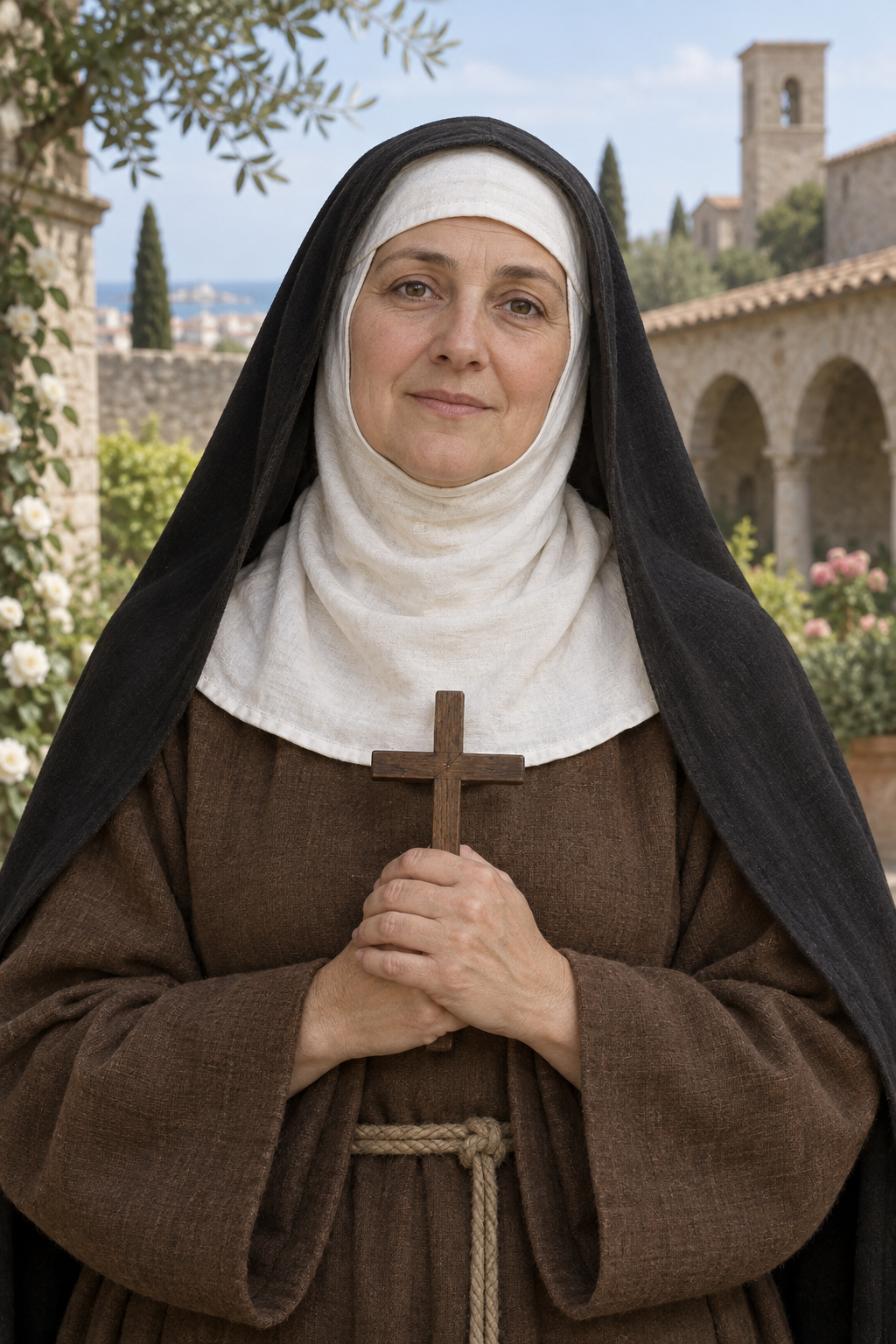
The catalog portrait and badge are modern AI-generated devotional images, not historical likenesses. They show the same middle-aged woman in a black veil and mantle, a white wimple, and a brown belted habit, holding a wooden cross before a cloister. That conventual presentation resembles the later tradition that made Clare a nun, even though modern scholarship rejects formal membership in an order. The images can remain as devotional illustrations only if their captions prevent costume from being mistaken for evidence. Clare remains significant because her near-contemporary Life preserves the contested religious agency of a medieval widow who joined prayer, public speech, practical care, and communal leadership. Historical care does not diminish that legacy; it lets her unusual lay vocation emerge from beneath later institutional labels.
Wondering how to weigh the stories and sources? Learn how to read a saint biography.
Prayers for Clare of Rimini
Prayer with Clare of Rimini: perseverance excerpt
Padre di misericordia e di carità, tu che ci hai dato di bene incominciare, donaci di crescere nel bene e di perseverarvi fino alla fine.