Biography
Conchita Barrecheguren
About Conchita Barrecheguren
María de la Concepción Barrecheguren García, known throughout her life as Conchita, was born in Granada, Spain, on November 27, 1905. Her parents were Francisco Barrecheguren Montagut and Concepción García Calvo. She was baptized at the Sagrario parish of Granada Cathedral on December 8 and received the fuller baptismal name María de la Concepción del Perpetuo Socorro. The Archdiocese of Granada's account places her within an attentive Catholic household. Her father managed the family's textile business; her mother cared for their home. Conchita was their only child, and the family's ordinary routines became the principal setting of her brief life.
Fragile health affected Conchita from early childhood and prevented regular attendance at school. Her father therefore directed much of her education at home, including her religious preparation. This arrangement limited some opportunities but did not make her passive. Archdiocesan accounts describe interests in reading, music, drawing, and domestic activity, alongside preparation for First Communion and confirmation. Responsible narration does not treat illness itself as virtue. The relevant actions are how Conchita and her family adapted: they provided sustained learning, maintained relationships, and built a daily pattern in which intellectual, practical, and spiritual formation could continue despite physical limits.
As an adolescent, Conchita developed a disciplined life of prayer. She and her father were seen making regular visits to churches in Granada, including Eucharistic adoration and devotion at the Basilica of Our Lady of Sorrows. She read spiritual works and kept a diary in which she examined her motives, failures, hopes, and choices. These writings are valuable evidence for her own voice, although quotations still depend on later editions and citations supplied by the cause. They show a young woman trying to make deliberate decisions rather than a figure whose interior life can be reconstructed from illness alone.
Conchita considered entering the Carmelite religious life. Her health prevented that intention from becoming profession, and she remained a laywoman living with her family. The distinction matters: admiration for religious life did not make her a nun, and her beatified vocation is presented by the Archdiocese of Granada as holiness within ordinary lay circumstances. Redemptorist spirituality also shaped her prayer, and her family's relationship with the Redemptorist community later became part of the preservation of her memory. She sought ways to offer hospitality, attention, and encouragement from within the life actually available to her.
A journey to Lisieux in October 1926 gave Conchita an opportunity to visit places associated with Thérèse of the Child Jesus, whose writings had influenced her. After returning, hoarseness signaled the tuberculosis that would soon dominate her final months. Doctors advised moving her to the family's Carmen near the Alhambra, where cleaner air was hoped to help. The historical record supports the journey, diagnosis, relocation, and rapid decline. Later church accounts interpret her response through trust and union with the suffering Christ. Those theological judgments belong to her received witness; they should never imply that treatment, fear, pain, or dependence were spiritually unimportant.
During her final illness, Conchita continued writing and receiving family members and visitors as strength allowed. The archbishop's pastoral letter quotes her *Via Crucis*: “Here I am, Lord, drawn by your love and sufferings.” The words are brief enough to preserve her voice without reproducing the work. Other diary passages show self-questioning rather than effortless serenity. This complexity is important. Church testimony remembers courage and confidence, while her own writing records the work of discernment. Her example is not that a sick person should conceal distress; it is that she continued relating to God and others honestly while her choices and mobility narrowed.
Conchita died in Granada on May 13, 1927. She was twenty-one years old, although some church news reports round her age to twenty-two because she was in her twenty-second year. Her father Francisco was widowed in 1937, later entered the Redemptorists, and became a priest; his own cause of canonization is distinct from hers. In 2007 Conchita's remains were transferred beside his to the Shrine of Our Lady of Perpetual Help in Granada. These later developments help explain the close association between the family, the shrine, and the Redemptorist community without making Francisco a co-subject of Conchita's biography.
The Roman Catholic cause examining Conchita's life eventually recognized her heroic virtues, and Pope Francis authorized that decree in May 2020. A separate process considered the reported healing of a sixteen-month-old child in 2014 after prayer for Conchita's intercession. The Holy See accepted that healing as the miracle required for beatification. This packet describes the ecclesial finding accurately but does not offer an independent medical conclusion. On May 6, 2023, Cardinal Marcello Semeraro presided as papal representative at Conchita's beatification in Granada Cathedral, attended by clergy, relatives, and pilgrims.
The day after the beatification, Pope Francis recalled Conchita's grave illness and the spiritual strength with which church testimony says she bore it. Her feast is observed on May 13 in the Roman Catholic context represented by the Granada sources. She is properly classified as a layperson and confessor, not as a Carmelite, religious sister, or canonized saint. Her actions support virtues of prayerfulness, honesty, and courage: she maintained a reflective diary, discerned a vocation she could not physically enter, and continued offering attention to others during tuberculosis. No prayer is stored because no exact traditional text with verified reusable provenance was established.
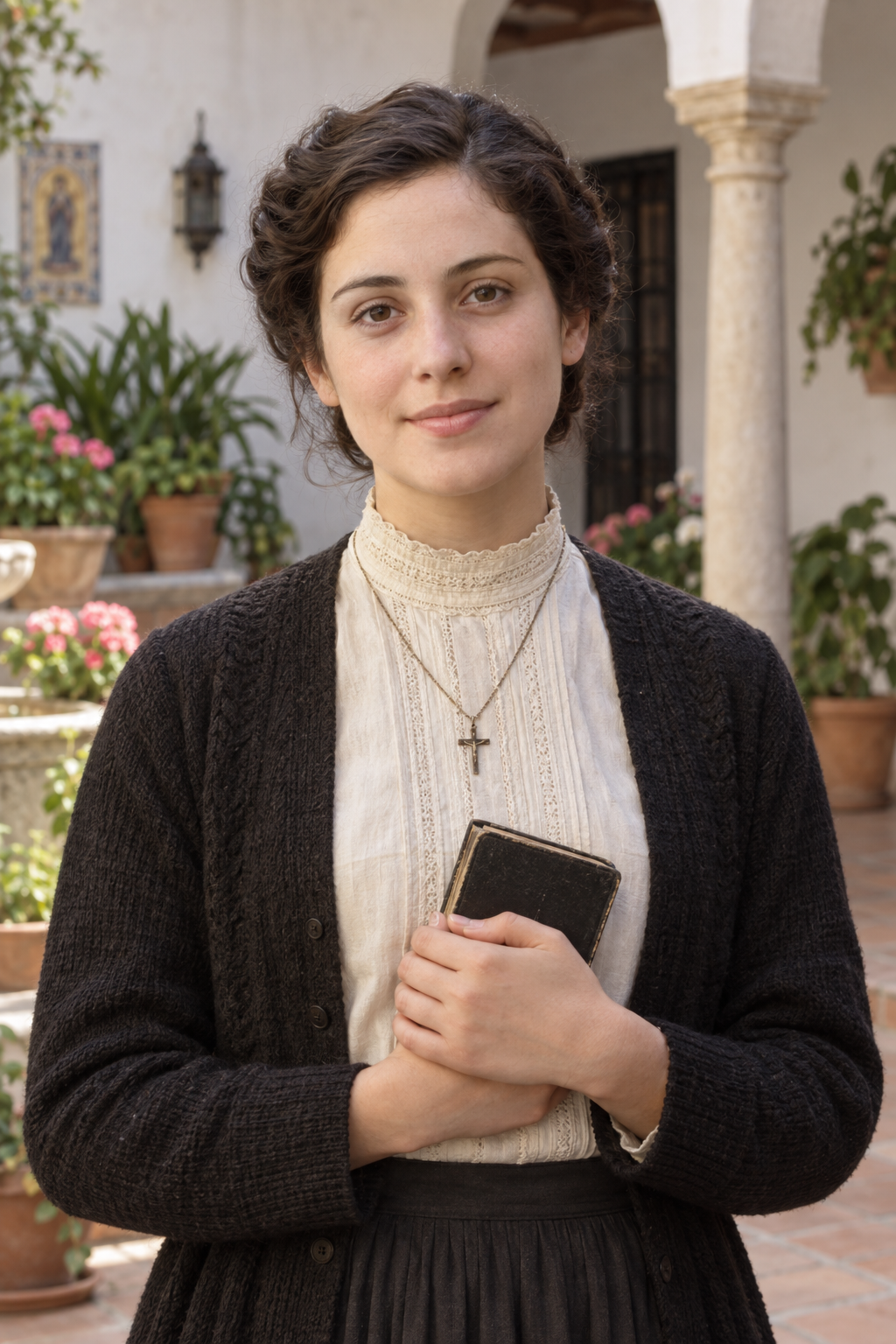
Conchita's evidence base is unusually personal because her diary, meditations, and *Via Crucis* preserve traces of a young adult's own reflection. Yet most readily accessible facts arrive through the archdiocese and cause, so this is an ecclesially documented life rather than a comprehensive critical biography. The profile avoids making suffering beautiful for its own sake. It also avoids describing home education, dependence, or an unrealized vocation as failures. Conchita's witness rests in the practical fidelity of examining her choices, receiving care, remaining connected to family and community, and directing limited energy toward prayer and encouragement. The accompanying artwork is AI-generated devotional imagery, not a historical likeness.
Wondering how to weigh the stories and sources? Learn how to read a saint biography.