Biography
Cyril of Thessalonica
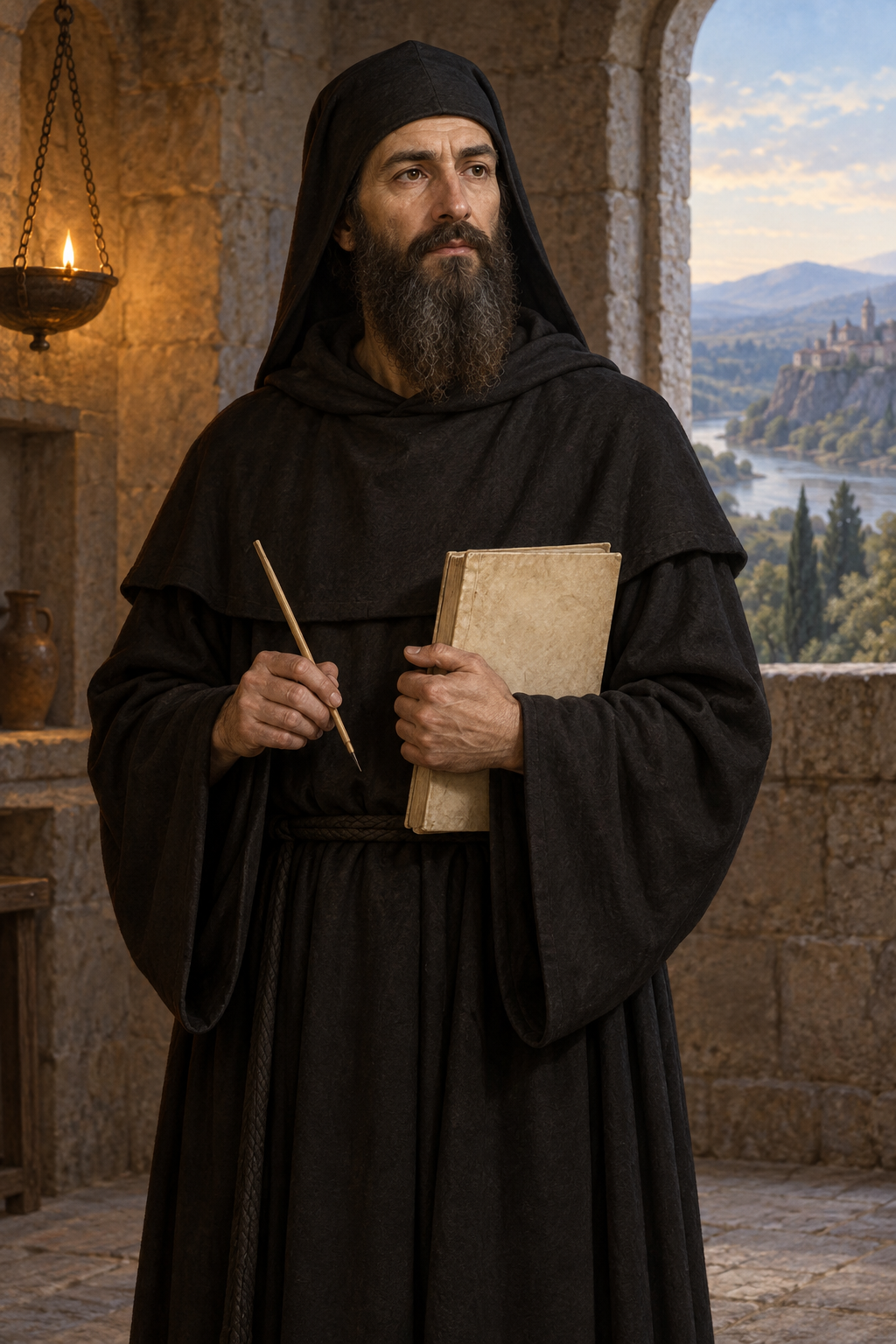
About Cyril of Thessalonica
Cyril, the younger brother of Methodius, is remembered as one of the great missionaries and teachers associated with the Christianization of Slavic peoples. Benedict XVI described the two brothers as natives of Thessalonica, a city whose setting exposed them to Greek and Slavic worlds. This background helps explain the later character of their work: they did not simply carry a message across a border; they sought ways for people to hear and pray in language that could become their own.
The brothers undertook a mission to the Khazars before their mission to Moravia. The exact sequence and many details of their travels belong to a complicated historical record, so this dossier does not fill those journeys with anecdote. What Benedict’s audience clearly supports is the broader missionary purpose and the pivotal Moravian work, where the problem of language in preaching and worship became especially urgent.
Cyril and Methodius are associated with the use of Slavonic in liturgy and with the preparation of tools for communicating Christian doctrine. That association should be described carefully. A source may establish their missionary work and its linguistic dimension without proving every later attribution of a particular alphabet, translation, or text to Cyril alone. The central historical and spiritual point remains strong: they argued, in practice and before Church authorities, that the Gospel could be spoken and prayed in the tongue of those receiving it.
Their work also required dialogue with Rome. John Paul II’s encyclical *Slavorum Apostoli* treats the brothers as servants of unity who worked in the tensions between different Christian cultures and ecclesial jurisdictions. It cautions against reducing their mission to a modern political story. Cyril and Methodius belonged to the undivided Church of their age and became figures through whom East and West can remember both common faith and the difficulty of sustaining communion.
Cyril died in Rome on 14 February 869. Benedict XVI distinguishes this from Methodius’s continuing mission; the latter should not be credited to Cyril after his death. Keeping the brothers’ cooperation visible while retaining that distinction is a matter of historical honesty. Cyril’s individual legacy lies in his learning, missionary service, and the linguistic and pastoral vision he shared with his brother.
In 1980, John Paul II named Cyril and Methodius co-patrons of Europe, alongside Benedict. That recognition reads their legacy as more than a regional story. It honors a model of evangelization attentive to language, culture, and ecclesial unity. It does not erase the differences and disputes of history; it asks Christians to receive the brothers’ witness as an invitation to communicate the faith with respect and to seek reconciliation across inherited divisions.
Language was not a secondary question for Cyril’s mission. When worship and teaching use words people can understand, the faith can be received as something addressed to real communities rather than as a possession of a foreign elite. The sources associate Cyril and Methodius with this conviction, while historical care requires leaving open the precise development and authorship of later Slavonic texts. That boundary is not evasive; it is what allows their linguistic legacy to be honored without attribution beyond the evidence.
Their relationship with Rome also matters for the way their work is remembered. The brothers did not imagine local expression as separation from the Church’s communion. Their mission involved bringing pastoral needs into dialogue with authorities whose approval mattered. John Paul II reads that tension as a resource for Christian unity, especially where inherited divisions tempt people to treat cultural difference as a reason for estrangement.
Cyril’s death in Rome gives the final part of his life a particular symbolic force, but the source should not be made to bear more than it says. It establishes a date and place, and it distinguishes Methodius’s subsequent ministry. It does not authorize romantic scenes of farewell or a complete chronology of the final journey. The durable evidence is enough: Cyril’s service ended in communion with the Church whose recognition had been important to the mission.
The title co-patron of Europe belongs to later ecclesial reception. It does not turn Cyril into a modern political figure or a spokesman for any one contemporary nation. Rather, it identifies a witness whose life is received as linking cultures, languages, and Christian traditions. The title asks Europe to remember that its spiritual history has been shaped by encounter and translation as well as by conflict.
For a careful modern account, Cyril is neither an isolated inventor nor merely Methodius’s companion. He was a missionary, scholar, and monk who shared a pastoral vision with his brother, died before Methodius’s later work, and remains a central figure in the Church’s memory of Slavic Christian culture. Keeping those distinctions visible makes the shared legacy stronger, not weaker.
Wondering how to weigh the stories and sources? Learn how to read a saint biography.