Biography
Deborah
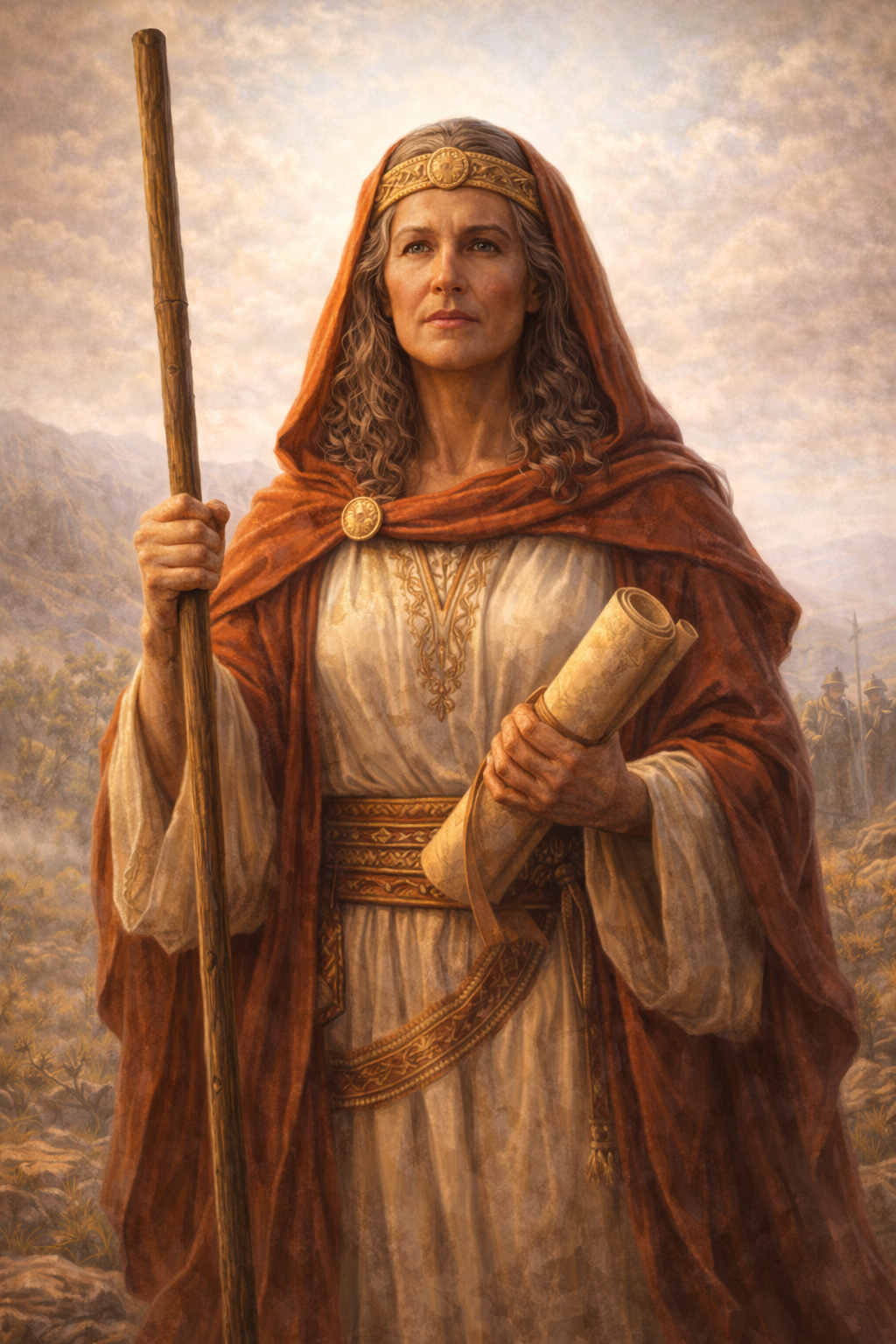
About Deborah
Deborah appears in Judges 4–5, within a book about Israel’s life between conquest traditions and monarchy. The USCCB introduction explains that Judges combines stories derived from older written or oral traditions with a later Deuteronomistic framework. That literary history matters: no contemporary inscription establishes Deborah’s dates, and the narrative’s periods cannot responsibly be converted into birth and death years. This account therefore presents her story as traditional sacred narrative while treating scholarly observations about the book as documented claims about the text.
Judges 4 introduces Deborah as a prophet, the wife of Lappidoth, and a judge. Israelites come to her for judgment while she sits beneath a palm between Ramah and Bethel in the hill country of Ephraim. The Hebrew term translated judge can describe leadership more broadly than a modern courtroom office, yet this passage explicitly depicts people bringing matters to her. Nothing in the chapter supplies her ancestry, age, children, or a chronology for her life. The narrative places a woman’s recognized prophetic and public authority at the center of Israel’s response to crisis.
The crisis is narrated as twenty years of harsh oppression under Jabin, a Canaanite king associated with Hazor, and Sisera, commander of an army with nine hundred iron chariots. Deborah summons Barak son of Abinoam from Kedesh in Naphtali. She conveys a command to gather fighters from Naphtali and Zebulun at Mount Tabor and says Sisera will be drawn toward the Wadi Kishon. These numbers, speeches, and durations belong to the biblical account rather than an independently verified military archive, so they should not be used to plot a precise campaign date or route.
Barak answers that he will go only if Deborah accompanies him. She agrees without hesitation but says the expedition’s glory will go to a woman. The exchange has often been reduced either to condemnation of Barak or to a simple slogan about Deborah. The text itself is more concrete: Barak requests her presence, Deborah travels with him to Kedesh, and both participate in mobilizing resistance. Her leadership is expressed through presence as well as speech. The prediction ultimately points beyond Deborah to Jael, whose role overturns the expectations of armed commanders.
When Sisera moves his chariots and forces toward the Kishon, Deborah tells Barak to rise and declares that the Lord has gone before him. Barak descends Mount Tabor with his fighters. Judges says Sisera’s force is thrown into panic and defeated, while Sisera abandons his chariot and flees on foot. The chapter describes total battlefield slaughter. A truthful retelling must not turn that violence into picturesque adventure or infer that every narrated act supplies a moral rule. Deborah’s decisive encouragement can be recognized without celebrating killing as such.
Sisera seeks shelter in the tent of Jael, wife of Heber the Kenite, because relations between Heber’s household and Jabin are peaceful. Jael welcomes him, gives him milk, covers him, and kills him with a tent peg while he sleeps. She then shows the body to Barak. Judges presents this brutal act as the fulfillment of Deborah’s prediction that the honor would pass to a woman. The scene also uses hospitality and domestic tools as instruments of deception and death. Its gender reversal and deliverance theme must be preserved alongside its disturbing violation and violence.
Judges 5 gives a poetic account in the voices of Deborah and Barak. It summons rulers to listen, praises willing leaders and volunteers, recalls roads abandoned under danger, and says village life ceased until Deborah arose as a mother in Israel. The song is not a neutral battle transcript. It is liturgical and political poetry that interprets deliverance through God’s action, remembers tribal participation unevenly, and rebukes communities that did not join. Scholars often value its archaic features, but the poem itself does not provide a secure modern calendar date for Deborah.
The song depicts stars fighting from heaven and the Kishon sweeping the enemy away. It blesses Jael, recounts Sisera’s death in compressed poetic images, and ends by imagining Sisera’s mother waiting at a window while her attendants explain the delay as division of plunder, including captive women described as spoil. This ending is deliberately severe. It gives voice to triumph over an oppressor, yet it also exposes a world in which women could be treated as war booty. Deborah’s song should not be sanitized, nor should its enemies’ dehumanization be imitated devotionally.
The prose account concludes that Jabin’s power is broken and the land has rest; the song closes with a prayer that God’s friends rise like the sun. Neither chapter narrates Deborah’s later years or death. Claims that she lived forty additional years, died at a particular age, or was buried at a known site go beyond these sources. Likewise, no jurisdictionally sourced Christian feast or traditional collect was found for this packet. Leaving those fields empty is more accurate than filling them from unsourced devotional repetition.
Deborah’s enduring witness lies in specific actions rather than generic perfection. She received people seeking judgment, summoned Barak, accompanied a dangerous undertaking, announced the moment to act, and joined in communal remembrance afterward. Her authority did not erase collaboration: Barak led fighters, volunteers answered, and Jael became the unexpected agent of Sisera’s death. Judges also makes clear that deliverance occurs within morally difficult warfare. Deborah can encourage attentive judgment, courage, and cooperation while readers remain honest about historical uncertainty, poetic rhetoric, and the human cost carried in the story.
Wondering how to weigh the stories and sources? Learn how to read a saint biography.