Biography
Denis
About Denis
Denis is remembered as an early bishop of the Christian community among the Parisii and as a martyr. That compact statement is more secure than most familiar details about him. Gregory of Tours, writing in the sixth century, knew a tradition that Denis was one of seven missionary bishops sent into Gaul and that he died by the sword for Christ. The surviving evidence does not disclose Denis’s childhood, family, education, age, or exact dates. Modern readers should therefore meet him first as a third-century figure preserved through later testimony, not as the fully documented subject of a contemporary biography.
The dating itself requires care. Gregory’s framework places the mission during the reign of Decius, in the middle of the third century. A later passion and older scholarship sometimes place the death around 275, while medieval accounts pushed Denis back into apostolic times. These claims cannot all describe one chronology. The catalog clears the former birth and death entries because both used January 1 placeholders and implied precision no source supplies. A mid- or later-third-century martyrdom remains probable, but October 9 is a feast observance rather than evidence for the calendar day on which he died.
Later tradition describes Denis arriving near Paris with Rusticus, a priest, and Eleutherius, a deacon. The first passion that narrates their work dates only from the late sixth or early seventh century and is interwoven with legend. It says Denis established worship on an island in the Seine and preached until opposition drew the attention of a governor named Fescenninus Sisinnius. The current Roman Martyrology uses cautious language: Denis is said to have been sent by a Roman pontiff, to have become the first bishop of Paris, and to have been martyred near the city with his companions. Those are received ecclesiastical memories, not a surviving mission log or trial record.
The martyrdom narratives become increasingly elaborate. The early summary in Gregory says only that Denis suffered various punishments and ended his life by the sword. Later accounts add scourging, imprisonment, the rack, wild beasts, fire, and beheading. Responsible retelling does not arrange those torments as entertainment or claim each one as verified. It records the durable tradition that coercion and execution followed Christian ministry, while identifying the catalog of tortures as hagiographic development. Rusticus and Eleutherius are honored beside Denis, but their precise roles and the circumstances of all three deaths remain traditional.
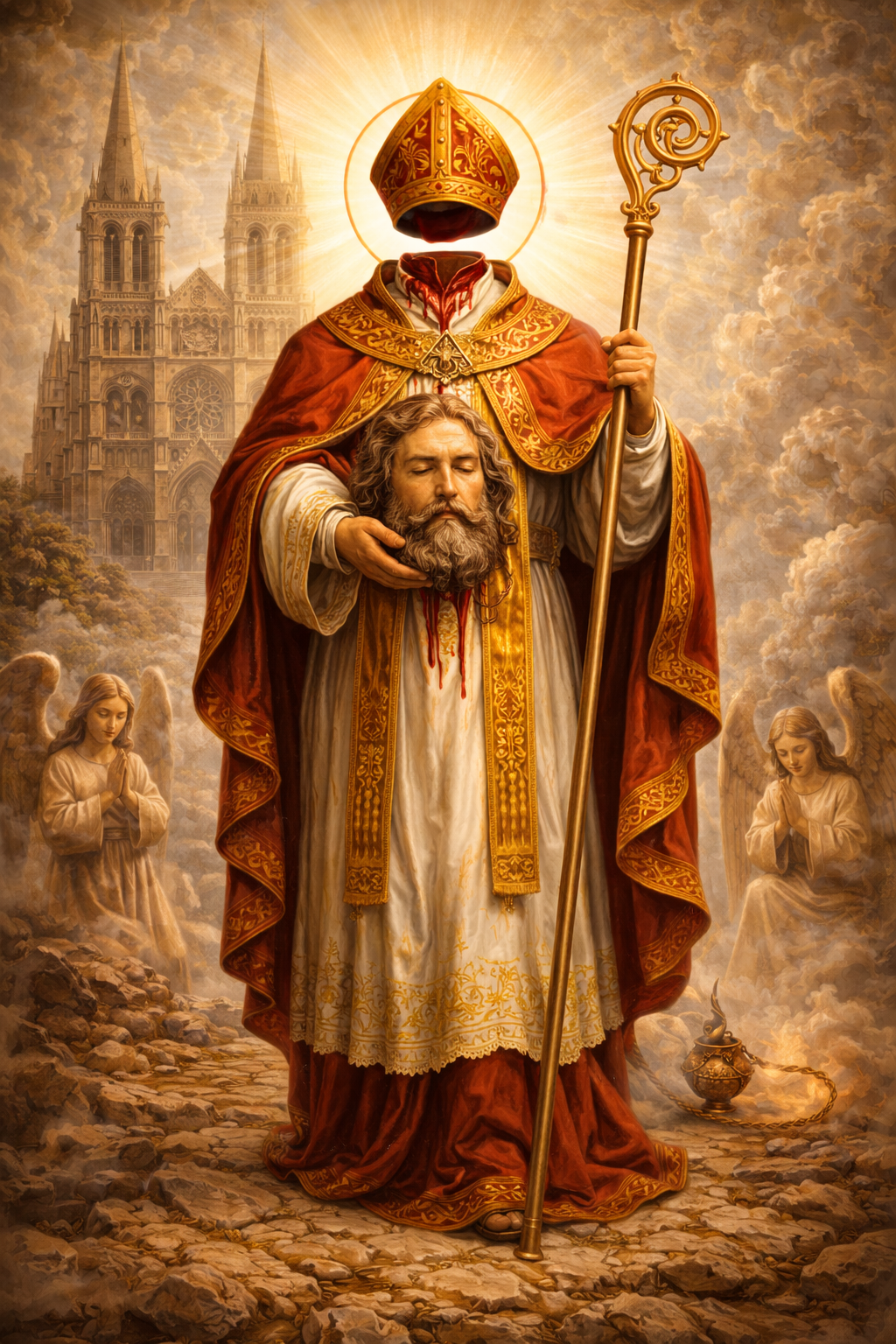
The best-known image is later still. Legend says that after decapitation Denis rose, took his head in his hands, and carried it while traveling from the place of execution to burial. This makes him a cephalophore, or head-carrying saint, in medieval art. The French Ministry of Culture presents the story as legend and links its landscape to Montmartre and Catulliacus, the future Saint-Denis. Neither the miracle nor a several-mile route can be mapped as history. The packet therefore records Paris only at settlement level and the burial cult at Saint-Denis, without coordinates, a drawn path, or an asserted execution site.
A burial shrine became the material center of Denis’s remembrance. The sources associate his tomb with Catulliacus and report that a basilica stood there by late antiquity; archaeological interpretation places an early church around the fifth century. Under later Frankish rulers, the church and its monastery acquired extraordinary prestige. Royal patronage made Saint-Denis closely connected with French monarchy and national memory. These developments are documented history of reception, not additional evidence for Denis’s own actions. They explain why a locally remembered bishop became one of the most recognizable saints of medieval France.
That prestige also encouraged a major identity conflation. Medieval authors identified the Parisian martyr with Dionysius the Areopagite, the Athenian who appears in Acts, and with the unknown late-antique theologian now called Pseudo-Dionysius. Hilduin, abbot of Saint-Denis, gave the combined story lasting authority in an Areopagitica written in 836. Historical scholarship rejects the identification: the three belong to different settings and bodies of evidence. Denis of Paris did not therefore study under Paul, write the Dionysian theological corpus, or carry apostolic-era learning from Athens to Gaul. Keeping the identities separate prevents borrowed achievements from replacing his own sparse record.
The Roman Church continues to commemorate Denis with Rusticus and Eleutherius on October 9. That calendar entry documents living reception while carefully introducing parts of the story with language equivalent to “it is told.” The distinction matters. A feast can preserve communal memory even when modern historical method cannot recover every episode. Likewise, titles such as first bishop of Paris and martyr express the received identity around which the cult formed. They should carry probable or traditional confidence where they reach beyond the later calendar’s existence itself.
Denis remains significant at the meeting point of fragile biography and powerful memory. The historically defensible outline is modest: an early Parisian Christian leader was remembered as a bishop who died violently for his faith. Communities then honored him with companions, a shrine, art, legends, and institutions that shaped France for centuries. His witness can be described through steadfast ministry under danger without celebrating torture or presenting miracle stories as reportage. Historical restraint also restores the distinct voices of the Areopagite and Pseudo-Dionysius. A fitting response to Denis is to practice integrity when a cherished story needs careful correction, while preserving what the evidence genuinely allows a community to honor.
Wondering how to weigh the stories and sources? Learn how to read a saint biography.