Biography
Dietrich Bonhoeffer
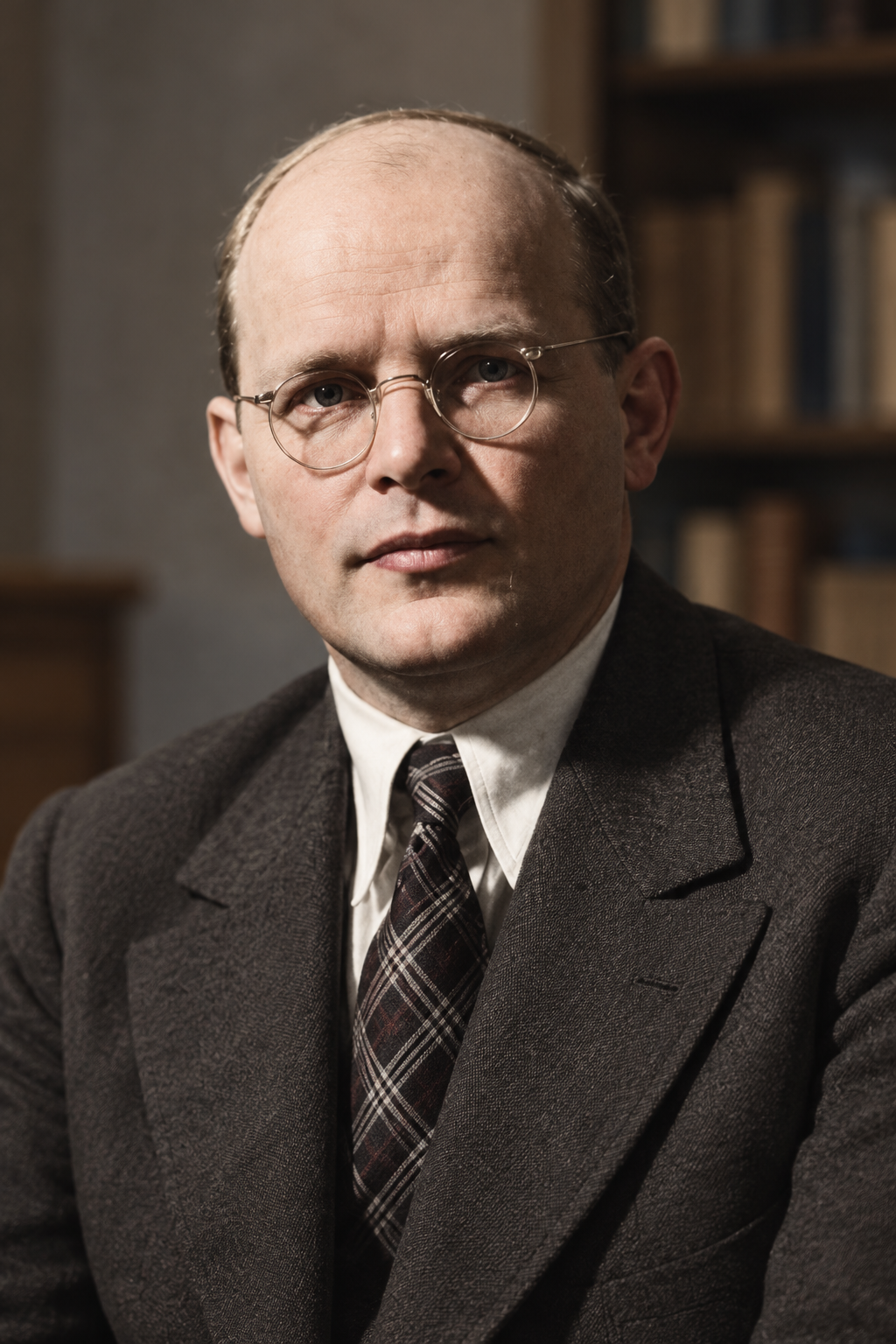
About Dietrich Bonhoeffer
Dietrich Bonhoeffer was a German Lutheran pastor whose encounters with American church life helped reshape his understanding of Christian responsibility. Born in Breslau, he pursued theological studies and became a scholar as well as a minister. His early academic work concerned the church as a community, rather than simply a collection of individual believers. After serving a German congregation in Barcelona, he traveled to New York in 1930 to study at Union Theological Seminary. He questioned the academic rigor of the courses, but their engagement with social questions opened a different kind of education.
At Union he formed friendships across national and racial boundaries. The French student Jean Lasserre challenged him to take the peace teaching of the Sermon on the Mount seriously. Albert Franklin Fisher, a Black fellow student, introduced him to Abyssinian Baptist Church in Harlem. Bonhoeffer taught Sunday school, visited congregants, and listened to spirituals. He also read African American writers. Historian Lori Brandt Hale describes these relationships as central to his growing awareness of racial injustice and to his movement away from nationalism. His American experience involved learning from people whose lives exposed the limits of his earlier assumptions.
The congregation’s own history places his Sunday school work within a wider ministry in Harlem. Abyssinian was led by Adam Clayton Powell Sr.; his son directed kitchen and relief work during the Depression. Bonhoeffer entered a church already combining worship with practical service. Its history records his participation without making him the center of that community’s work.
He also belonged to International House while studying in New York. Its archives describe his involvement in a women’s Bible study and weekly church school, his reading, and his travels in the American South. These activities extended his education beyond the classroom. The institution preserves an application from his residence there, a tangible record of this period abroad.
Back in Germany, Bonhoeffer taught and worked with young people. Bonhoeffer opposed excluding Christians of Jewish ancestry from ministry. His essay The Church and the Jewish Question argued that churches must assist victims beyond their own membership and might need to resist state injustice. Yet the United States Holocaust Memorial Museum notes that the same essay retained traditional anti-Jewish theology, including the expectation of Jewish conversion. His opposition to Nazi persecution did not mean that he had escaped every inherited prejudice.
His work with young people included a confirmation group in a poor Berlin neighborhood. He arranged weekend visits to his family’s holiday house, bringing pastoral responsibility into activities outside formal teaching.
While living in London he served two German-speaking congregations and developed a friendship with George Bell, the bishop of Chichester. Bell became an important British supporter. Bonhoeffer sought allies beyond Germany while the struggle over his own church continued. His interest in other Christian communities also extended to Roman Catholicism, which had impressed him during an earlier visit to Rome.
After ministering to German-speaking congregations in London, he returned to lead a Confessing Church seminary. At Finkenwalde, theological study shared the day with prayer, worship, meals, and service to others. Geffrey Kelly’s introduction to Life Together explains that Bonhoeffer wanted this common life to prepare ministers for work among people, with fewer clerical privileges and greater availability. The Gestapo closed the seminary in September 1937. He continued supporting dispersed students through visits and letters, then recorded the experiment in Life Together, published in 1939.
In that book, Bonhoeffer treated Christian community as a gift received through Christ. He warned against constantly measuring its spiritual success. A community that seemed unremarkable to its members might still matter to God. His account placed gratitude ahead of the attempt to manufacture an ideal fellowship. These were theological convictions about ordinary shared life, not claims that his own community had been free of difficulty.
In 1939 he returned to New York as war approached. Friends had helped arrange the visit partly because military service threatened him. After only a short stay, he chose to return to Germany.
Through his brother-in-law Hans von Dohnanyi, Bonhoeffer entered resistance circles within military intelligence. He used foreign contacts to communicate resistance plans and became involved peripherally in an effort to help Jews escape. Arrested in April 1943, he was already imprisoned when the July 1944 attempt on Hitler’s life failed. Later discoveries exposed his wider connections. He was hanged at Flossenbürg on April 9, 1945.
His prison correspondence preserves ongoing theological work alongside separation from family and friends. Letters could be censored, while other writings left prison secretly. These materials later appeared in Letters and Papers from Prison.
Westminster Abbey honored him among its twentieth-century martyrs in 1998.
The Church of England commemorates this Lutheran pastor on April 9.
His writing on community continues to connect prayer with listening, practical help, and care for those most easily overlooked.
Wondering how to weigh the stories and sources? Learn how to read a saint biography.