Biography
Dominic Savio
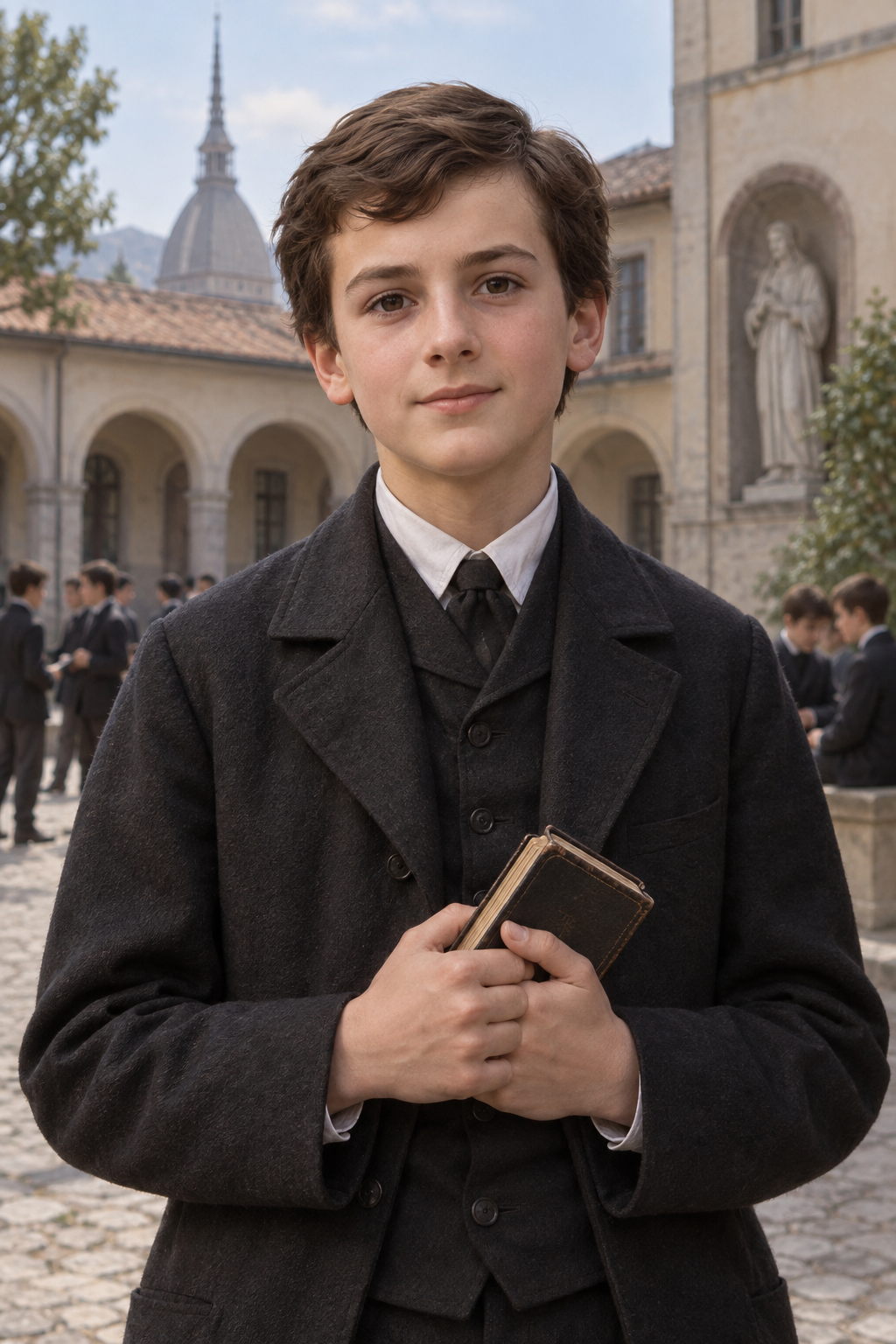
About Dominic Savio
Dominic Savio grew up in a family whose search for work took them between villages near Turin. His father, Carlo, was a blacksmith, and his mother, Brigida, worked as a seamstress. Born in 1842 at San Giovanni, a hamlet of Riva near Chieri, Dominic moved with his parents to Morialdo the following year. There they lived in a few rooms of a cottage while Carlo tried to improve the family's circumstances. Dominic began primary lessons with the local chaplain, Giovanni Battista Zucca, who later supplied John Bosco with an account of his pupil.
He received his first Communion at seven, earlier than was usual in his community, and did well at lessons. His parents arranged further schooling because his weak health made manual work unsuitable. After completing the elementary classes available nearby, he attended the municipal school at Castelnuovo, walking there and back. When the family returned to Mondonio, his teacher Giuseppe Cugliero recommended him to John Bosco. Dominic met Bosco in October 1854 and entered the Oratory at Valdocco later that month. The institution offered poor boys either preparation for a trade or further academic study that might lead to priesthood. Dominic followed the academic route, attending Latin lessons with Giuseppe Bonzanino in central Turin, alongside pupils from more prosperous families.
Bosco's early biography describes a turning point after Dominic heard a sermon about becoming holy. Instead of treating this as a distant possibility for adults, he asked how he could begin. Bosco warned him against anxiety and insisted that he keep up his studies, prayers and games with the other boys. He also redirected Dominic's wish for severe penances, which were unsuitable for his age and health. In this account, Dominic put his religious enthusiasm into helping other children learn their catechism. When home with his family, he taught his younger brothers reading and writing as well as prayers. His ambition to become a priest and teach children in Mondonio remained a hope, not a vocation he lived long enough to fulfill.
Dominic's concern for companions also took an organized form in the Company of the Immaculate Conception. Historian Francesco Motto places the group within the Oratory's wider network of youth associations. The older Company of Saint Aloysius already existed there, so Dominic's initiative developed within an established practice of association. It joined Marian devotion to practical attention to pupils who were struggling. Members befriended boys who were homesick, ill, difficult to manage or unable to speak Italian, helping them settle into school life. An individual member took responsibility for accompanying a particular boy rather than leaving every difficulty to the adults. Motto explains that these associations made pupils active partners in education, while still working under adult supervision. Some members of Dominic's company, including Michael Rua and John Cagliero, later became early Salesians. The group therefore belonged both to the everyday care of schoolboys and to the beginnings of a larger educational community.
Poor health repeatedly interrupted Dominic's progress. John Dickson's Salesian account describes headaches and coughing that led Bosco to consult a doctor and send him home for holidays in 1855. When the Oratory began an internal secondary course in 1855–56, Dominic studied with the young cleric John Baptist Francesia. Lessons inside the house spared him the journey across Turin to an outside school. Rest did not produce a lasting recovery. He went home again in the summer of 1856 on medical advice, returned to his studies and continued to struggle with illness. At the beginning of March 1857, Bosco sent him back to his family in Mondonio, hoping that care at home would help. Dominic's desire to remain at school could not overcome his physical weakness.
Accounts of his final illness mention treatment by bloodletting, but later writers have disagreed about the diagnosis. Arthur Lenti's examination of the evidence does not provide grounds for treating tuberculosis or pleurisy as certain. His study also cautions that Bosco shaped the biography as an educational example, drawing on recollections as well as personal knowledge.
Dominic died at Mondonio on 9 March 1857, shortly before his fifteenth birthday. Pope Pius XII canonized him in 1954. The pope's address emphasized the influence that a schoolboy could exercise among his companions, especially through friendship, religious practice and steady encouragement. This recognition honored a lay adolescent whose brief life had unfolded within a family and a school, rather than in an ordained ministry.
Fifty years after the canonization, Salesian leader Pascual Chávez addressed the movement's young people about Dominic and Laura Vicuña. His 2004 message connected their memory with friendship, study, service and the development of young people's own gifts. It encouraged participation in groups and concrete help for others, not merely admiration for exceptional figures. Dominic's place in Salesian education continues through this attention to the religious and social responsibilities that children and adolescents can already undertake.
Wondering how to weigh the stories and sources? Learn how to read a saint biography.
Prayers for Dominic Savio
Dominic Savio: collect petition
grant that we too may grow as your children in joy and love, till we attain the full stature of Christ.