Biography
Dorothy of Montau
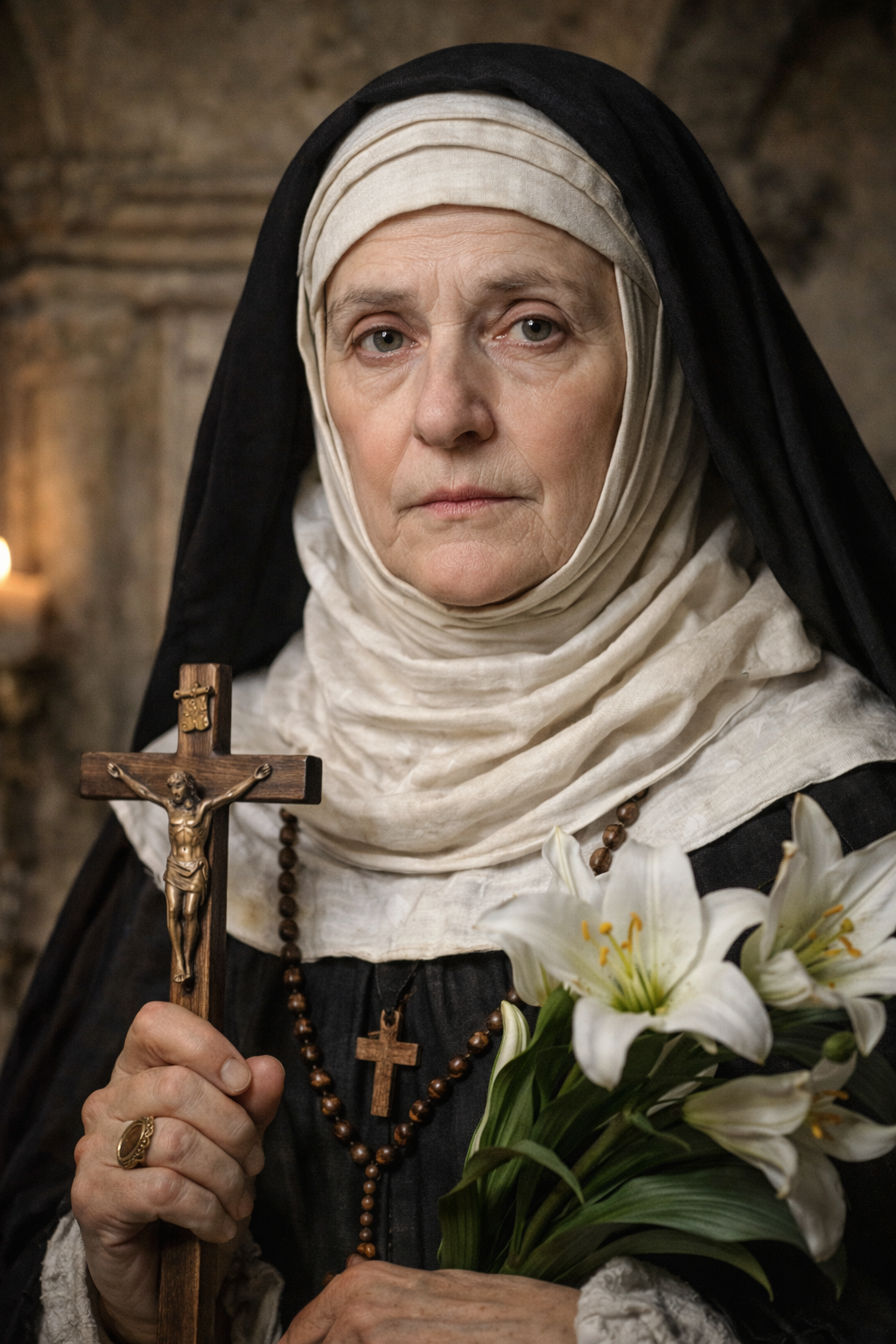
About Dorothy of Montau
Dorothy of Montau was born in the Prussian village of Groß Montau, now Mątowy Wielkie in Poland, early in 1347. A 1976 Roman decree used 25 January as her birth date, while later sources have confused that date with baptism dates of 6 or 8 February. Because no baptismal register survives and the textual witnesses disagree, this packet records 25 January as a probable, approximate date rather than an established birthday.
Her parents were Wilhelm Swartze and Agatha, prosperous farmers in the Vistula delta. In 1363, when Dorothy was sixteen, she married Adalbert, an older sword craftsman, and moved to Danzig, now Gdańsk. They had nine children; eight died before her, while their daughter Gertrud later entered the Benedictine community at Kulm. The surviving record therefore belongs first to the life of a lay wife and mother, not to a woman formed in a convent.
Johannes of Marienwerder's later Vitae portray the marriage as painful and describe harsh treatment by Adalbert. Recent scholarship reads those passages as evidence of domestic abuse while also warning that Johannes shaped the marriage into a hagiographic contrast with Dorothy's later enclosure. The official Roman profile describes Adalbert instead as a good Christian with a difficult character who initially reproached Dorothy and later joined her in a commitment to continence. The evidence supports a difficult and at times violent marriage, but it does not support the catalog's present claim that Adalbert was irreligious.
Dorothy maintained household responsibilities while pursuing prayer and pilgrimage. She and Adalbert traveled to Aachen and Einsiedeln, and in 1389 she joined a pilgrimage from Danzig to Rome with his consent. Adalbert died during her absence, with the official profile assigning his death to 1390. After returning, Dorothy arranged for Gertrud's religious life and moved away from Danzig; sources differ over the exact sequence of disposing of the household.
The unusually extensive record of Dorothy's inner life did not come from an autobiography written in her own hand. In Marienwerder she met Johannes, cathedral dean, Teutonic priest, and former Prague theology professor. Beginning in 1392, he recorded her accounts and later produced several Latin and German Vitae and collections of revelations. A Bavarian Academy source catalogue classifies the short Life written in 1395 as both hagiography and biography, while the seven-book Life followed in 1398. Those texts preserve valuable testimony, but they also reflect a male cleric's selection and a campaign for official recognition.
The Vitae report visions, ecstasies, invisible stigmata, and experiences Dorothy and Johannes understood as mystical union with Christ. They also describe severe fasting and repeated injury that Dorothy deliberately inflicted on her own body from childhood. These reports document what her hagiographer claimed and how late-medieval ascetic practice was interpreted; they do not independently verify supernatural causes. Nor should dangerous self-harm be turned into a devotional technique for modern readers.
Dorothy settled in Marienwerder in 1391 and accepted Johannes as confessor and spiritual guide. Her wish to become a recluse required institutional permission rather than a private decision. On 2 May 1393, with approval from the bishop and cathedral chapter, she entered a cell built against Marienwerder Cathedral. Her enclosure made her an anchoress, a lay religious recluse, but not a nun under monastic vows.
Enclosure did not mean that Dorothy lived without material support or contact. A recent study of Johannes's records says an attendant brought her one daily meal of fish, bread, honey, and beer. The same evidence reports daily Communion and locates the cell by the cathedral's lower choir. Visitors also sought her counsel, although accounts of conversions and miracles attributed to those encounters remain devotional claims.
Dorothy died in the cathedral cell on 25 June 1394 and was buried at Marienwerder Cathedral. Within months, Johannes asked the Teutonic Order's representative in Rome to seek a papal inquiry into the deceased widow and recluse. The surviving letter exists in a contemporary copy and identifies her parents, making it unusually close evidence even though it openly promotes her cause. A formal process began in 1404 but did not reach completion in the Middle Ages.
On 9 January 1976, Paul VI confirmed Dorothy's longstanding cult through what the Dicastery for the Causes of Saints now calls an equivalent beatification. The same Dicastery lists her liturgical memorial on 25 June. A modern Teutonic Order missal also observes her that day, identifying her as mother, mystic, and recluse. Only a short German excerpt from that collect is retained as a draft because the issuing authority and reuse terms of the online edition remain unclear.
Recognition terminology still varies. The Roman Dicastery presents Dorothy as Blessed, while Teutonic Order books call her Saint. The Order also calls her patroness of Prussia and the Teutonic Order, but modern scholarship argues that broad Order-wide patronage was constructed long after her local medieval cult. The packet therefore records titles and jurisdiction-specific usage without treating every later patronage claim as medieval fact.
Dorothy's historical significance lies partly in the unusual density of evidence surrounding a medieval laywoman's choices, losses, travel, and negotiated enclosure. She lived successively as daughter, wife, mother, widow, pilgrim, and recluse. Her story also demonstrates why a richly documented life still requires source criticism: nearly all her reported speech and visions reach readers through clerical texts written for spiritual instruction and recognition.
Wondering how to weigh the stories and sources? Learn how to read a saint biography.
Prayers for Dorothy of Montau
Dorothy of Montau: collect excerpt
Allmächtiger Gott, mit deiner Hilfe ist die heilige Dorothea ihren Lebensweg gegangen