Biography
Eliswa of the Blessed Virgin Mary
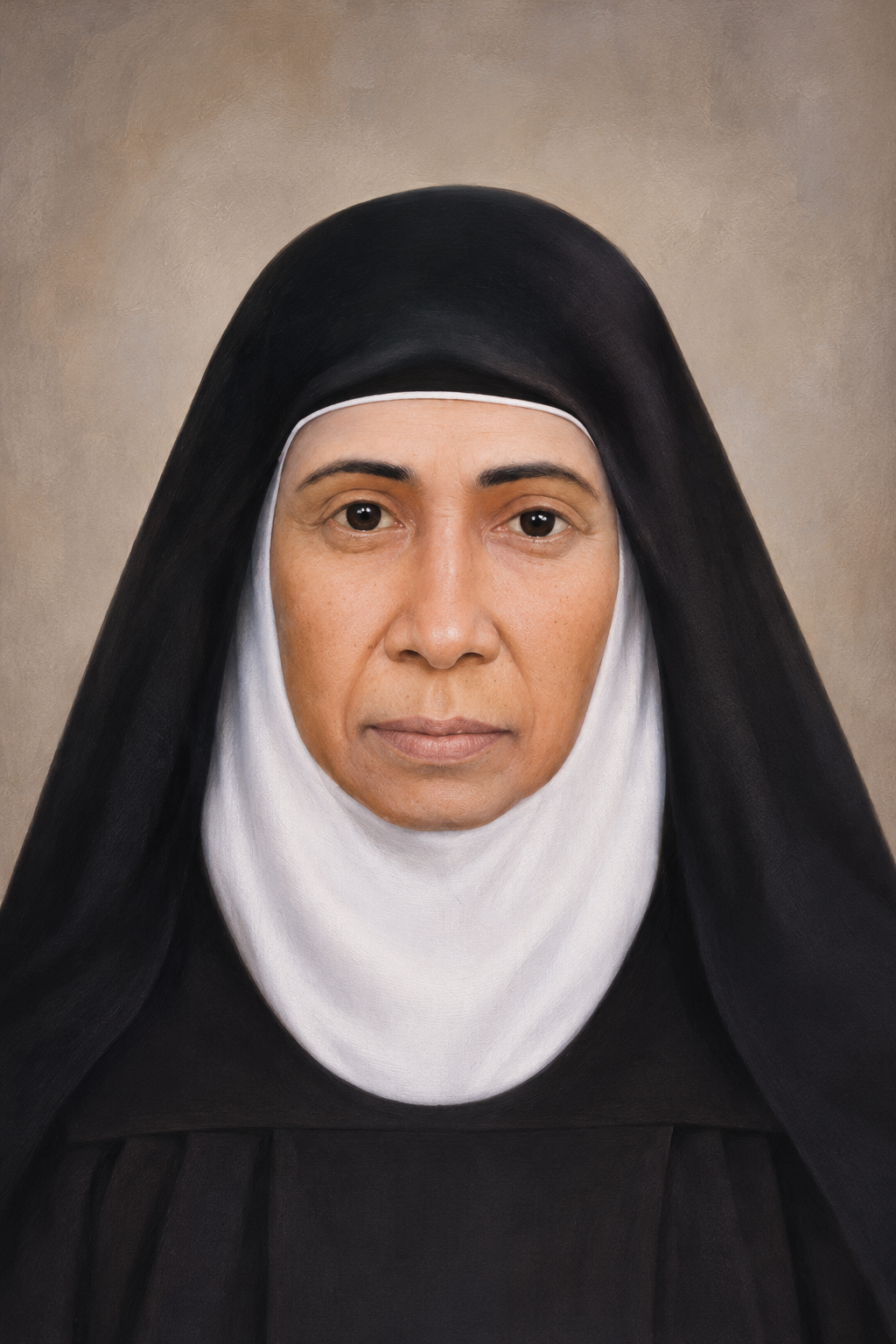
About Eliswa of the Blessed Virgin Mary
Eliswa Vakayil was born at Ochanthuruth in Kerala on 15 October 1831, the eldest of eight children of Thomman and Thanda. The congregation she later founded remembers a prosperous family and an education given at home, and it names her brother Louis as a Carmelite priest and Malayalam writer. In 1847 Eliswa married Vatharu Vakayil of Koonammavu. Their daughter Anna was born around 1850 or 1851. Official church accounts disagree by about a year on the date of Vatharu’s death, but all place Eliswa’s widowhood while she was still young. She chose not to remarry.
For years after his death she lived simply with her daughter, prayed frequently, and helped poor neighbors. The Dicastery describes a small dwelling and regular participation in the sacraments. This was not yet a convent, and her daughter’s presence is part of the history, not a detail to omit from a later account of religious life. In 1862 Eliswa spoke with Leopold Beccaro, an Italian Discalced Carmelite missionary, about her wish for a community. He became a spiritual guide and brought the proposal to Bernardine Baccinelli, the vicar apostolic of Verapoly.
Anna and Eliswa’s younger sister Thresia joined her. Baccinelli approved the foundation, and on 13 February 1866 the three women received the Carmelite scapular. They began in a dwelling made from bamboo mats on family property at Koonammavu; a more permanent Saint Teresa’s Convent followed. The congregation dates that move to March 1867, and the Dicastery records their first religious profession on 6 July 1868. Thus the beginning was a family initiative that took on a formal ecclesiastical life over several years, with women themselves forming its first community.
The foundation admitted both Latin-rite women and women of the Syro-Malabar Church. A Syro-Malabar widow joined very soon after the first three, according to the superior general’s later account. For about two decades the community lived with that double-rite character. Its members shared a Carmelite pattern of prayer while the church authorities to whom they belonged remained distinct. Calling Eliswa founder of only one of the later congregations obscures this earlier common foundation; both successor institutes trace their beginnings to the house at Koonammavu.
Prayer and service developed together. Eliswa and the sisters organized schooling, a boarding house, and care for girls without family support. The congregation describes language, mathematics, moral instruction, household work, and handicrafts among the subjects taught. L’Osservatore Romano adds catechism and notes the rosary-making practice associated with the community. These details show a school concerned with literacy and practical skills at a time when girls’ formal education was limited. The same institutional records remember an orphanage and assistance to people left without support.
Eliswa served as prioress, directed novices, taught girls, and oversaw an orphanage. Her role therefore was neither solely that of a contemplative nor only a founder named on an institutional charter. She formed women who would continue the work and took responsibility for children in the houses the sisters operated. The congregation remembers her attention to women excluded by caste and poverty, and traces its own commitment to their education to her example.
A major change came in 1890 when church jurisdictions for the Syro-Malabar faithful were reorganized. The community was divided along ritual lines into two independent congregations, the Latin-rite Congregation of Teresian Carmelites and the Syro-Malabar Congregation of the Mother of Carmel. The Teresian Carmelites say that the Latin sisters, including Eliswa, left Saint Teresa’s Convent in September 1890. They stayed briefly at Ernakulam before moving to Varapuzha. This separation was an institutional decision amid wider changes in Kerala’s Catholic churches, not an abandonment of the women who had once shared the foundation.
At Saint Joseph’s Convent in Varapuzha, Eliswa lived the last twenty-three years of her life. She continued as prioress and novice director and took part in teaching and care of orphans. The Dicastery portrays sustained prayer before the Eucharist as part of the way she met the demands of the foundation and its division. Those spiritual descriptions belong to the church’s assessment of her life, while the offices and places show the concrete work that continued after Koonammavu. She died at the convent on 18 July 1913.
The congregation later moved her remains within the Varapuzha convent property and established a memorial there. Her cause advanced when Pope Francis declared her venerable on 8 November 2023. In 2025 the Holy See recognized a reported healing before birth as the miracle associated with her intercession; that is the Church’s judgment on a reported event, not an independently observed event of Eliswa’s lifetime. She was beatified at Vallarpadam in Kerala on 8 November 2025. Her memory belongs to both the community she led and the larger history of women’s religious education in Kerala. The sisters’ later institutions do not by themselves prove the reach of her personal actions, but they preserve the educational purpose of her foundation.
Wondering how to weigh the stories and sources? Learn how to read a saint biography.