Biography
Elizabeth Cady Stanton
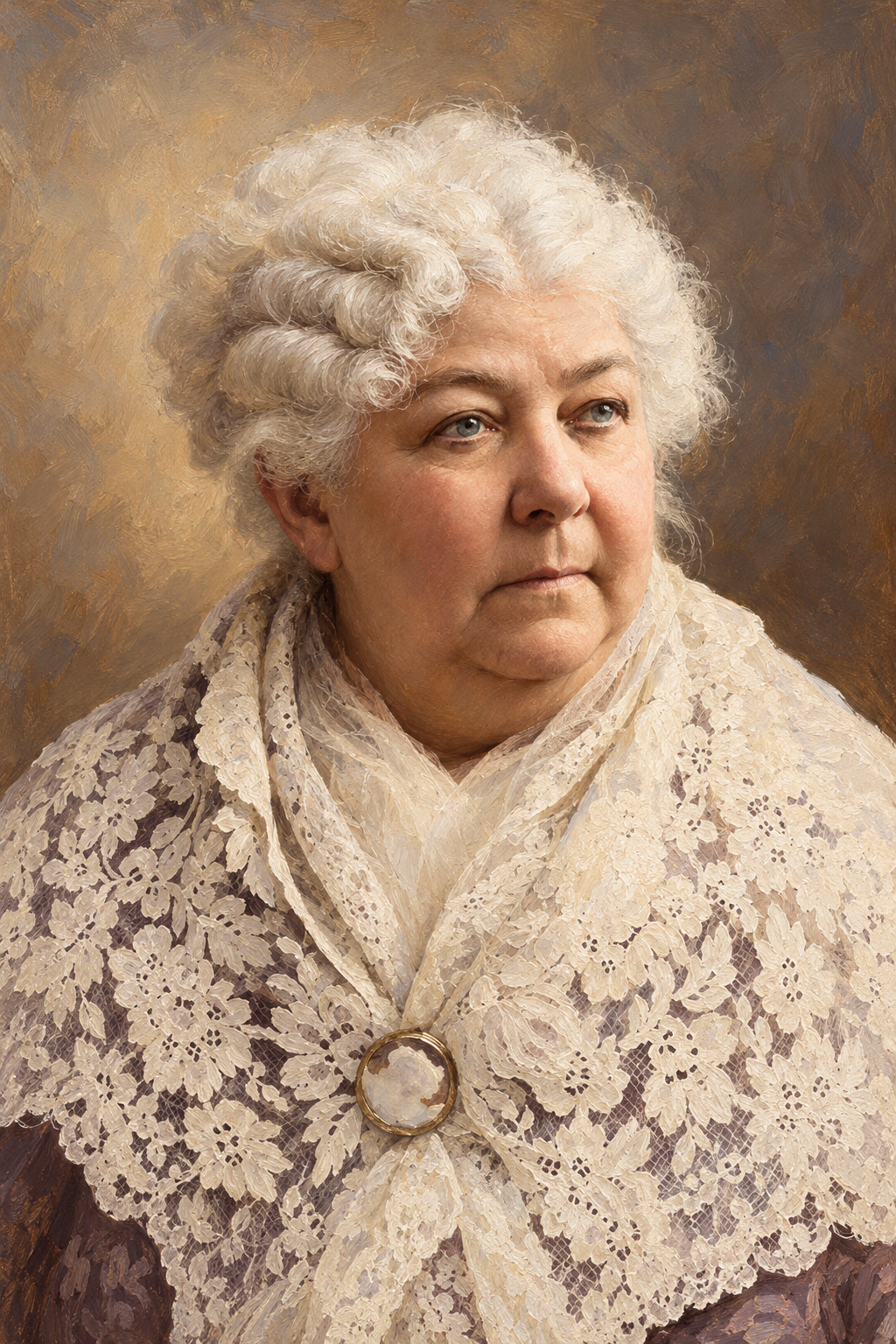
About Elizabeth Cady Stanton
Elizabeth Cady Stanton argued that women’s exclusion from public life was sustained by law, custom, and religious teaching. Her demands went beyond voting to include education, property, employment, and freedom within marriage. Born into a privileged, slave-owning family in Johnstown, New York, she experienced both the advantages of her social position and the restrictions placed on women. Those experiences shaped a reformer whose expansive language of equality could coexist with serious racial and class prejudice.
She studied at Troy Female Seminary and learned about women’s legal position through her father’s law office. In 1840 she married the abolitionist Henry Brewster Stanton and traveled with him to the World’s Anti-Slavery Convention in London. The exclusion of women delegates there brought her into contact with Lucretia Mott. In 1848 Stanton, Mott, and other organizers convened the women’s rights meeting at Seneca Falls. Stanton helped write its Declaration of Sentiments, which demanded changes in women’s civil, political, and social position.
Her 1854 address to New York lawmakers made the problem of representation concrete. Women paid taxes and helped sustain public institutions, yet could not vote. She asked what authority permitted men to govern half the population without its consent. The address rejected the assumption that fathers, husbands, and brothers adequately represented women’s interests. It called for changes to the state’s laws and constitution rather than relying on individual kindness within unequal arrangements.
The same address exposed limits in her understanding of equality. Stanton appealed to the status of educated, native-born women and used degrading comparisons with Black men, immigrants, and people with intellectual disabilities. Those comparisons were part of her argument, not merely hostile words attributed to opponents. Her defense of women’s rights could challenge one hierarchy while drawing strength from others.
Stanton’s long partnership with Susan B. Anthony joined writing with organizing and public speaking. During the Civil War they founded the Women’s Loyal National League and gathered petitions against slavery. Stanton also worked as an editor and lecturer. Her collaboration with Anthony and Matilda Joslyn Gage produced the early volumes of History of Woman Suffrage, preserving documents while helping establish the public memory of their movement.
After the war, disputes over voting rights broke the earlier coalition. Historian Lori Ginzberg explains that Stanton opposed giving priority to Black men’s enfranchisement while women remained excluded. Her rhetoric claimed universal liberty but also ranked some people as more fit for citizenship than others. Ginzberg identifies this as more than a regrettable turn of phrase: Stanton’s priorities could narrow women’s rights to the interests of educated white women and miss the different needs of Black, immigrant, and working-class women.
Religion was another field in which she challenged authority. The Woman’s Bible, published in two volumes in 1895 and 1898, collected biblical passages with essays and commentaries by a committee she chaired. As Harvard Divinity School Library explains, the project disputed the claim that women’s subordination expressed divine will. Its authors sought to expose human domination in interpretations presented as sacred commands. It was a work of criticism and commentary, not a new translation of the whole Bible.
Her own pamphlet, Bible and Church Degrade Woman, shows how far that criticism extended. She rejected the idea that the Bible was divinely inspired and argued that church teaching had cultivated women’s fear and dependence. She urged education grounded in reason and science and greater participation in public questions. These were her polemical judgments about religion, not statements that can simply be substituted for the history of all Christian communities.
The pamphlet also addressed a possible objection to women’s suffrage: that religious enthusiasm might lead women to impose their beliefs through law. Stanton criticized coercive moral campaigns but refused to make that a reason to deny women self-government. Her answer was wider education and responsibility. She wanted women to have political power while also challenging the assumptions they might bring to its use.
In her 1892 address Solitude of Self, she argued from the individuality of every person. A woman’s identity could not be exhausted by her roles as wife, mother, sister, or daughter. Each person needed education, practical resources, and freedom of judgment because no one else could bear every responsibility or endure every crisis in her place. The argument joined voting rights with the development of a whole human life.
She connected this independence with Protestant freedom of conscience and republican citizenship. Education, in her account, should develop every faculty rather than train a girl only for an expected domestic role. Even a life surrounded by affection could bring decisions and losses that another person could not face for her.
Stanton died in New York City on October 26, 1902.
The Episcopal Church commemorates her on July 20 with other women reformers. That later recognition should not obscure her criticism of church authority or imply that her religious views were conventional.
Wondering how to weigh the stories and sources? Learn how to read a saint biography.