Biography
Elizabeth Evelyn Wright
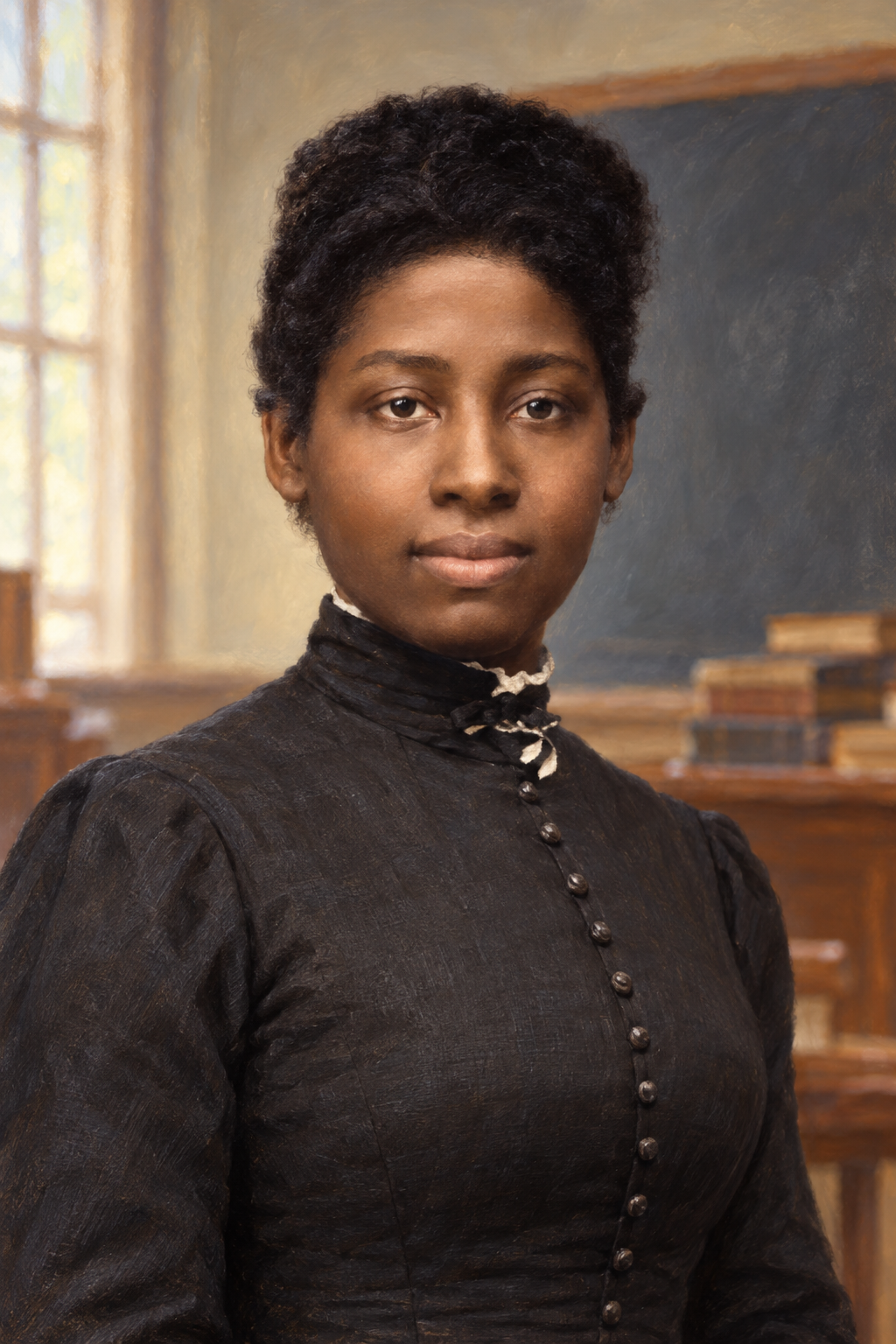
About Elizabeth Evelyn Wright
Elizabeth Evelyn Wright built an educational opportunity for Black children in rural South Carolina that grew into Voorhees University. She came from Talbotton, Georgia, and studied at Tuskegee, where Booker T. Washington’s example helped shape her work. Her studies combined learning with paid work that helped meet her expenses. She carried that understanding of education into her efforts to establish a school.
Katherine Reynolds Chaddock’s South Carolina Encyclopedia entry gives her birth as April 3, 1872, while Coleman’s 1922 biography gives August 18, 1876. The earlier date is retained here as probable; the disagreement between these accounts remains unresolved.
The university’s account describes a childhood of poverty and her departure for Tuskegee as a teenager. It identifies domestic service as the work that helped support her studies, and describes her educational aims as including character and moral responsibility.
Her early attempts in South Carolina faced arson and official opposition. She nevertheless taught basic literacy and mathematics to adult workers in evening classes while pursuing a larger institution. In 1897 she opened a school in Denmark and sought money for land and buildings. Ralph Voorhees supplied substantial support for the project, which offered both classroom subjects and vocational training.
Wright’s own second annual report records how demanding those first years were. She described a school with more pupils than its buildings could properly accommodate. Some children stood because there were not enough desks; younger ones sat on the floor. Only a few could board on the grounds. Her plans for industrial education were limited by the lack of a suitable building, tools, and materials. Students worked the small farm, but it needed equipment and an animal of its own. Wright had usually visited local churches to collect small contributions. As enrollment grew, however, teaching kept her at the school and reduced the time she could spend raising funds.
The report also describes meetings with parents and work beyond the classroom. Wright wanted education to affect family life, health, practical skills, and moral responsibility. She described the school as nonsectarian, with students attending different churches in town. Her advice to men included buying homes, avoiding the mortgage system, and growing more food for their households.
Her colleague Martin A. Menafee left a contemporary account of the school’s growth. He arrived in 1900 as Wright’s stenographer and subsequently became its treasurer. Writing in 1905, he described a central building containing offices, classrooms, and a large chapel, as well as a separate building for girls. Other Tuskegee graduates brought skills in farming, carpentry, sewing, cooking, and primary teaching. Menafee reported that about three hundred day and boarding pupils attended. For students who could not afford ordinary fees, work on the farm and in the shops made evening study possible. He also emphasized the school’s determination to remain free of debt. His account presents the institution as a shared undertaking, sustained by teachers, students, trustees, and donors as well as its founder. Menafee noted that the young institution had not yet graduated students; many arrived unable to read or write. He recorded receipts exceeding eighteen thousand dollars for the 1903–1904 school year.
Religious differences could complicate that cooperation. Coleman’s later biography recounts a dispute in which a local pastor accused Wright of being an Adventist. Her colleague Jessie Dorsey rejected the accusation and identified herself as the Adventist member of the group. The account cautions against assigning Wright a denomination simply from her associates.
Wright married Menafee in 1906. Later that year she sought medical treatment in Battle Creek, Michigan, where she died on December 14.
The institution continued after her death. The university dates its formal relationship with the Episcopal Church to 1924, through the American Church Institutes for Negroes. It later developed into a four-year college and adopted the name Voorhees University in 2022. That later church affiliation belongs to the school’s history rather than establishing Wright’s personal church membership.
The campus also included a hospital during Wright’s lifetime. The historic-district nomination prepared in 1980 identifies Booker T. Washington Hall as a hospital built in 1905, designed by Wilson Cooke of Claflin College and constructed by Black builders. Its brick walls, columned porch, and decorative windows were recorded in the architectural survey. The same inventory identifies Wright’s burial place on the campus, where she was buried in December 1906. Later buildings show how the institution continued to remember its founder and develop practical training after her death. Wright Hall, a dormitory built in 1932, bore her name. The survey records that Voorhees masonry students built St. Philip’s Episcopal Chapel in 1935. These later buildings belong to the work of her successors, rather than to Wright’s own building program.
The Episcopal Diocese of Los Angeles commemorates her with Anna Julia Cooper on February 28 in its cycle of prayer drawn from A Great Cloud of Witnesses.
Wondering how to weigh the stories and sources? Learn how to read a saint biography.