Biography
Erasmus
About Erasmus
Erasmus of Formia, widely known in Western devotion as Saint Elmo, is honored as an early Christian bishop and witness under persecution. The historically recoverable life is very small. A cult centered at Formia in southern Italy preserves his name, episcopal identity, and memory of suffering, but no contemporary trial record or ordinary biography survives. Later passions supply a vast itinerary, speeches, miracles, and repeated tortures. This account therefore treats the established cult as documented reception, the basic episcopal and persecuted identity as traditional, and the developed narrative as legend rather than combining every episode into apparent history.
The catalog’s previous dates illustrate the problem. It gave January 1 in both 250 and 303, although no source supports either month or day and the birth year is not established. The OCA life concludes that Erasmus died at Formia in 303, within its narrative of the Diocletianic persecution. That year can be reported only as a traditional approximation, not as documented chronology. The parent dates are cleared rather than preserving false precision. June 2 in the Roman Martyrology and May 4 in the OCA calendar are observances in different traditions; neither automatically identifies the historical day of death.
In the Eastern received life, Erasmus is consecrated bishop of Formium and withdraws to Mount Libanus during persecution under Diocletian and Maximian. After seven years, an angel commands him to leave concealment. Soldiers encounter him and take him to Antioch, where he confesses Christianity before Diocletian and is tortured. The story then has an angel release him from prison and promise to lead him to Italy. These scenes express the hagiographic themes of reluctant safety, renewed public ministry, and divine deliverance. They do not establish a datable journey from Lebanon to Antioch or a route suitable for an interactive map.
The itinerary expands further. Erasmus is said to preach in Lycia, restore the son of a prominent citizen, and inspire ten thousand baptisms. Brought before Maximian, he again confesses his faith, survives beatings, and faces a threat of crucifixion. When forced toward an idol temple, the idols fall and fire kills many pagans. The numerical conversion, resurrection, collapsing images, and destructive fire are presented by the source as miracles. They should not be detached from that genre, plotted as verified stops, or used to celebrate retaliatory violence. The moral center is refusal to renounce conviction under state coercion, not supernatural harm to opponents.
The same life next sends Erasmus to Sirmium, where officials place him in a heated oven. He emerges unharmed, crowds react, and another angelic release returns him to Formia. There he resumes baptizing and eventually dies; Christians bury him with honor. The geographical sweep may preserve elements from more than one saintly tradition, including an Erasmus associated with Antioch. It cannot responsibly become a continuous historical route. This packet therefore uses Formia as the cult’s secure center and labels the other cities only within the legendary narrative. It supplies no coordinates and draws no lines between them.
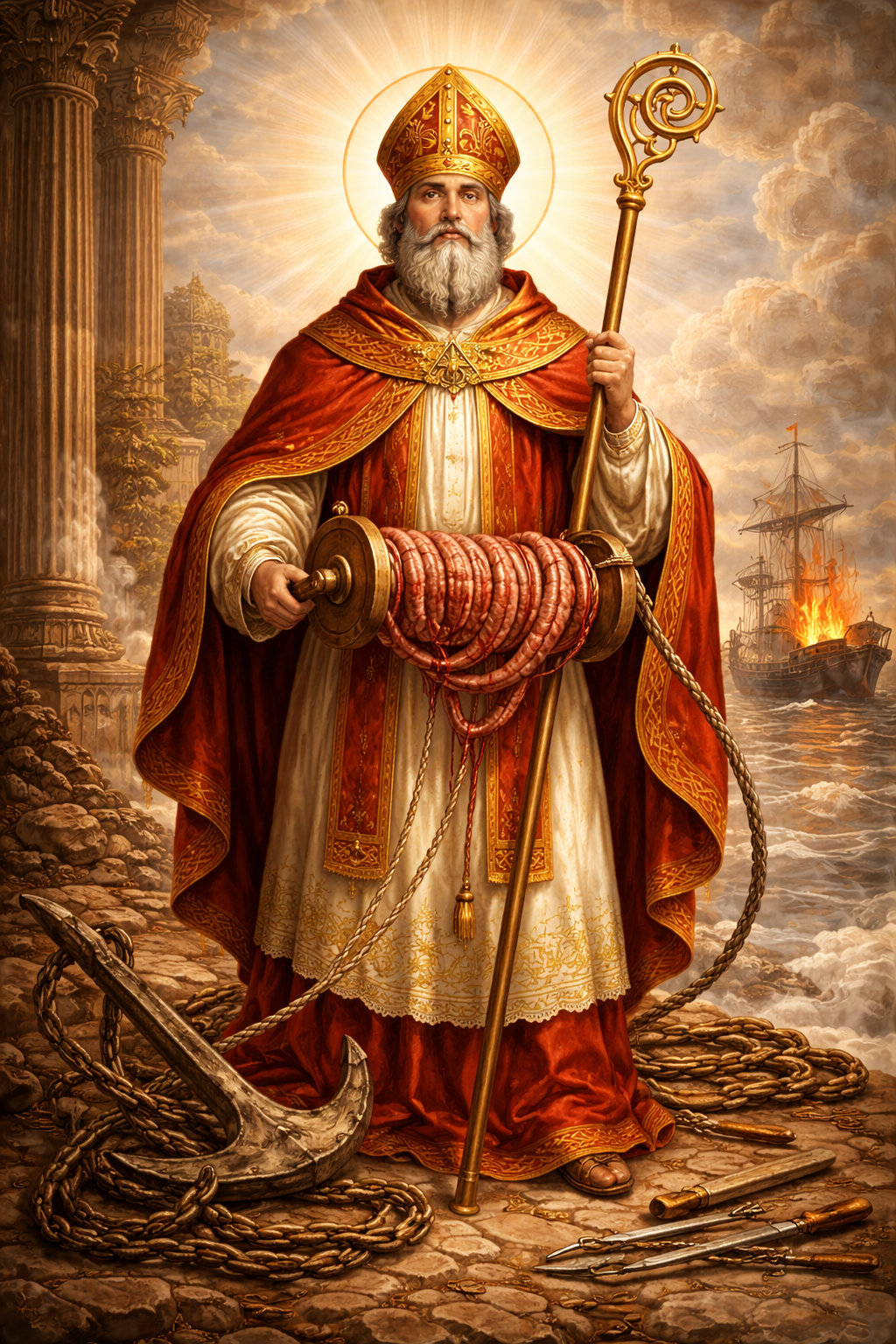
Western art often gives Erasmus a windlass with intestines wound around it. The image encouraged a graphic story that he was disemboweled during torture, but critical reference works treat this as a late legendary development or an interpretation of his attribute. The OCA account lists severe torments yet does not make disembowelment his death. Violence should be named without sensational detail: the tradition remembers arrest, bodily abuse, confinement, threatened execution, and endurance. Artwork can identify the windlass as a later symbol, but neither image nor patronage proves a method of martyrdom.
Erasmus’s second familiar name grew through maritime devotion. Elmo became a form of his name, and sailors invoked Saint Elmo during storms. The electrical glow seen around ship masts became known as St. Elmo’s fire. Its natural occurrence is not evidence that Erasmus traveled by sea or personally protected a particular vessel. The association documents how seafaring communities interpreted danger and reassurance through his cult. Similarly, later Christians invoked him for intestinal illness because of the windlass image. These patronages belong to reception history and should not be projected backward as occupations or actions from his life.
In late medieval Western devotion Erasmus was counted among the Fourteen Holy Helpers, saints invoked together amid sickness and danger. That collective identity greatly widened his visibility beyond Formia. It also multiplied prayers, images, and retellings. Membership in the group is a documented devotional classification, not proof that every attached passion detail is ancient. No prayer enters this packet: a hymn on the OCA page remains a hymn, and publication in a prayer table requires exact text, edition, translation, provenance, tradition, and rights review. Genre and source custody matter even when a text is sincerely devotional.
The official calendars preserve complementary memories. The OCA commemorates a holy confessor and bishop of Formia on May 4 and narrates his peaceful death after repeated suffering. The Roman Martyrology commemorates Erasmus at Formia on June 2 as bishop and martyr. These classifications should remain attached to their traditions instead of being forced into false agreement. “Confessor” here recognizes steadfast witness; “martyr” reflects the Western cult’s understanding of persecution and death. The titles do not resolve the precise historical manner of death, and a feast date does not settle chronology.
Erasmus remains significant because communities facing danger remembered endurance rather than surrender. The received stories portray a bishop repeatedly returning to ministry after coercion, while sailors and the sick later made his name a language for hope. Historical care keeps that legacy from depending on invented spectacle. It acknowledges that Formia’s cult is firmer than the trans-Mediterranean itinerary, that the windlass belongs to iconography rather than a verified autopsy, and that calendars differ. His practical example is steady accompaniment: help someone pass through a frightening week with concrete support, without promising miraculous escape or making another person’s suffering into a dramatic story.
Wondering how to weigh the stories and sources? Learn how to read a saint biography.