Biography
Etienne-Théodore Cuenot
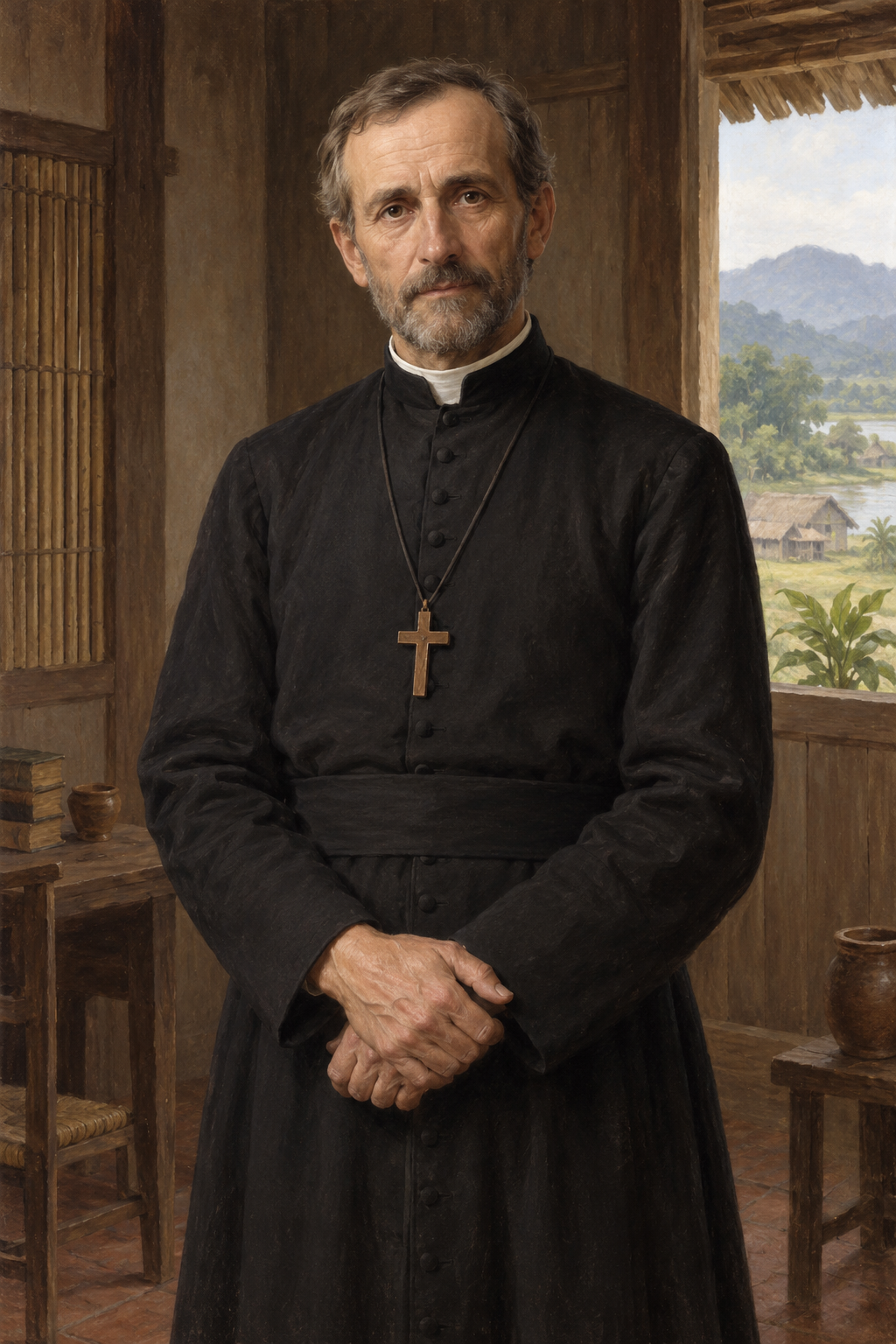
About Etienne-Théodore Cuenot
Étienne-Théodore Cuenot was born on 8 February 1802 at Le Bélieu in eastern France. He studied in several French towns and at the seminary in Besançon before joining a religious teaching house in Aix-en-Provence. Ordained a priest in 1825, he entered the Paris Foreign Missions Society in 1827. His formation led from provincial France toward a church whose communities would soon face persecution in Vietnam.
He left for Macao in January 1828 and reached Cochinchina the following year. Illness interrupted his first pastoral work. When repression intensified in 1833, he fled to Siam, helped a Christian community there and later moved with Vietnamese seminarians to Singapore. Bishop Taberd chose him as coadjutor and consecrated him bishop in May 1835. He returned to Cochinchina and worked while hiding among communities willing to shelter him.
After Taberd’s death in 1840, Cuenot became apostolic vicar. A history published by the Diocese of Qui Nhon describes a pause in state pressure under the next ruler, though earlier prisoners remained and local officials determined much of the danger. In August 1841 Cuenot convened a synod at Gò Thị with his coadjutor and Vietnamese priests. They made common rules for pastoral practice, religious instruction and reports from clergy. The record shows administrative care under unstable conditions.
Training local clergy was another sustained priority. The diocesan history records his expansion of seminary opportunities in the region and his decision to send students to Penang. It describes the 1841 meeting as a way to align teaching and service across a dispersed mission. These efforts involved Vietnamese priests and seminarians as active participants in the church’s life, rather than treating the bishop’s decisions as a solitary achievement.
The mission also reached beyond existing congregations. A Paris Foreign Missions account of the Kontum diocese traces early attempts to Cuenot in 1848. It says several initiatives failed before the deacon François-Xavier Nguyễn Do explored routes into the Central Highlands. Cuenot then sent priests, catechists and seminarians. Progress depended on their travel, language learning and relationships with Bahnar communities. The same account treats 1853 as the effective beginning of the highland mission.
Kontum’s later commemoration of those beginnings included people from many local ethnic communities. The retrospective account remembers the early missionaries and first believers together. That wider memory helps place Cuenot’s leadership within a network of Vietnamese and foreign coworkers. The region’s eventual Christian communities cannot be reduced to one founder or one journey. The account itself records failed attempts, local guidance and an evolving welcome, which make the history more complex than a single heroic expedition.
Persecution again narrowed his choices. The French bishops’ account says he was arrested under Emperor Tự Đức and died after confinement in severe conditions, before the intended execution. The Portuguese Roman Martyrology describes his imprisonment in an elephant stable at Bình Định and his death from suffering there. He died on 14 November 1861. These accounts support a death in custody; they do not support a claim that he was beheaded.
The Roman Martyrology commemorates Cuenot as a bishop and martyr on 14 November. John Paul II named Stephanus Theodorus Cuenot among the bishops in his 1988 decree canonizing the Vietnamese martyrs. These documents preserve both his individual name and the collective recognition shared by clergy and laypeople. His life joins ordinary diocesan work—training priests, convening a synod and planning missions—to the danger under which those communities lived.
Wondering how to weigh the stories and sources? Learn how to read a saint biography.