Biography
Euthymius of Sardis
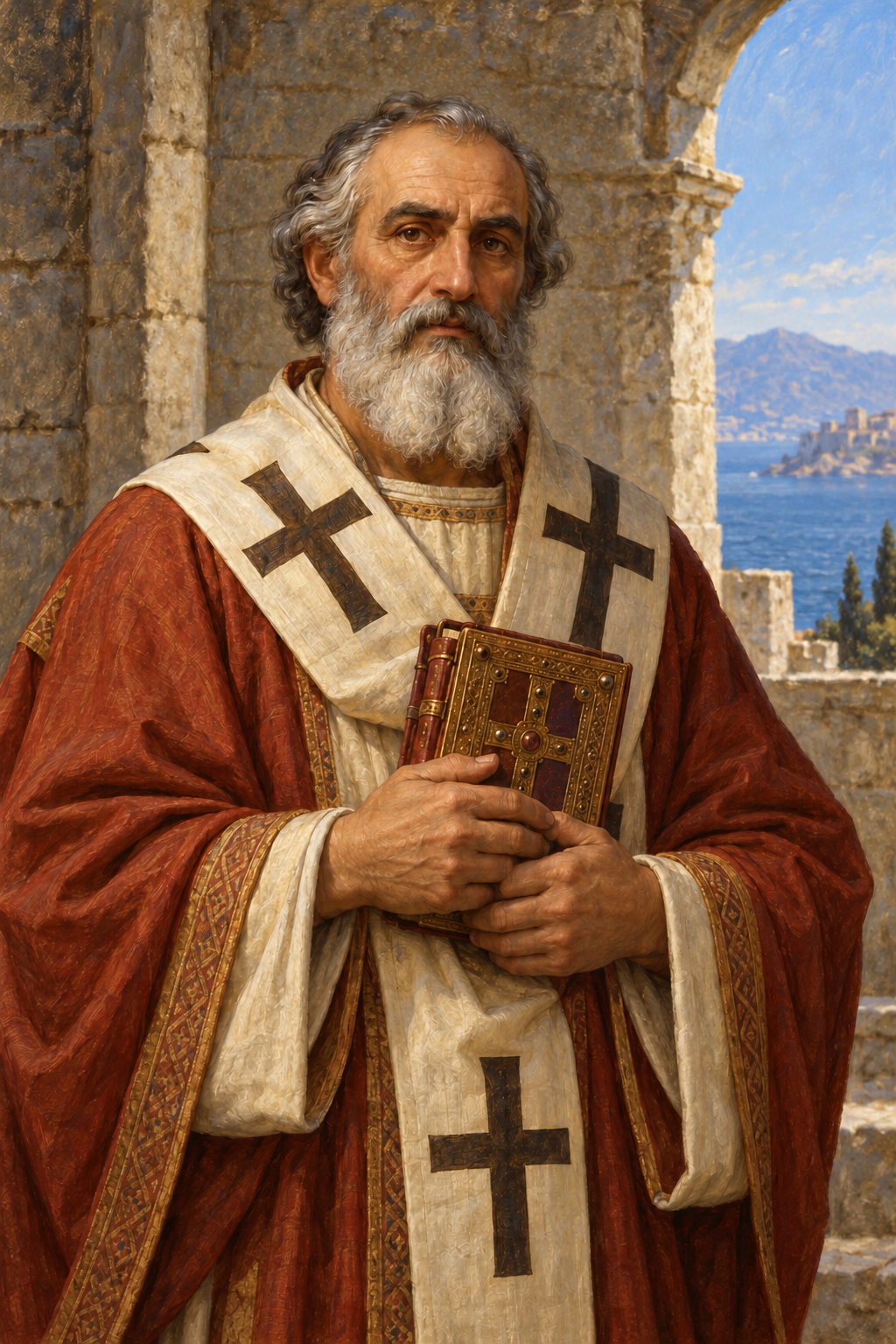
About Euthymius of Sardis
Euthymius of Sardis was a Byzantine metropolitan whose defense of icons brought repeated exile and, finally, death after torture. Tradition places his birth at Uzara in Asia Minor; scholarly estimates give 751 or 754. Patriarch Tarasius appointed him to Sardis between 784 and 787, and he participated in the council of Nicaea in 787.
The later panegyric by Metrophanes portrays him teaching a community divided over religious images. In the passage translated by Clive Foss, he goes directly to his congregation and finds its faith weakened. Foss summarizes the narrative as an account of Euthymius winning people back to icon veneration. This is the devotional portrait of his pastoral work, not a record of individual conversions.
At that council he supported receiving repentant former iconoclast bishops back into communion. He also asked that older church writings be consulted when deciding whether bishops ordained by heretics could retain their office. His defense of images thus accompanied a willingness to consider reconciliation with people who had previously opposed them.
The council’s records also show him questioning the use of texts. He challenged former iconoclast bishops about their failure to inspect complete copies of the writings cited to them. Later he read aloud a statement affirming the council’s faith and its acceptance of icon veneration. These interventions place him within the detailed work of the assembly, rather than merely on its list of participants.
His first exile arose in a different setting. Around 803–804, he was sent to Pantelleria amid accusations of support for the revolt of Bardanes Tourkos. He was eventually recalled but did not recover his see. At the palace gathering in December 814, he again opposed iconoclasm; another exile, this time to Thasos, followed.
The Orthodox Encyclopedia doubts both an alleged diplomatic mission to Baghdad and the story that Euthymius first angered the emperor by sheltering a young woman in a convent. It treats the political charge connected with Bardanes as the more credible explanation for the first banishment. Those cautions matter because the accounts otherwise make the bishop’s conflicts with successive rulers seem more straightforward than the evidence allows.
His release in 821 did not end the disagreements with imperial authority. The Orthodox Encyclopedia describes another palace meeting under Michael II, where Euthymius rejected the emperor’s proposed compromise over images. Michael ordered him into exile but almost immediately recalled him. The account distinguishes that short episode from his final imprisonment under Theophilus, rather than treating the successive punishments as a single uninterrupted exile.
Under Theophilus, suspicion of a political conspiracy brought another arrest. The Prosopography of the Byzantine Empire connects the investigation with a pamphlet predicting the emperor’s death.
The interrogation reached into the imperial household. Warren Treadgold notes that Euthymius named one visitor: Theoctista, whose daughters had married the emperor and the official questioning him. Thus the account does not describe an absolute refusal to identify anyone. Treadgold interprets the questioning as evidence that officials suspected Euthymius of helping circulate the prediction, rather than proof that he had written it. He attributes the prophetic pamphlets to Methodius, while acknowledging scholarly disagreement over the authorship of the Life. The investigation helps explain why an elderly bishop’s visitors mattered to imperial officials: religious opposition and fears about the emperor’s security had become entangled.
Euthymius was questioned about his visitors and sent to the island of Saint Andrew near Cape Akritas. There he was beaten during further interrogation. Despite care from his attendants and fellow prisoner Methodius, he died eight days later, on December 26, 831.
Methodius, later patriarch of Constantinople, wrote an account of the bishop’s life. The Orthodox Encyclopedia also identifies a surviving work by Euthymius about the election of bishops. His legacy therefore includes both remembrance of his suffering and a contribution to the Church’s own ordering of its leadership.
His writing on episcopal elections gives a more practical view of his concerns for church leadership. As Patricia Karlin-Hayter explains, the text allows candidates to be sought among monks, church officers, priests, deacons, and laypeople known for upright lives. Its inclusion of lay candidates helps her date the work before later restrictions and supports its attribution to Euthymius the Confessor. She reads it as evidence for the selection of metropolitan bishops during the first restoration of images. In the procedure it describes, elections take place in Constantinople and belong to the synod, while the patriarch stays outside the voting deliberations. The surviving text therefore preserves specific arrangements for choosing bishops, alongside the accounts that remember its author principally for exile and martyrdom.
The Orthodox Church in America honors him as a hieromartyr, a member of the clergy who died for his faith, and lists commemorations on December 26 and March 8. Its account remembers his refusal to abandon icon veneration under successive emperors and his death following brutal punishment.
Wondering how to weigh the stories and sources? Learn how to read a saint biography.