Biography
Ezekiel
About Ezekiel
Ezekiel was a priest and prophet among Judean deportees in Babylonia. The book identifies him as the son of Buzi and locates his call by the Chebar waterway in the fifth year of King Jehoiachin’s exile. The USCCB introduction connects that setting with the Babylonian deportation of 597 BC and places Ezekiel’s commission five years later. It calls him the first prophet commissioned outside Judah or Israel. The text’s ‘thirtieth year’ is ambiguous, however, and does not securely establish Ezekiel’s age. His birth, death, birthplace, and burial therefore remain unset rather than being reconstructed from later tradition.
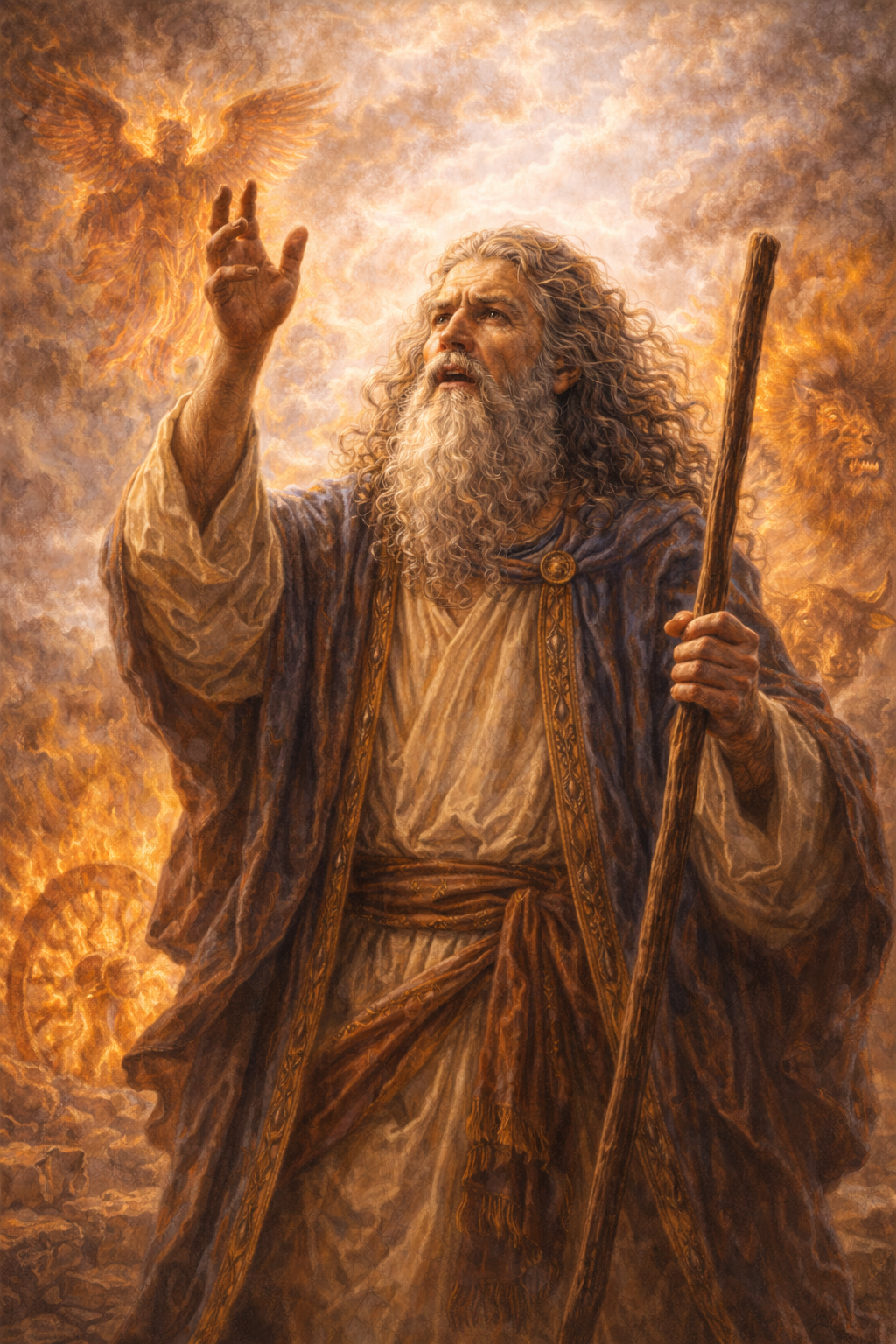
The opening vision presents a storm cloud, four living creatures, intersecting wheels, and a radiant throne-like form. Ezekiel falls to the ground, receives a commission to a resistant people, and eats a scroll of lamentation and woe that tastes sweet. He is appointed as a watchman responsible for warning others. The imagery is preserved as Ezekiel’s scriptural vision, not as an independently observed physical event or a blueprint for machines. Later Christian symbolism associated the creatures with the evangelists, but that reception should not be projected back into a biography as Ezekiel’s own stated interpretation.
Before Jerusalem’s fall, Ezekiel performs severe signs. He draws the city on a brick, lies on his sides, measures restricted food and water, and shaves and divides his hair to portray siege, famine, death, and scattering. The book’s notes describe these actions as symbolic performances. Their exact practical duration and execution are debated within the text’s difficult chronology, and they should not be embellished into a daily schedule. The rationing and violence are not picturesque details: they communicate the suffering of siege and the prophet’s own bodily participation in a message of impending disaster.
A vision in chapters 8–11 transports Ezekiel from the elders gathered at his house to Jerusalem, where he sees idolatrous rites and violence in the temple precincts. The divine glory moves from the sanctuary and departs eastward. Ezekiel protests when judgment threatens the remnant, but the narrative does not reverse its course. Because the episode is explicitly visionary, it does not establish physical travel from Babylonia to Jerusalem. Its imagery is also morally difficult: collective punishment and lethal commands must remain visible rather than being softened into a generic lesson about spiritual renewal.
Ezekiel’s public language can be disturbing. Chapters 16 and 23 use extended sexualized metaphors for Jerusalem and Samaria, describing political alliances and worship through accusations against women and threats of gendered violence. Those images belong to ancient prophetic rhetoric; repeating them without context can obscure the real people harmed by war and can normalize abusive speech. Elsewhere Ezekiel acts out exile by carrying baggage through a wall and trembling while he eats. His signs confront denial among the deportees, but the book’s rhetoric should be read critically rather than imitated as a pastoral method.
Chapter 18 rejects the proverb that children suffer merely because their parents ate sour grapes. It insists on individual accountability and allows for moral change: a righteous person can turn toward wrongdoing, and a wicked person can turn away from it. The chapter closes by saying that God takes no pleasure in anyone’s death and calls for a new heart and spirit. This argument does not erase the book’s collective judgments, but it complicates them. Ezekiel’s role is not only to announce catastrophe; he also argues that inherited circumstances do not remove personal responsibility or the possibility of turning.
On the day the siege begins, the book says Ezekiel’s wife dies. He calls her ‘the delight of your eyes’ and is commanded not to perform ordinary public mourning, making his loss a sign of the coming desecration of the sanctuary. The episode is painful and should not be presented as a simple example of obedience or emotional restraint. It depicts private bereavement being absorbed into prophetic performance. The text gives no name for his wife and no account of her perspective. Responsible retelling acknowledges both Ezekiel’s loss and the troubling instrumental use of that loss in the narrative.
After a survivor reports Jerusalem’s fall, Ezekiel’s emphasis turns toward restoration. He renews the watchman charge and condemns leaders who feed themselves rather than the flock. The shepherd oracle promises that God will search for scattered sheep and appoint ‘my servant David’ over them. Later passages promise cleansing, a new heart, and a new spirit. These words addressed a displaced community after political and religious collapse. Christian readers have received the Davidic shepherd messianically, but the oracle’s immediate literary work is to criticize failed rulers and imagine a reunited people under just care.
The valley of dry bones gives restoration its most memorable image. Ezekiel sees scattered bones joined, covered with flesh, and animated by breath. The text interprets them as the whole house of Israel, whose members say their hope is lost. A second sign joins two sticks for Judah and Joseph, envisioning reunification. Later Jewish and Christian traditions have connected the vision with resurrection, but within the chapter it first addresses communal restoration from exile. The scene is a narrated vision, not an archaeological report, and no valley location or route can responsibly be plotted from it.
Ezekiel 40–48 closes with an elaborate visionary temple, reordered land, and a river that deepens as it brings life to the arid country. The divine glory returns, reversing its departure, and the city receives the name ‘The LORD is there.’ These chapters are visionary architecture rather than evidence that Ezekiel built a temple or surveyed a completed city. The book’s ending holds order, worship, land, and ecological abundance together as an answer to displacement. It does not disclose what happened to Ezekiel afterward. The OCA preserves later stories of miracles, execution, and burial near Baghdad, but this packet does not treat them as verified biography.
The Orthodox Church in America commemorates the Prophet Ezekiel on July 21. That feast records later Christian reception, not proof of every story attached to him. Ezekiel’s enduring importance lies in a demanding prophetic book shaped by deportation, siege, and the loss of Jerusalem. It remembers a priest without access to the temple, a watchman who challenged denial, a bereaved husband, and a visionary who imagined renewed life after devastation. Its hope is inseparable from violent judgment and troubling rhetoric. Reading Ezekiel carefully means receiving the force of his visions while preserving historical limits, moral difficulty, and the displaced community for whom those visions first spoke.
Wondering how to weigh the stories and sources? Learn how to read a saint biography.