Biography
Fanny Crosby
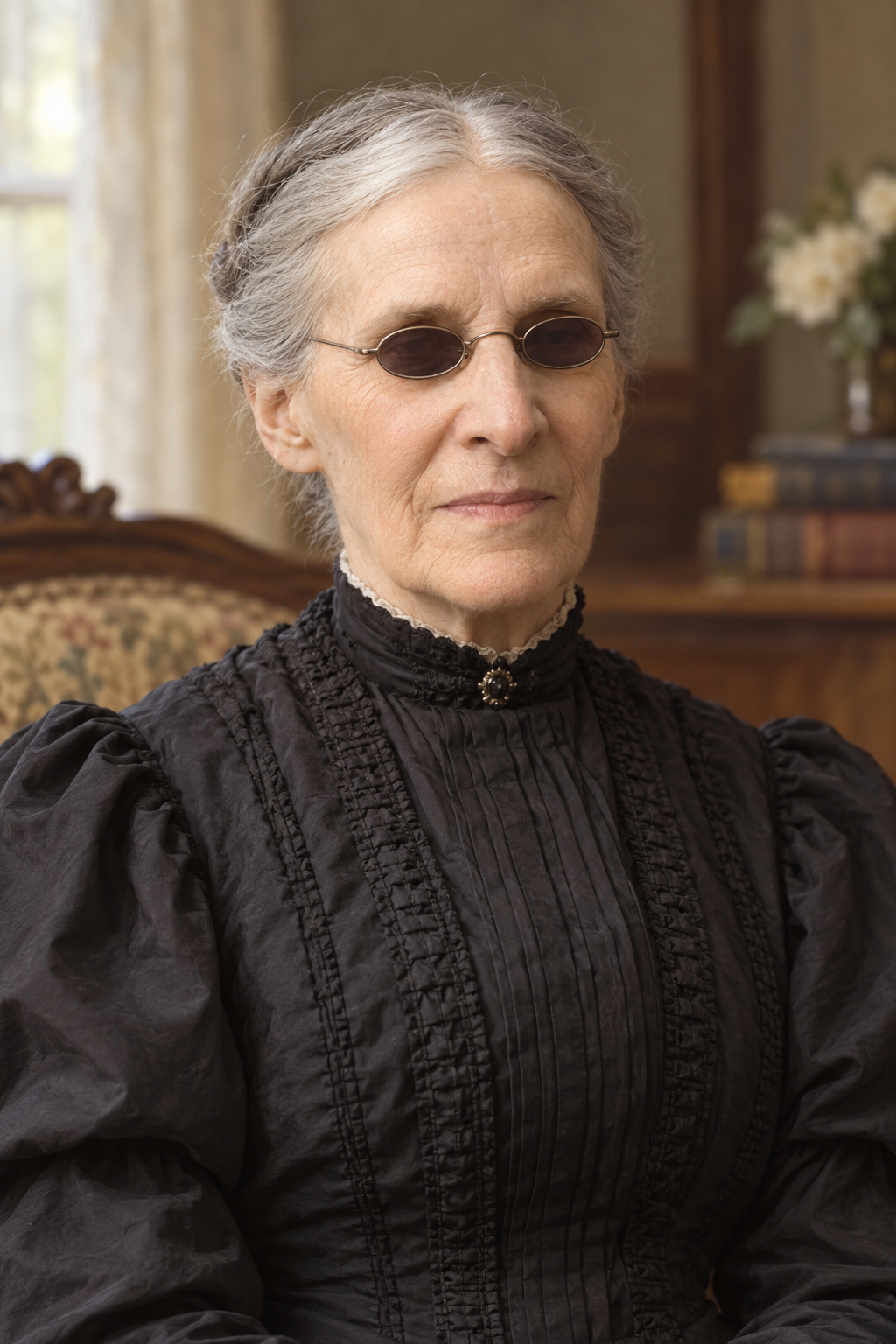
About Fanny Crosby
Frances Jane Crosby was born on March 24, 1820, in Southeast, Putnam County, New York. Known as Fanny, she became a teacher, poet and writer of gospel hymns. She entered the New York Institution for the Blind at fifteen and later taught there. Her subjects included grammar, rhetoric, Roman history and American history. Before the hymns that made her famous, she wrote secular songs with the composer George F. Root. These collaborations belonged to a working musical career that began well before her association with religious publishers. Her collaboration with Root also produced The Flower Queen, a cantata published in 1852 in New York by Mason Brothers, with his music for female voices and her words.
Blind from infancy, Crosby received an education that cultivated both literature and music. In her memoir she recalled enjoying English, history and philosophy, while finding arithmetic much harder. Lessons used movable types arranged in a wooden frame. She remembered being excused from further mathematics and taking another subject instead. Singing lessons were a particular pleasure, and she credited her teacher Anthony Reiff with a lasting influence. Her account describes particular teachers and methods that helped her learn, rather than an education achieved without support.
Her first collection, The Blind Girl and Other Poems, appeared in 1844. Raised in a Presbyterian setting, she joined the 30th Street Methodist Episcopal Church in 1851 and became a friend of Phoebe Palmer. In 1858 she married Alexander van Alstyne, a blind composer, while continuing to publish under her maiden name. During the following decade, her hymns began appearing in books used by different denominations. Her career thus crossed institutional boundaries even while she retained a Methodist identity.
Crosby began supplying Sunday-school hymns to William B. Bradbury in 1864. The work became a sustained occupation, followed by a long association with Biglow and Main. Hall’s 1914 account describes her regular visits to the publisher’s office and the many composers who sought her words. She also published under numerous pen names, including Grace J. Frances and Lizzie Edwards. The familiar name on a hymnbook page therefore represents only part of a much larger body of work.
Her own description makes the craft behind that output clear. Bradbury sometimes supplied a title or an existing melody, while at other times she chose the subject; she also revised other authors’ poems. Crosby recalled composing forty texts for Philip Phillips before dictating them to an amanuensis. She presented the episode as an example of trained memory. She also valued Hubert P. Main’s criticism and Robert Lowry’s ability to detect faults in poetic meter. Her writing involved revision and collaboration as well as speed. Her memoir itself was a collaborative undertaking. She acknowledged H. Adelbert White’s help in compiling, copying and arranging it, alongside assistance from relatives, friends and fellow musicians.
The marriage brought grief as well as companionship. Their only child died in infancy, and Crosby and her husband eventually lived apart. Although widely known, she often had little money; publishers paid poorly for hymn texts. Her religious life included contact with Baptist and Presbyterian congregations as well as her Methodist church. The songs and the practical concerns of urban mission work developed within this broad network of Christian relationships. Crosby and Phoebe Palmer helped promote rescue missions, a movement in America and other countries that crossed denominational boundaries and offered assistance to people in poverty, including migrants in growing cities.
Mission work became central to her later life. The Bowery Mission remembers her as a frequent visitor there and at the McAuley Water Street Mission. She addressed gatherings but also sat among the guests and spent time with them. The institution describes this service as unpaid and without an official appointment. She sought to offer people facing poverty an assurance that they were worth listening to and helping. Her contribution depended on conversation and presence, not simply on the circulation of her songs. Around 1880 she moved into a rundown flat at 9 Frankfort Street on Manhattan’s Lower East Side. Jerry McAuley’s account of his conversion drew her interest, and she visited his Water Street Mission.
Crosby moved to Bridgeport, Connecticut, in 1907 to care for a sick friend. Her concern for people without secure homes continued: her will included funds for a home for homeless men. Further local fundraising helped establish the Fanny Crosby Memorial Home for the Aged, which operated from 1925 until 1966, when it merged into the Bridgeport Rescue Mission.
She died on February 12, 1915. Her hymns remained part of congregational worship beyond her lifetime. Among the enduring examples identified by Bridwell Library are Blessed Assurance, written in 1873, and To God Be the Glory, published in 1875. Their continued use places her work within the shared musical life of churches that differ in doctrine and organization.
Wondering how to weigh the stories and sources? Learn how to read a saint biography.