Biography
Frances of Rome
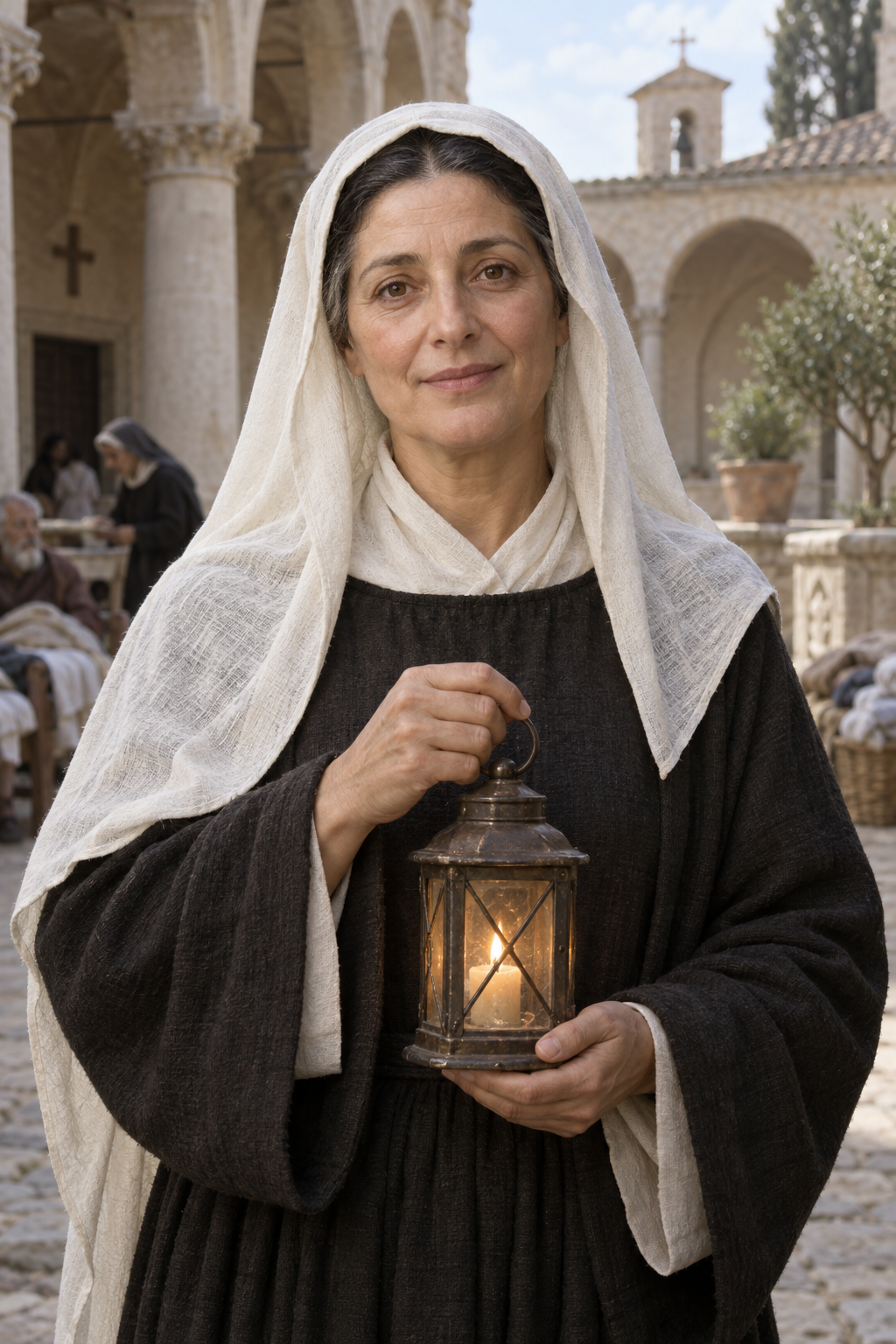
About Frances of Rome
Frances of Rome raised a family before joining the women's community she had helped to establish. Born in Rome in 1384, she was the daughter of Paolo Bussa and Iacobella Roffredeschi, whose home was in the Parione district. Marriage to Lorenzo Ponziani took her across the Tiber to Trastevere. Their children included Battista, Evangelista, and Agnese; the two younger children died before their mother. Her later reputation as a religious founder belonged to a life already shaped by marriage, the care of children, and bereavement.
Political violence brought further losses to the Ponziani household. During the occupation of Rome by forces from Naples between 1408 and 1414, their allegiance exposed them to reprisals. Lorenzo suffered a serious wound that affected his later life, and Battista was taken hostage. The family palace was plundered and its property confiscated before being restored. Frances nevertheless continued helping patients at Roman hospitals and receiving people who sought assistance at her home. During famine she distributed supplies from the household's grain stores and cellars, placing family resources at the service of hungry neighbours.
Her religious life also included sustained contemplation. The Catholic Encyclopedia recounts her practice of continence with her husband's agreement and describes the visions associated with her name. Among these traditions are stories of a visible guardian angel and revelations concerning purgatory and hell, attributed to Frances rather than established as ordinary events. Her confessor Giovanni Mattiotti recorded accounts of visions, and the stories later became an important part of her reputation. The same biographical tradition remembers her practical intervention during disease and famine, bringing together inward devotion and work among suffering people.
The evidence assembled by historian Arnold Esch gives that service a particularly concrete shape. Frances cleaned wounds and used ointments, visited hospitals, and offered reassurance to people in distress. Her willingness to beg publicly for others could embarrass relatives conscious of the family's standing. Women formed a large part of the testimony gathered after her death, recording encounters with someone who listened, intervened, and helped. These witnesses also remembered her efforts to reconcile people in a city divided by factions. The household was therefore not simply the setting she left behind: it supplied resources, relationships, and demanding responsibilities within which much of her charitable work developed.
A shared religious commitment gradually gave her companions a more lasting connection. On the feast of the Assumption in 1425, Frances and nine women made their offering at Santa Maria Nova in Rome. They drew inspiration from the Rule of Benedict while developing a form of dedication suited to their circumstances. Leo XIV recalled this beginning in his message for the community's six-hundredth anniversary, identifying both prayer and charity as central to its inheritance.
The women first continued living at home; eight years later, in 1433, a group began common life at Tor de' Specchi. Their arrangement did not simply reproduce the enclosed convents already familiar in medieval Rome. Alessandra Bartolomei Romagnoli describes a community in which women retained space for mutual support, work, and charitable contact beyond the house. Its spiritual oversight involved three procurators: an Olivetan monk, a Franciscan friar, and a secular priest. Drawing support from different religious circles helped preserve the community's particular character. The women worked to sustain their common life and assist people in need, rather than separating religious observance from all everyday labour.
Frances remained with her husband until his death in 1436. She then entered the community herself and became its superior. Her own years in the house were comparatively few: she died in Rome on 9 March 1440.
Later remembrance kept the city and its vulnerable inhabitants close to her story. Visiting the oblates in 1984, John Paul II recalled her care for poor, sick, and oppressed Romans amid painful divisions. He linked her active charity with the contemplative life that continued at Tor de' Specchi. His address also distinguished her example from the later history of the community, whose forms of service changed across the centuries. The connection between family responsibilities, prayer, and practical assistance remained an important part of how the oblates understood their founder.
The monastery preserves another form of remembrance in its painted narrative of her life. Its fifteenth-century frescoes have captions in the Roman vernacular, connecting the scenes with the language of the city around them. The final scene bears the year 1468, after Frances's death. Rome's municipal description attributes the cycle to an unidentified painter, possibly connected with Antoniazzo Romano's workshop. These images are evidence of how her community told her story, as well as a record of the places and daily activities that a later generation associated with her.
Frances was canonized on 29 May 1608. Benedict XVI recalled that date when visiting Tor de' Specchi in 2009, describing her life through its successive responsibilities as wife, mother, widow, and religious woman. Her enduring significance lies in that connection: care within a household and service beyond it became part of the same religious commitment, eventually sustaining a community that outlived her.
Wondering how to weigh the stories and sources? Learn how to read a saint biography.
Prayers for Frances of Rome
Frances of Rome: sourced prayer excerpt
Tenuisti manum dexteram meam