Biography
Francisca de Paula de Jesus
About Francisca de Paula de Jesus
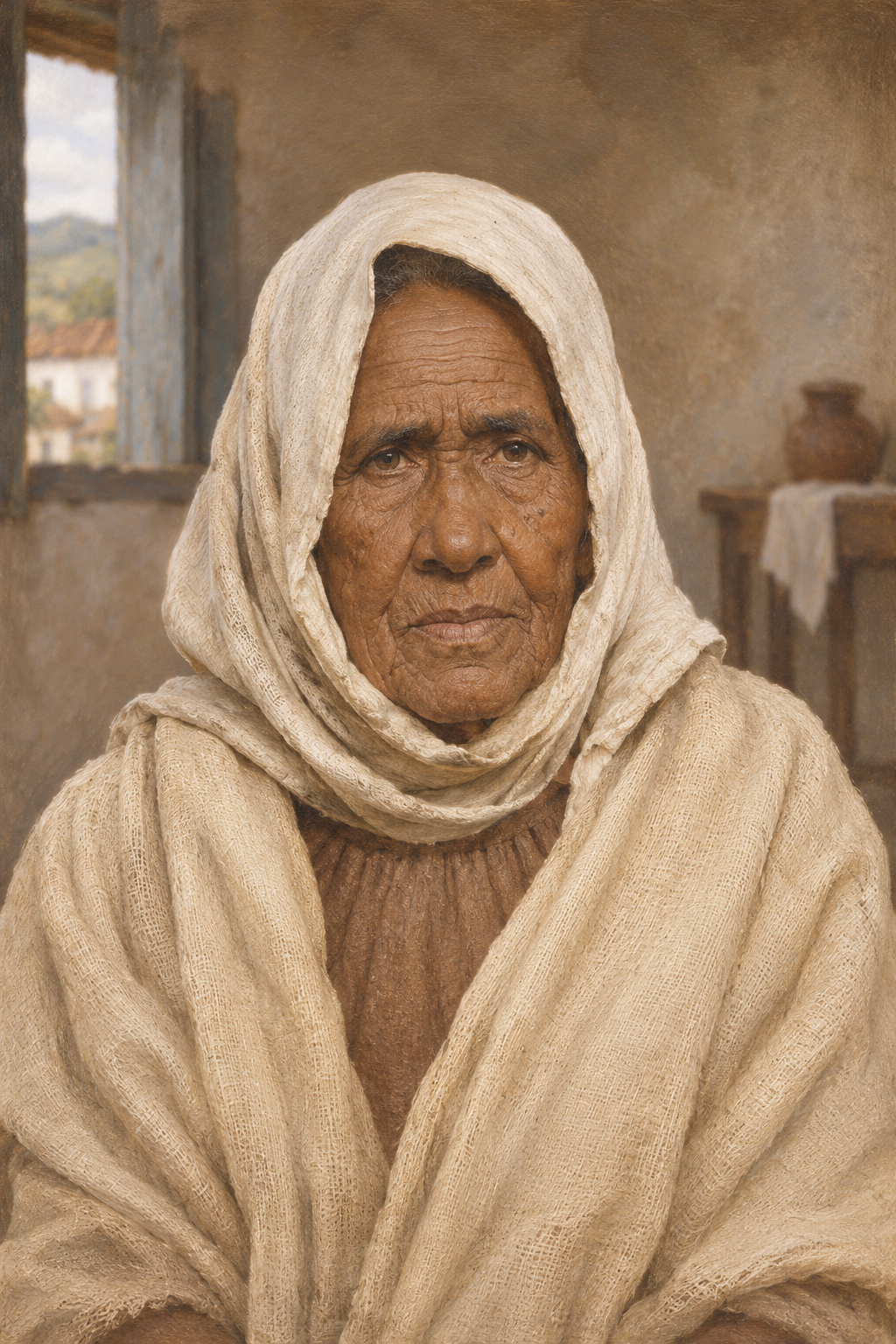
Francisca de Paula de Jesus, remembered as Nhá Chica, made her home in Baependi a place where people sought prayer, advice and practical help. She was a Black Brazilian laywoman whose family history reached back through slavery. Historical research places her birth in 1808 in Santo Antônio do Rio das Mortes, in the São João del-Rei district of Minas Gerais. The nickname by which she became known is an affectionate shortening of Senhora Francisca. Her lasting influence grew within the relationships and religious life of nineteenth-century Baependi.
Her early history needs care. Some devotional accounts describe her as enslaved and orphaned in childhood, but the surviving records produce a more complicated picture. Historian Paula Anunciação notes evidence that her mother had already obtained freedom before Francisca’s birth. The family later acquired property and social connections in Baependi. Those findings qualify the familiar image of an isolated woman without resources, while leaving her African ancestry and descent from enslaved women central to her story.
The baptism entry transcribed in the historical study records Francisca’s baptism on 26 April 1810 at the chapel of Santo Antônio do Rio das Mortes Pequeno. It names her mother as Izabel Maria and identifies two godparents. The baptism date is sometimes confused with her birth year. A separate death entry records Izabel’s death in Baependi on 1 November 1843. That document places Francisca’s bereavement in adulthood, rather than during the childhood described by many later biographies.
Her brother’s inheritance increased the resources available for her work. The contemporary visitor Henrique Monat remembered a small fortune that she devoted to building a church beside her home. His account places the chapel within her own lifetime, rather than presenting it only through later devotional recollection. Prayer and practical decisions about money came together in this undertaking. The building became a place where people sought her out, and where the resources received from others took a visible and lasting form.
A visitor near the end of her life, physician Henrique Monat, recorded the reputation she already enjoyed in southern Minas Gerais. In excerpts of his 1894 account, people came to her for counsel and the promise of prayer. He also noticed the church’s care and the gifts that supported it. His description remembers Francisca acknowledging benefactors, including the Viscount of Cruzeiro. The chapel was therefore connected to a wider network of donors and visitors, even though she herself remained its distinctive center of welcome and devotion.
The surviving baptism record later became central to a public act of remembrance in her birthplace. Francisco José dos Santos Braga described the ceremony on 30 April 2011 at which a court-ordered civil birth registration was entered. He participated as a musician and recorded the reading of the judicial order, the signing of the register and its display near the baptismal font. The occasion joined civic documentation with religious memory, while also showing why later historians must distinguish the baptism date from a securely established birthday.
She died in Baependi on 14 June 1895 and was buried in the chapel associated with her life. The institution that preserves her memory records the burial on 18 June. Its history also describes the church’s later care by the Franciscan Sisters of the Lord from 1954 and the development of assistance for children beside it. These later works gave her memory a continuing material setting: the chapel remained a place of prayer, while service to children carried forward its association with practical help.
When Brazilian bishops prepared for her beatification, they emphasized listening and counsel as well as help for people in poverty. Their signed 2013 statement described a lay life of prayer and service and recalled her popular recognition as a mother to poor people. Its emphasis placed ordinary availability at the center of her example: receiving visitors, attending to suffering and offering consolation. Her influence was remembered through such personal encounters rather than through the foundation of a religious order or the holding of an ecclesiastical office.
Nhá Chica was beatified in Baependi on 4 May 2013. Pope Francis’s apostolic letter authorized her designation as blessed and the annual observance of her feast on 14 June in the places and manner permitted by church law. The letter honors her prayer and care for people in material and spiritual need. Her recognition thus preserves a laywoman’s place in the church’s public memory, while historical records continue to help readers distinguish the woman’s life from details added or simplified in later retelling.
The public celebration also drew attention beyond the church. The Legislative Assembly of Minas Gerais reported participation by state and national representatives and choirs from Baependi, São Lourenço, Caxambu and Lambari. Cardinal Angelo Amato presided as the pope’s representative, alongside the bishop of Campanha. The gathering joined neighboring communities in honoring a woman whose local reputation had endured long after her death. Its regional character reflected the continuing connection between her memory and the towns of southern Minas Gerais.
Wondering how to weigh the stories and sources? Learn how to read a saint biography.