Biography
Francisco Marto
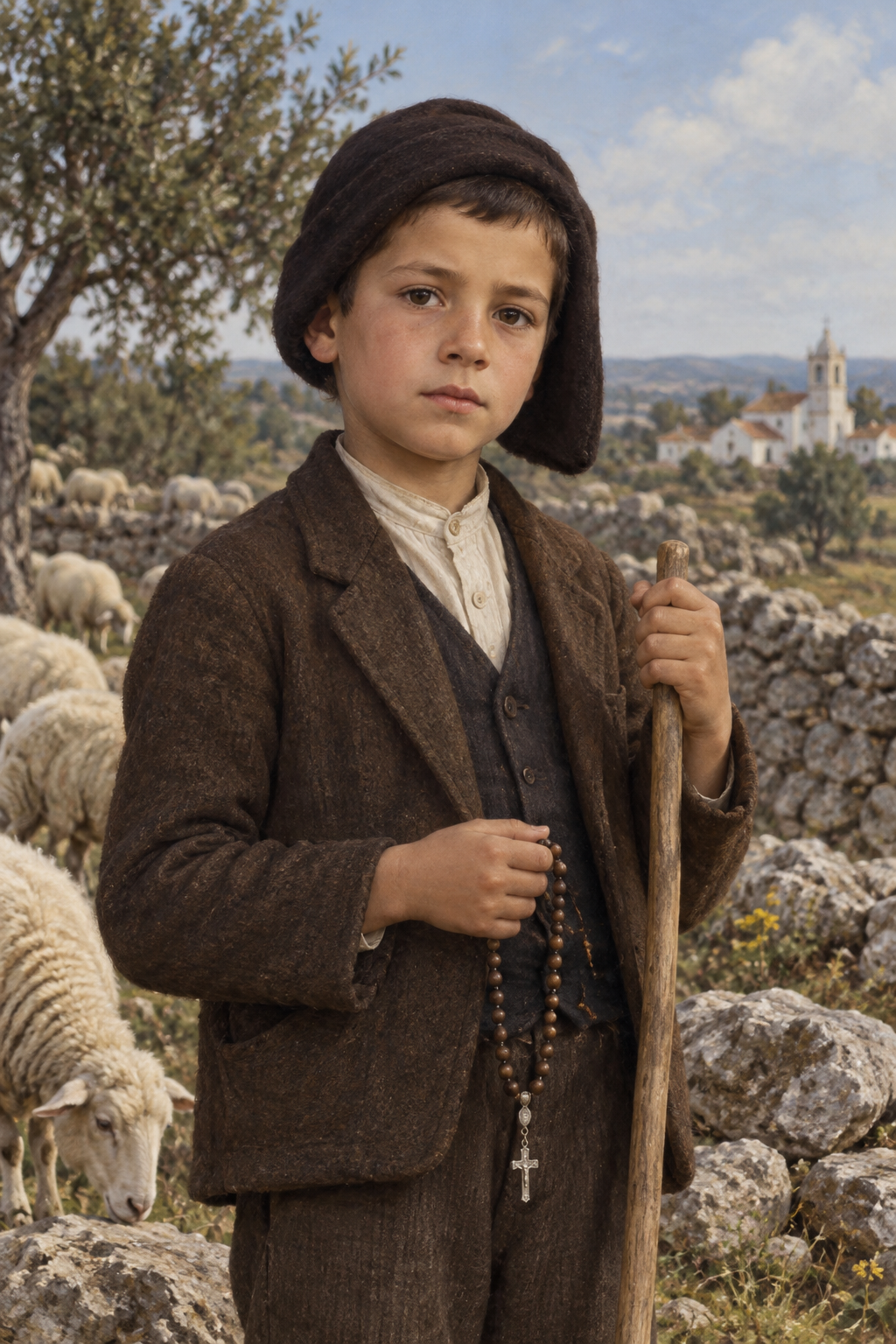
About Francisco Marto
Francisco Marto was born on 11 June 1908 at Aljustrel, near Fátima, Portugal. He was the older brother of Jacinta Marto and one of the three children named in the Catholic account of the events at the Cova da Iria in 1917. The official profile presents him within his family and village setting, not as an isolated religious figure. He was a shepherding child whose life included ordinary work, family obligations, and the religious culture of rural Portugal. [FJ1]
In 1917 Francisco, Jacinta, and their cousin Lúcia reported a series of Marian encounters at Fátima. A responsible catalog entry must identify this as the content of their testimony and of the Church's later recognition, not as an independently demonstrated historical description of supernatural events. The three children were questioned, observed, and remembered together, but their personal responses were not identical. [FJ1]
The official account describes Francisco as especially drawn to prayer and contemplation. He did not receive the same emphasis as Jacinta in accounts of the suffering of others, and the final biography should avoid flattening the children into one composite personality. His distinct witness was expressed in silence, prayer, and a desire to be close to God. Those are devotional interpretations in the official narrative and should be cited as such. [FJ1]
After the events at Fátima, Francisco continued living with his family while his health deteriorated. He became ill during the influenza pandemic and was treated in hospital. The causes profile records his death on 4 April 1919 at Aljustrel, before he reached ten years of age. The illness and death should be recorded as historical events separately from the later beatification and canonization. [FJ1]
Francisco and Jacinta were beatified in 2000 and canonized on 13 May 2017. The shared recognition reflects their common place in the Fátima history, while the catalog must retain separate dates, places, names, and biographies. Francisco's feast observance and the exact status fields should be taken from the current official calendar rather than inferred from the canonization ceremony. [FJ1]
Francisco's place in the Fátima account should be described with attention to age and circumstance. He was a child living in a rural community, not a trained theologian or public religious leader. The source's description of his prayer and contemplation belongs to the later ecclesial interpretation of his life, while the historical record also includes family life, shepherding, illness, questioning, and hospitalization. Keeping those layers together makes the profile more truthful and avoids assigning adult motives to a child. [FJ1]
The three children were remembered together because their testimonies concerned the same 1917 setting, but their experiences were not interchangeable. Francisco was described as less interested in speaking and more drawn to prayer. That distinction should not be turned into a psychological diagnosis. It is enough to report the pattern preserved in the official account and to link it to the claims about his later devotional life. [FJ1]
Francisco's illness changed the scale of his world. The child who had been part of a village and family routine spent his final period under medical care. The record of hospitalization should not be used to romanticize suffering or to suggest that illness itself made him holy. The relevant claim is that he endured illness, continued the religious practices described by the source, and died at Aljustrel in 1919. [FJ1]
The Church's later recognition of Francisco and Jacinta together creates a cataloging challenge. A shared feast or canonization act does not justify sharing the same birth, death, event, or artwork records. Francisco's separate record should carry his own name forms, dates, place labels, and claims, while a relationship row may identify Jacinta as his sister and the shared Fátima context as a related event. [FJ1]
Francisco's significance is therefore not exhausted by the supernatural claims associated with Fátima. He is also remembered as a child whose short life was shaped by family, rural work, illness, and prayer. The final profile can state the Church's recognition of his witness while leaving disputed details and unverified quotations empty. [FJ1]
The official cause material also makes it possible to describe Francisco's response without assigning him an adult role. He remained within the family and village setting while the events at Fátima became known more widely. His prayer and desire for solitude are presented as features of his response, not as evidence that he withdrew from every ordinary responsibility. The profile should preserve that balance: he was a child whose life included family, illness, and religious attention, not a symbolic figure detached from age and circumstance. [FJ1]
His illness is recorded as part of the final period of his life. A responsible account gives the hospitalization and death dates supported by the source but does not speculate about medical details that the cause profile does not state. The supported claim is that Francisco continued his brief life after the 1917 events, became ill, was hospitalized, and died in 1919. [FJ1]
Wondering how to weigh the stories and sources? Learn how to read a saint biography.