Biography
Frederick Douglass
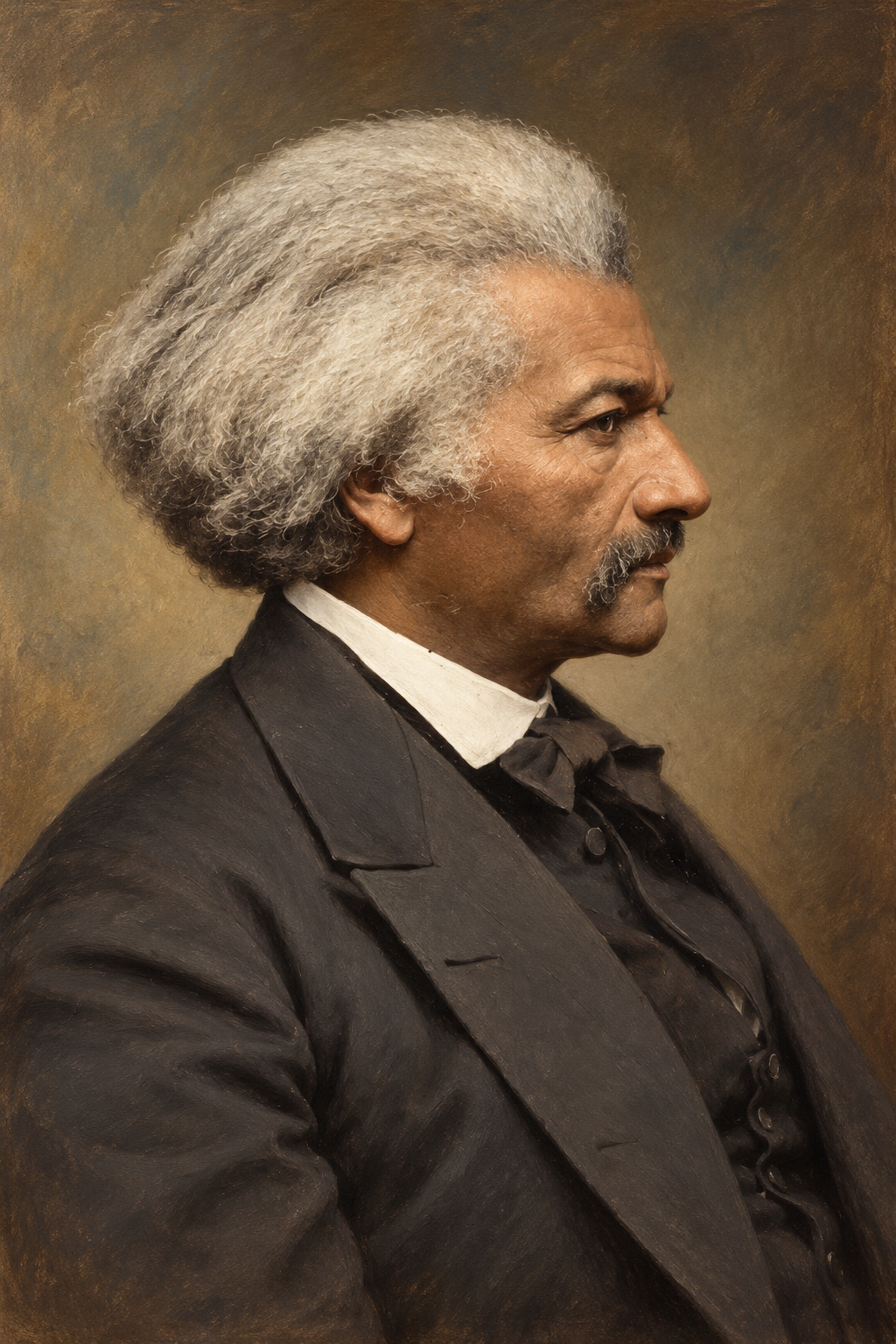
About Frederick Douglass
Frederick Douglass escaped slavery and became a writer, newspaper editor, and public advocate for freedom.
Born in Maryland, he spent part of his childhood in Baltimore, where Sophia Auld began teaching him to read. Enslavement separated him from his mother, whom he barely knew before her death. He never knew his father. As a boy, he learned to read and write outside formal schooling and obtained The Columbian Orator, a collection of speeches and debates about rights. Later, when forced into field labor on Maryland’s Eastern Shore, he taught other enslaved people. An unsuccessful escape attempt preceded his return to Baltimore, where Anna Murray helped him obtain the train ticket for his successful journey north.
He escaped to New York in 1838, disguised as a sailor, and married Anna Murray, a free Black woman. They settled in New Bedford, Massachusetts. An invitation to address the Massachusetts Anti-Slavery Society in 1841 opened a new career as a lecturer. His account of enslavement reached a wider audience through his first autobiography, published in 1845.
The book also explained the distinction at the heart of his religious criticism. In its appendix, Douglass rejected the assumption that his attacks on churches meant hostility to all religion. He affirmed his commitment to the Christianity of Christ while condemning the religion practiced by people who enslaved others. He described the contradiction between preaching family fidelity and separating families through sale, or urging people to read Scripture while preventing them from learning to read. Religious activity could conceal violence rather than restrain it. His indictment included northern churches that maintained fellowship with slaveholders, as well as southern congregations. For Douglass, elaborate worship and charitable concern for people overseas could not excuse cruelty toward neighbors. He presented this criticism as testimony he was obliged to give, and closed the book by renewing his commitment to ending slavery.
Publishing became another way to undertake that work. In the first issue of The North Star, dated December 3, 1847, Douglass explained why people directly subjected to oppression needed a newspaper under their own control. He valued white abolitionists’ efforts, but argued that their work could not replace the voices of those who had suffered enslavement. He envisioned cooperation, with Black authors and editors speaking for themselves. The editorial also recorded the practical beginnings of the venture: a purchased press, an office, prospective printers, subscriptions, and contributors. Friends in Britain had helped purchase his legal freedom and supplied money for printing equipment. He acknowledged the difficulties and the failure of earlier ventures, but described the undertaking as a responsibility to God and humanity.
His July 5, 1852, oration challenged the nation’s celebration of independence. Douglass honored the revolutionary struggle for liberty while asking what that anniversary meant to people still enslaved. He insisted that their humanity and right to freedom did not need further proof. He also confronted churches that supported the Fugitive Slave Law or remained silent about its consequences. In his argument, religion required sheltering vulnerable people and acting with mercy; ceremonies could not substitute for those duties. He named antislavery clergy as exceptions to his condemnation. The speech also set out his reading of the Constitution as a document that could serve freedom, rather than conceding that it necessarily protected slavery. His criticism called Americans to confront the distance between their professed principles and their conduct.
During the Civil War, Douglass urged that emancipation become an explicit aim of the conflict. He helped recruit Black men for the Massachusetts infantry regiments, including his sons Lewis and Charles. Afterward, his public service included appointments as United States marshal for the District of Columbia and minister to Haiti.
One undertaking ended in failure. The Freedman’s Bank had made risky investments and loans under trustees whose interests were sometimes entangled with other banks. The financial panic of 1873 further weakened it, while congressional supervision had been inadequate. Its trustees turned to Douglass to replace president John Alvord. He accepted without understanding how serious the bank’s condition had become. Once he examined the situation, he concluded that it could not be saved. Six weeks after taking office, he urged Congress to close it. The bank shut in June 1874. This episode places limits on a story told only through his achievements: his public reputation could not repair an institution already damaged by mismanagement.
Douglass continued speaking for racial equality and women’s rights in his later years. He published his third autobiography in 1881. Anna died in 1882, and he married Helen Pitts in 1884. Their interracial marriage provoked controversy. On February 20, 1895, he attended a National Council of Women meeting in Washington. He died later that day at his home, Cedar Hill, while preparing for another speaking engagement.
The Episcopal Church commemorates Douglass on February 20 as a social reformer. Its 2022 General Convention gave final authorization to his place in the calendar.
Wondering how to weigh the stories and sources? Learn how to read a saint biography.