Biography
Gemma Galgani
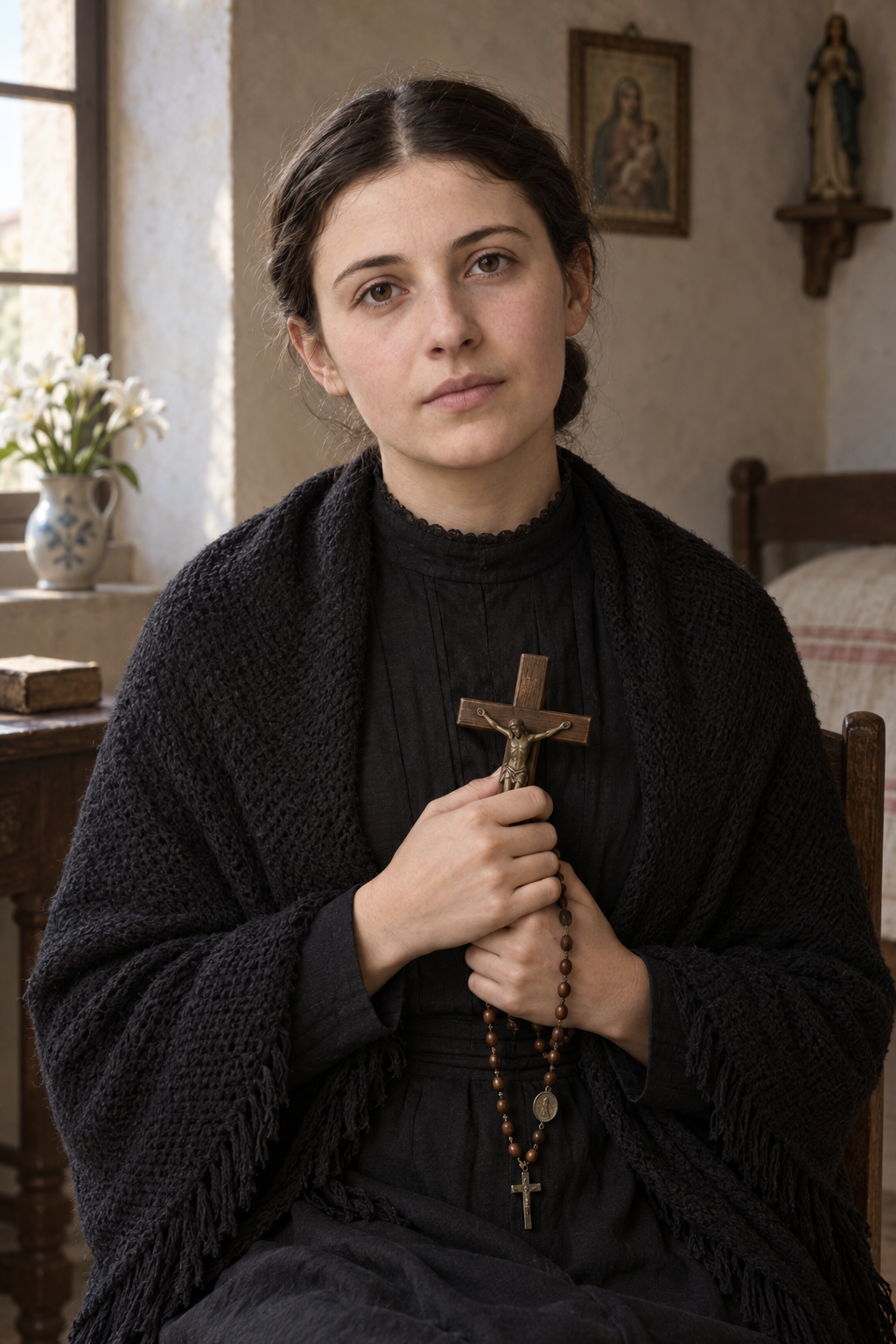
About Gemma Galgani
Gemma Galgani was born on 12 March 1878 at Borgonuovo di Camigliano, a village in the municipality of Capannori near Lucca, the daughter of Enrico Galgani and Aurelia Landi. Some months after her birth the family moved into Lucca itself, where her father ran a pharmacy.
She was the fifth of eight children. The Dizionario Biografico degli Italiani notes that her paternal grandfather had been a physician and that her mother's family counted Blessed Giovanni Leonardi among its forebears. Her devout mother shaped her earliest religious formation.
Childhood brought early loss. Her mother died of tuberculosis while Gemma was still a small girl, and in 1894 her older brother Gino, a seminarian, died at the age of eighteen.
She was confirmed on 26 May 1885 in the church of San Michele in Foro and received her first communion on 17 June 1887. From 1889 to 1893 she attended the school of the Zitine sisters, an institute directed by Elena Guerra, who was herself later beatified.
In November 1897 her father died of throat cancer, and the family's affairs collapsed. According to the Passionist account, creditors took the pharmacy and the house, and Gemma helped to support the household with sewing work. Vatican News adds that for a time she was taken in by an aunt.
In 1898 and 1899 she was gravely ill. Vatican News describes osteitis of the lumbar vertebrae and a mastoid ear infection that kept her in bed, partly paralysed, for several months, and the Passionist account records that she received the last rites.
Her recovery in early 1899 was received as a grace. The accounts differ in emphasis: Vatican News connects it with a novena to St Margaret Mary Alacoque made after she had read a life of the young Passionist Gabriel of Our Lady of Sorrows, while the Dizionario Biografico reports that, by her own account, Gabriel appeared to her and that prayer to the Sacred Heart accompanied the cure.
She had taken a private vow of chastity and hoped to enter a convent. In May 1899 she made a retreat with the Visitation nuns but was not admitted to their novitiate, because of her health and the lack of a dowry. Her hope of joining the Passionist nuns at Corneto, then the only such monastery in Italy, also came to nothing, and she was never professed as a nun.
On 8 June 1899, the eve of the feast of the Sacred Heart, Gemma reported that during an ecstasy Christ had marked her hands, feet and heart with his wounds. In the accounts left by her and her directors, the marks recurred from Thursday evening to Friday afternoon for about two years and then ceased.
These claims met caution. Her confessor, Monsignor Giovanni Volpi, auxiliary bishop of Lucca, remained reserved and arranged a medical examination that found nothing abnormal, and the Dizionario Biografico stresses the scepticism of many people in Lucca.
In the summer of 1899 she came to know the Passionist fathers preaching a mission in Lucca, and through them the Giannini family. From September 1900 until her death she lived in the household of Matteo Giannini and his sister Cecilia, supporters of the Passionists. The diocese records that there she was said to relive the sorrows of the Passion each week.
In January 1900 she wrote, without any prior acquaintance, to Father Germano of St Stanislaus (Germano Ruoppolo), a Passionist priest and scholar in Rome who had written the life of Gabriel. At Volpi's invitation he came to Lucca in September 1900 to examine her. Cautious at first, he became her spiritual director and defended the authenticity of her experiences.
Their correspondence, in which she called him her "babbo", and the autobiographical pages she wrote under obedience became the main record of her inner life. As she described them, these included frequent ecstasies, familiar conversations with her guardian angel, and troubles she attributed to the devil.
Tuberculosis was diagnosed in May 1902. She spent her final period in an apartment in Via della Rosa in Lucca, where, the archdiocese notes, she endured both bodily pain and spiritual darkness.
She died there on Holy Saturday, 11 April 1903, at the age of twenty-five.
In 1907 Father Germano published her life. The Dizionario Biografico reports that some 52,000 copies were printed within about six years and that the book became a principal source for her cause, whose informative process opened in Lucca that same year amid considerable local doubt.
A monastery of Passionist nuns was later established in Lucca, a foundation she was said to have foretold. In 1923 her remains were moved there from the cemetery, and the sanctuary beside the monastery remains a place of pilgrimage.
Pius XI declared her venerable in 1931 and beatified her on 14 May 1933. Pius XII canonized her on 2 May 1940, in the same celebration as Mary Euphrasia Pelletier.
The Church's own summaries dwell on her contemplative love for the Crucified Christ. In a 1990 letter to the Passionist Superior General, John Paul II wrote that she shared in the Passion in a mystical and singular way, burned with love for the Crucified, and offered herself for the conversion of sinners.
Historians have read her life differently. The Dizionario Biografico places her within a pattern of contemplative female holiness, distinct from the active charitable and teaching vocations prominent in her century, in which chronic illness came to be understood as election and expiatory suffering.
Vatican News styles her a virgin of Lucca and a Passionist tertiary, and her feast is kept on 11 April. She remains closely bound to Passionist spirituality, though she never wore its habit.
Wondering how to weigh the stories and sources? Learn how to read a saint biography.