Biography
Gideon
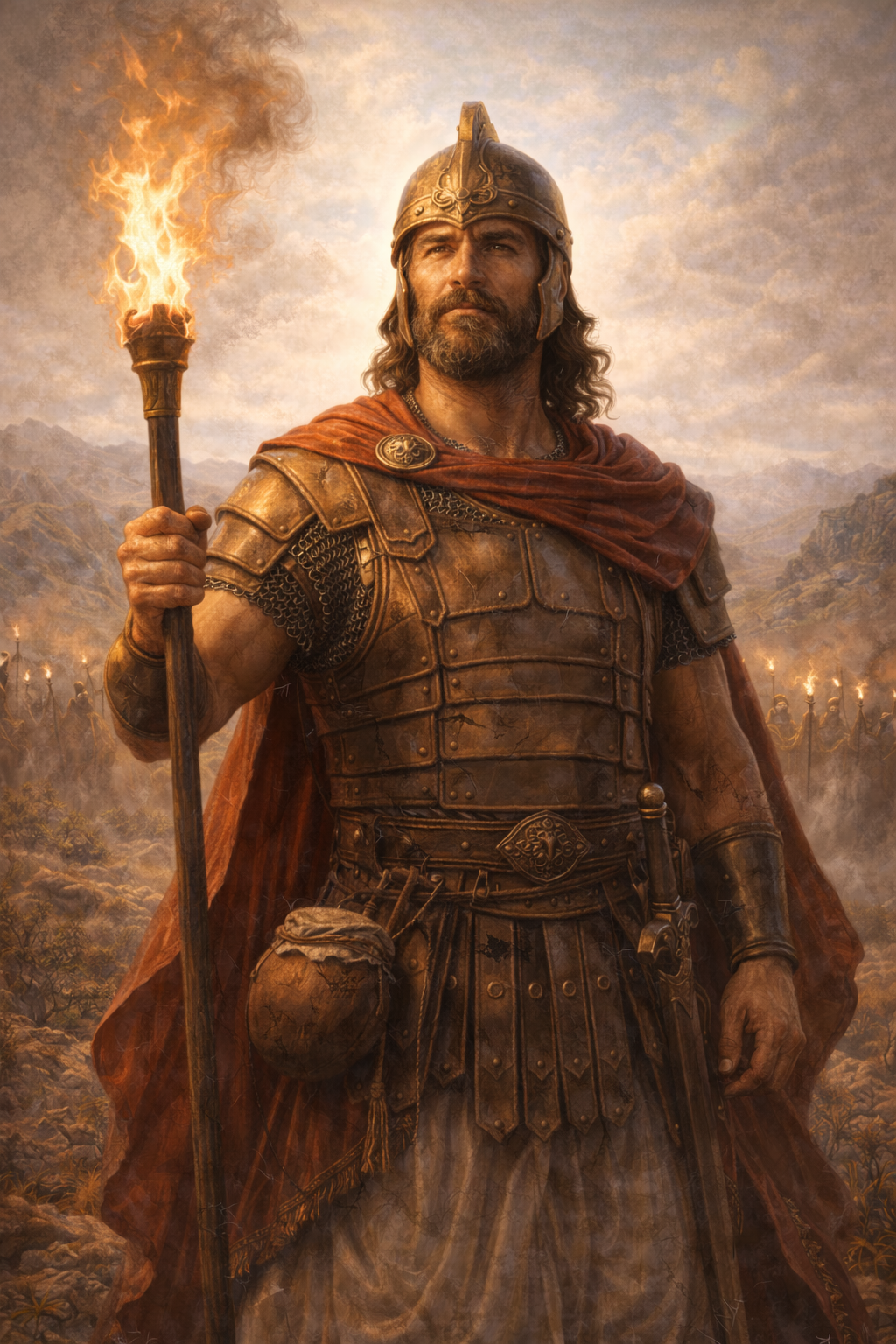
About Gideon
Gideon appears in Judges 6–8, within an ancient collection of stories about leaders who delivered Israel from danger before the monarchy. The book’s introduction explains that these accounts reached their present form through older written or oral traditions shaped by a Deuteronomistic historian. No contemporary record securely dates Gideon’s life. The catalog therefore treats the narrative as traditional sacred history and does not convert its internal periods into a birth or death year.
Judges opens Gideon’s story during seven years of Midianite domination. Raiders repeatedly destroy crops and livestock, leaving Israel impoverished. The narrative finds Gideon beating out wheat in a winepress at Ophrah to conceal it. A messenger addresses him as a mighty warrior and commissions him to save Israel. Gideon answers with a question about suffering and with an objection that his family is poor in Manasseh and he is insignificant within it. The exchange presents reluctance and reassurance, not effortless confidence.
Gideon asks for a sign and prepares an offering, which fire consumes when the messenger touches it. After receiving words of peace, he builds an altar called Yahweh-shalom. That night he dismantles his father’s altar to Baal and cuts down the adjoining asherah. Judges explicitly says he acts at night because he fears his family and the townspeople. His father Joash refuses the crowd’s demand for Gideon’s death, and Gideon receives the name Jerubbaal, explained as a challenge for Baal to contend for himself.
When Midian and its allies assemble in the Jezreel Valley, Judges says Gideon is clothed with the spirit of the Lord and summons fighters from several tribes. He nevertheless asks twice for confirmation through a fleece, first seeking dew only on the fleece and then dryness only on it. The story preserves both his willingness to act and his repeated uncertainty. Later Christian teaching cites Gideon as one of the judges empowered by the Spirit, while Hebrews includes his name in a compressed list of figures associated with faith.
Judges 7 reduces Gideon’s force in stages so that Israel cannot claim victory by its own strength. Gideon is also permitted to hear a Midianite recount a dream interpreted as Israelite victory. He divides three hundred men into companies carrying horns, jars, and torches. At his signal they break the jars, reveal the lights, sound the horns, and shout. The account says panic spreads through the camp and the Midianites turn their swords against one another before fleeing. These numbers and details belong to the biblical narrative, not to a independently verified battle report.
The pursuit exposes conflict within Israel as well as against Midian. Gideon answers the angry Ephraimites with a comparison that calms them, an episode that supports a specific example of restraint. His conduct toward Succoth and Penuel is much harsher: after their leaders refuse provisions, he returns, punishes Succoth’s elders, destroys Penuel’s tower, and kills men of that city. A careful account cannot turn the entire campaign into uncomplicated heroism or present every violent act as a timeless model.
Gideon captures Zebah and Zalmunna and questions them about men killed at Tabor, whom he identifies as his brothers. He first tells his young son Jether to execute the kings; when the boy is afraid, Gideon kills them himself. The passage frames the act as family vengeance. It gives place-names along the pursuit, but their sequence does not justify drawing a precise modern route. This packet keeps map entries at settlement or regional precision and supplies no coordinates.
After the victory, Israelites ask Gideon and his descendants to rule them. He refuses a hereditary dynasty and says that the Lord must rule. Yet the chapter immediately complicates that refusal. Gideon requests gold earrings from the plunder, fashions an ephod, and places it in Ophrah. Judges says the object becomes a snare to Gideon and his household. The juxtaposition allows no simple claim that he consistently rejected status, wealth, or religious danger.
Judges reports that Midian was subdued and that the land rested during Gideon’s lifetime. It also says that he had many wives, seventy sons, and a son named Abimelech by a concubine in Shechem. Gideon dies at a good old age and is buried in his father Joash’s tomb at Ophrah. The text gives no age at death or calendar date. Afterward Israel returns to Baal worship, and the following chapter turns Abimelech’s ambition into a cautionary continuation of Gideon’s family story.
Christian reception remembers Gideon among the Old Testament judges. The Orthodox Church in America names him among the best-known leaders in its account of Old Testament history. John Paul II likewise used Gideon as an example of divine empowerment entrusted to frail human agents. Such reception documents why Gideon remains important without erasing the narrative’s moral tensions. His story joins questioning, courage, tactical leadership, restraint, vengeance, and a damaging religious legacy in one deliberately complex portrait.
Wondering how to weigh the stories and sources? Learn how to read a saint biography.