Biography
Giuseppe Moscati
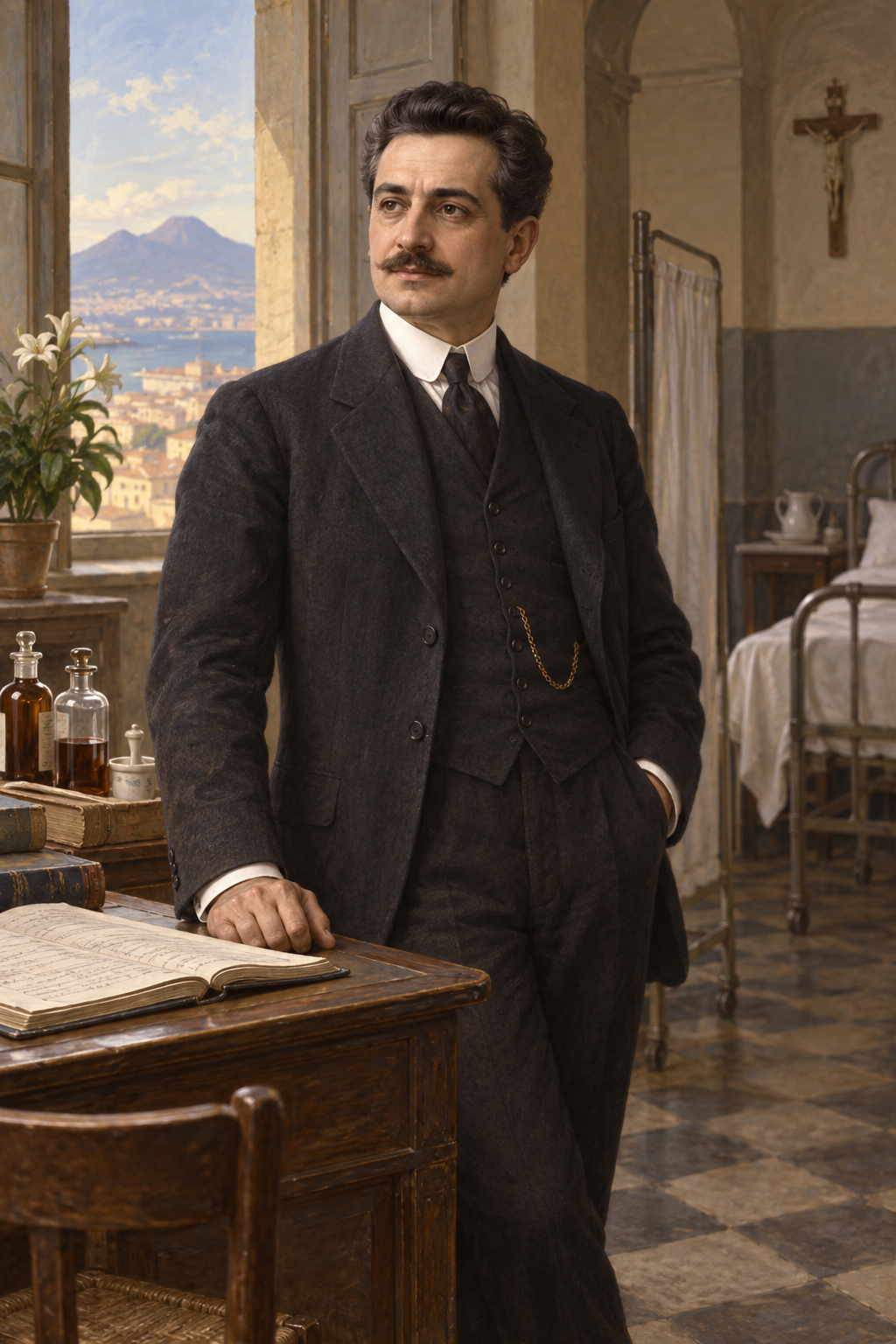
About Giuseppe Moscati
Giuseppe Moscati was born in Benevento on 25 July 1880, into a family associated with the legal profession. The family later settled in Naples, where Giuseppe went to school and eventually practiced medicine. His life was rooted in a city whose hospitals, university and poorer neighborhoods would all become places of work for him.
The family's moves and his brother Alberto's serious injury appear in the Dicastery's biography. It suggests that seeing Alberto's suffering may have influenced Giuseppe's choice of medicine, but presents this as a possibility, not a documented cause. What is certain is that he chose medical study and entered the University of Naples after finishing secondary school.
The medical world he entered was changing. Laboratory physiology and chemistry increasingly informed clinical work, while hospital doctors still learned by examining patients at the bedside. Moscati trained amid both approaches. Later accounts often emphasize either his religious service or his scientific credentials; neither alone describes the responsibilities of the physician he became.
In 1903 he completed his medical degree. He then won a public competition for work at Naples's united hospitals. These steps put a newly qualified doctor in wards where medical judgment had immediate consequences for patients.
He worked at the hospital known as the Incurabili and later held responsibility for several of its services. The Dicastery describes his attention to patients with rabies and his advancement through hospital appointments. Career progression did not take him away from ordinary patients: hospital duties, private consultations, and laboratory work continued alongside one another.
During the eruption of Vesuvius in 1906, Moscati went to the hospital at Torre del Greco, a branch of the Incurabili, and helped organize the patients' evacuation. A later Vatican health-care journal describes nursing staff working with him. The episode concerns coordinated care under danger, rather than a solitary feat detached from the hospital team.
Moscati's laboratory interests developed in the same years. Cascella's review of his publications places them within the early twentieth-century growth of biochemistry and physiology. He investigated bodily processes and used experimental methods, publishing results in medical journals. The scholarly record deserves attention on its own terms, without claiming a singular discovery that the review does not establish.
His research in physiological chemistry examined glycogen and related chemical reactions in the body. Such work connected laboratory measurements to questions a clinician might face. It also shows why his university and hospital careers cannot be separated into a scientific phase followed by a charitable one.
In 1911 Naples faced a cholera epidemic. The city's health authorities called on Moscati for public-health work, including inspections and investigation of how to contain the disease. Treating individual patients remained important, but epidemic response also required attention to the conditions in which a city lived.
That same year he received a teaching qualification in physiological chemistry and responsibilities for experimental research. He taught students about laboratory investigation applied to clinical practice. The Vatican health-care journal traces his later teaching in clinical chemistry and his 1922 qualification in general medicine. His students encountered a working doctor who continued to study.
During the First World War he directed military wards at the Incurabili. The patients and the tasks changed, but the hospital remained central to his life. The Dicastery lists these assignments alongside university teaching, showing the breadth of his work in Naples. It does not make each appointment a separate achievement of sanctity; those judgments belong to a later church process.
Outside the wards, people sought him at a consultation room in the family home. Ribeiro Corossacz records that he often waived fees for patients who could not pay and gave material help from his income. This pattern made medical care and personal charity overlap. It should not obscure the participation of nurses, colleagues and relatives in the broader network of care around him.
His religious commitments were visible to those around him. Paul VI, speaking at the 1975 beatification, presented Moscati as a layperson whose profession became a form of Christian service. That homily expresses the Church's interpretation of his life. It helps explain why the Church honored a physician, while the historical account still needs the concrete details of his practice and research.
John Paul II likewise described Moscati's faith as shaping how he approached people who were ill. In the 1987 canonization homily, he singled out the duties of a hospital physician, researcher and university teacher. These were demanding secular professions, not substitutes for one another. The papal account emphasizes the value of attending to a patient as a person.
Cascella argues that the familiar image of a benevolent doctor has sometimes hidden Moscati's scientific production. Reviewing his publications, he finds an original contribution in their questions and experimental method. This assessment does not require turning Moscati into the sole pioneer of modern biochemistry. It instead restores a part of his working life that devotional retellings may pass over too quickly.
His students and patients remembered both competence and concern. John Paul II cited his attention to people in poverty and his conviction that clinical work should not reduce them to bodily symptoms. Those claims are part of the Church's retrospective portrait. The historical record also shows specific hospital, teaching and public-health duties through which care took practical form.
Moscati died suddenly in Naples on 12 April 1927, aged forty-six. Devotion grew soon afterward, and his remains were moved to the Gesù Nuovo church in 1930. These events belong to the history of his reception as much as to his own life. They also show how patients and the city remembered a doctor whose career had been closely bound to Naples.
At Moscati's canonization on 25 October 1987, John Paul II described his hospital work, research and teaching as serious professional commitments. The homily also recalled his care for sick people, especially those who were poor or abandoned. It presents his religious conviction as part of how he practiced medicine.
Wondering how to weigh the stories and sources? Learn how to read a saint biography.