Biography
Gregory of Narek
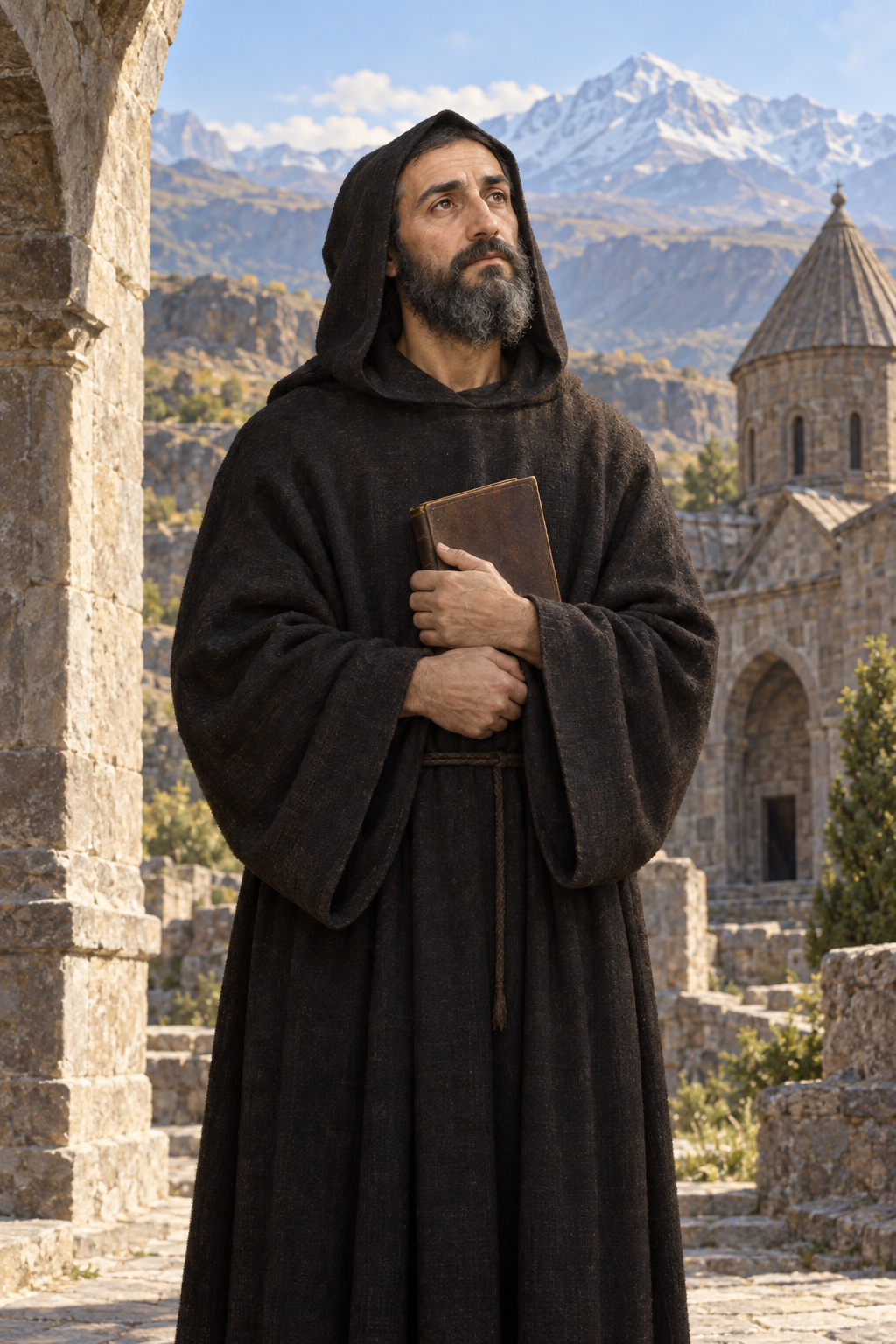
About Gregory of Narek
Gregory of Narek is one of the most loved figures in Armenian Christianity. The Holy See’s announcement preceding his proclamation as Doctor of the Church gives approximate anchors: he was born around 950 in Andzevatsik, then Armenia and now in Turkey, and died around 1005 at Narek, likewise then Armenia and now in Turkey. The approximation is important. It means the dates should be stored and presented as approximate, not turned into spurious precision.
Gregory was a priest and monk. Pope Francis’s apostolic letter describes him as a brilliant theologian, mystic, and poet, long honored as a saint by the Armenian people. It also identifies him as a teacher whose evangelical wisdom and theological doctrine continue to speak to his people and to the universal Church. These descriptions support a portrait centered on prayer and teaching rather than invented scenes from monastic daily life.
His lasting reputation is especially connected with the *Book of Lamentations*, commonly known among Armenians as the *Narek*. Francis’s letter says that, after the Gospels, it is among the writings most venerated and widely circulated by the Armenian people. The work is a book of meditations and prayers, and its voice is intentionally personal while also expressing the sorrow, repentance, and hope of those who pray it.
In the message given at his proclamation as Doctor of the Church, Francis called Gregory a monk of the tenth century who gave voice to the cry of sinful and sorrowful humanity. The Pope’s language does not turn that cry into despair. He links it to the splendor of God’s love and to hope in saving intervention. This theological horizon explains why Gregory’s writing has spoken across centuries: it takes suffering seriously while refusing to treat suffering as the final word.
On 12 April 2015, Pope Francis formally declared Gregory a Doctor of the Universal Church after consultation and deliberation. The formal rite uses the titles priest and monk. The declaration does not erase Gregory’s Armenian identity; rather, it recognizes that the theological and spiritual riches of an Armenian Christian writer belong to the wider Catholic Church.
Gregory’s life should also be received with sensitivity to Armenian history. The 2015 message was delivered in a commemoration marked by the Armenian people’s immense suffering. Francis presents Gregory’s prayerful voice as a source of mercy, remembrance, and hope. This does not make a tenth-century monk a witness to later events; it shows how his writing became a resource for a people who continued to pray through grief.
The sources sustain a careful biography: Gregory was an Armenian monk and priest, a theologian and poet associated with the monastery of Narek, author of a revered book of prayer, and Doctor of the Church from 2015. They do not settle every anecdote or literary attribution circulated under his name. Preserving that limit honors both his historical setting and the integrity of the spiritual tradition shaped by his work.
The *Book of Lamentations* is significant not only because it is admired as literature, but because it is used as prayer. Its voice gives words to guilt, grief, longing, and trust without pretending that human pain is easy to explain. Francis’s reception of Gregory highlights this pattern: sorrow can be brought before God rather than hidden or treated as incompatible with faith. The book’s authority for readers lies in that prayerful encounter, not in a claim that it functions as a modern historical chronicle.
Gregory’s Armenian setting should remain central even after his recognition as a Doctor of the universal Church. Universal reception does not flatten particular traditions. His writings came from an Armenian monastic and theological world, and their circulation among Armenian Christians is part of what gives the *Narek* its enduring voice. The Church’s 2015 proclamation extends esteem beyond that context; it does not transfer ownership of the tradition away from the people who cherished it.
The title Doctor of the Church also needs careful explanation. It is a recognition that a saint’s teaching has lasting value for the wider Church. It is not a claim that a writer’s every statement is detached from its time or that readers no longer need to attend to literary form, theology, and history. In Gregory’s case, the title directs attention to a teacher whose poetry and prayer communicate doctrine through a language of humility and hope.
His association with the monastery of Narek supports a portrait of a life shaped by prayer and learning. It does not license a fully detailed account of daily routine, personal friendships, or the composition of every work. The approximate dates supplied by the Holy See should remain approximate in the catalog. Such limits make the account more, not less, useful: they identify a real historical person without pretending that the surviving record is exhaustive.
For readers facing grief or uncertainty, Gregory’s legacy can be received as an invitation to truthful prayer. The official texts use him to speak about mercy, remembrance, and confidence in God’s compassion. This theological reception is not a substitute for the complex history of Armenia or for the real suffering remembered in 2015. It shows why a tenth-century monk’s words continue to provide a language for people who seek hope without denial.
Wondering how to weigh the stories and sources? Learn how to read a saint biography.