Biography
Harriet Beecher Stowe
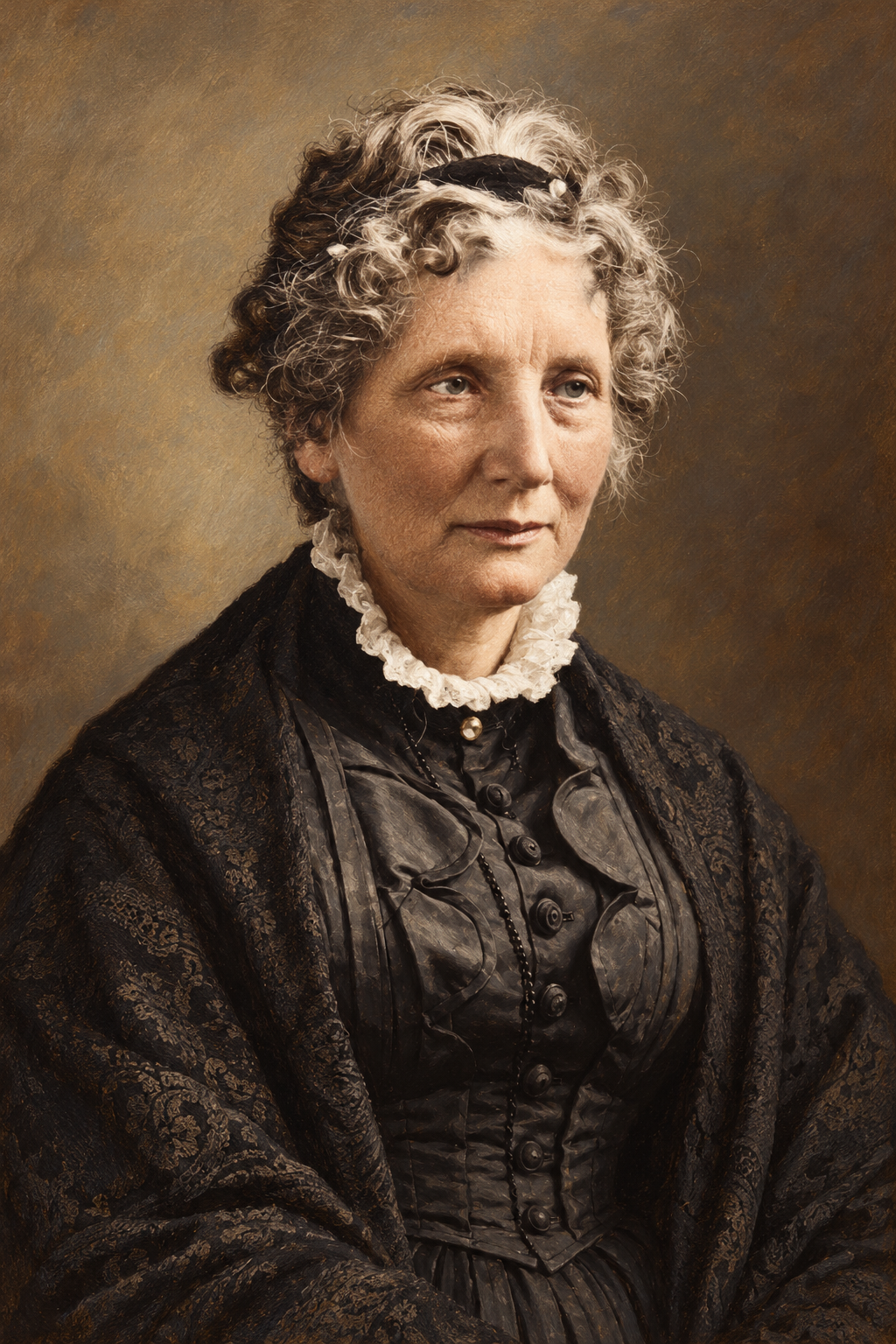
About Harriet Beecher Stowe
Harriet Beecher Stowe used fiction to bring the suffering caused by slavery into the homes of readers who might otherwise avoid it. Born in Litchfield, Connecticut, in 1811, she grew up in the family of the minister Lyman Beecher. She studied at Sarah Pierce’s academy and later at the Hartford Female Seminary established by her sister Catharine. Teaching and writing became part of her working life. In 1832 she moved with her family to Cincinnati, where she married the theology professor Calvin Stowe in 1836.
Cincinnati brought her close to the boundary between free and slave states. She heard accounts from people who had experienced slavery and gathered testimony for her writing. The death of her young son Samuel Charles in the cholera epidemic of 1849 deepened her attention to the anguish of parents separated from their children. She later connected that grief with the family separations portrayed in Uncle Tom’s Cabin.
The family moved to Brunswick, Maine, in 1850, when Calvin accepted a post at Bowdoin College. Harriet worked amid household demands, children, and a small school run with Catharine. A letter preserved in Bowdoin’s account describes repeated interruptions to her writing. Her literary work emerged within this busy domestic setting, rather than in a life set apart from it.
In Brunswick she sheltered John Andrew Jackson during his escape toward Canada. Jackson later recalled receiving food, clothes, money, and a night’s refuge. He remembered her listening to his account of separation from his wife and daughter. His testimony gives a concrete encounter behind her concern with slavery. Bowdoin also preserves Joshua Chamberlain’s recollection of evenings when Stowe read chapters to friends before sending them for publication. These accounts show both the personal testimony and the small circle of early listeners surrounding the novel’s development.
Uncle Tom’s Cabin appeared serially in The National Era in 1851 and as a two-volume book in 1852. Its account of slavery, especially the breaking apart of families, reached readers in the United States and Britain. The National Park Service places the novel within a much longer career: Stowe published some thirty books as well as many shorter works. Her international reputation rested chiefly on this novel, but it did not exhaust her interests or her writing.
The novel’s concluding remarks make its religious challenge explicit. Stowe recalled being disturbed by Christians who defended sending fugitives back into slavery after the legislation of 1850. She addressed readers in the North as participants in the injustice, not innocent observers of a distant wrong. She called on churches to open education and refuge to people escaping bondage and described assistance as a responsibility owed for national wrongdoing. Her appeal joined feeling with obligations: sympathy should change the conduct of Christians and their institutions.
That conclusion also exposes limits in her thinking. She supported eventual settlement in Liberia and described formerly enslaved people through a paternalistic framework. Her opposition to enslavement did not amount to an unqualified recognition of Black equality. Both the appeal for practical help and the proposed African destination belong to the text; neither should be omitted when describing its Christian argument.
Stowe also wrote directly about biblical women. The introduction to Woman in Sacred History presents women’s lives as central to a developing religious history. She urged readers to recognize biblical figures as human beings rather than to surround their names with a solemnity that prevented inquiry. Her stated approach allowed questions about their actions and imperfections. The book therefore offers another view of her religious writing: she sought to make sacred narratives available to sympathetic, questioning readers. Its introduction remains her interpretation of Scripture, not a neutral history of ancient society.
Her religious outlook changed through grief as well as through writing. David Hein and Gardiner Shattuck describe her distress after a son died without formally joining a church, and her struggle with the implications of the Calvinism she had inherited. The Minister’s Wooing explored these concerns. After moving to Hartford in 1864, she purchased a pew at St. John’s Episcopal Church. The historians connect that choice with her attraction to its worship and theological flexibility. Her later support for Episcopal work in Florida formed another part of this affiliation.
Scholar Eileen Razzari Elrod interprets these religious works as a revision of the tradition Stowe inherited from her father. In Elrod’s reading, female examples and maternal imagery reshape religious authority. This interpretation helps explain why Stowe’s faith cannot be described only through her father’s preaching.
Her later life included winters in Florida and the writing of Palmetto Leaves. Scholar Elif Armbruster argues that this postwar travel narrative reveals increasingly regressive racial views and support for a hierarchical society. That assessment complicates an account concerned only with her earlier antislavery fame. It keeps the distinction between opposing slavery and supporting racial equality visible in her legacy.
Stowe died in Hartford, Connecticut, on July 1, 1896.
Her Episcopal commemoration falls on July 1.
Wondering how to weigh the stories and sources? Learn how to read a saint biography.