Biography
Harriet Tubman
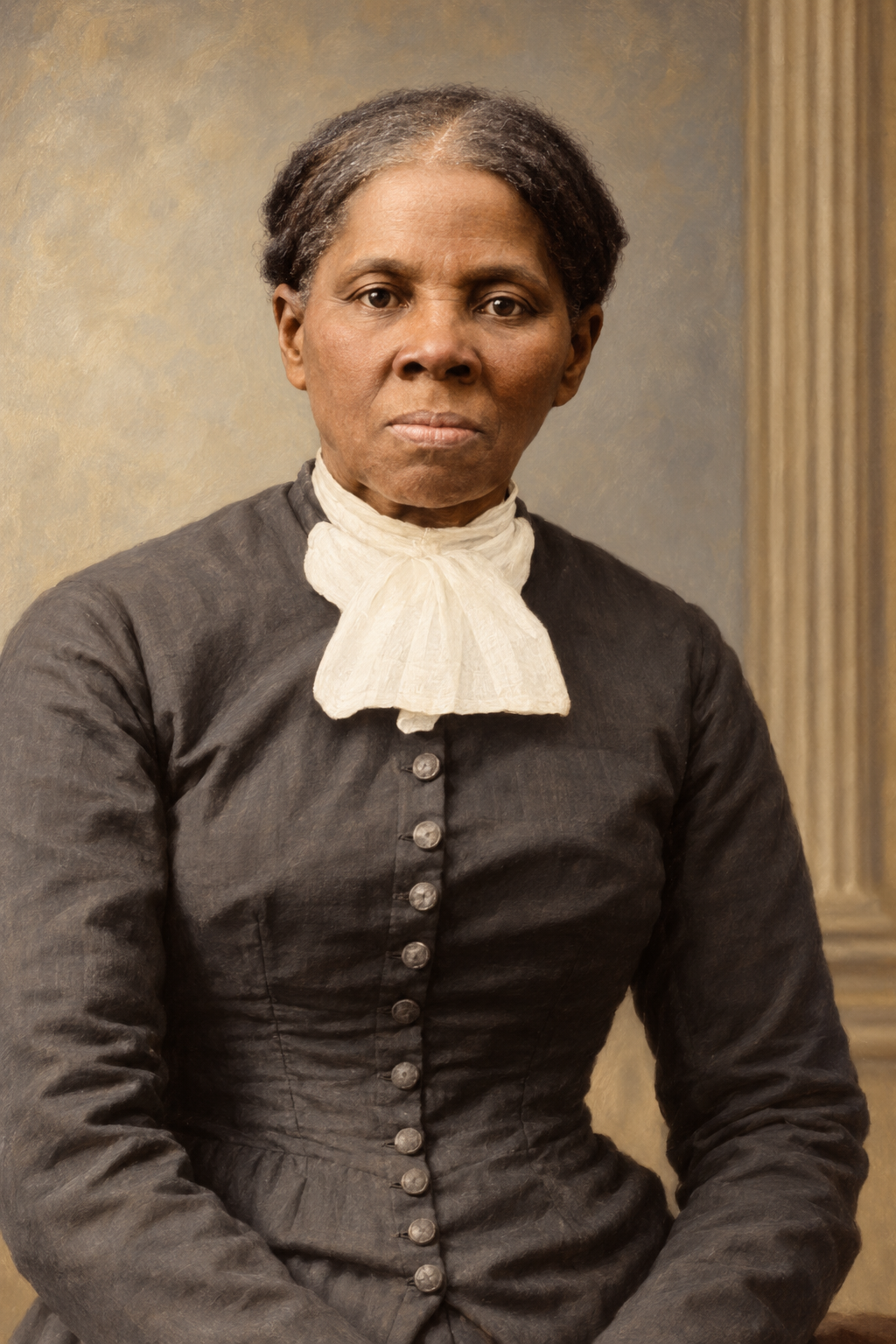
About Harriet Tubman
Harriet Tubman escaped slavery and repeatedly returned to help other people reach freedom. Born Araminta Ross in Dorchester County, Maryland, she experienced the separation of her family when three of her sisters were sold away. Her early work included childcare, agricultural labor, and work on the wharf. In 1849 she escaped to Philadelphia, but freedom did not end her concern for the relatives and friends she had left behind.
Her exact birth date is uncertain. A March 1822 account records payment for a midwife attending her mother, although it does not name the child. An advertisement seeking her capture in 1849 described her as about twenty-seven. These records support a birth around 1822 rather than an exact birthday.
Tubman first attempted escape with two brothers, then turned back when they reconsidered. She later traveled alone through Maryland and Delaware into Pennsylvania. Over roughly a decade she made about thirteen journeys back to Maryland and guided approximately seventy people to freedom. She also gave instructions to others making their own escapes. Her elderly parents were among those she brought north when her father faced arrest for helping freedom seekers. She lived for a time in St. Catharines, in what is now Ontario, where an abolitionist community offered support beyond the reach of American slaveholders. Her first husband, John Tubman, declined to leave Maryland when she returned for him. These journeys brought some families together, but they could not undo every separation imposed by slavery.
During the Civil War, Tubman worked in South Carolina as a nurse, cook, and spy. She helped lead the Combahee River raid in June 1863, during which Union forces destroyed Confederate resources and liberated hundreds of enslaved people. Her wartime work extended the struggle for freedom that had begun with her own escape.
Tubman later sought payment for that service. In a compensation affidavit, she described three years of nursing and cooking in hospitals and command of a small group of scouts. She requested eighteen hundred dollars. The statement records her effort to have the government recognize skilled work performed on its behalf, rather than treating her contribution only as a celebrated story.
Obtaining that recognition proved difficult. She began seeking compensation in 1865, with support from William Seward and former military officers. Bills introduced during the 1870s failed to bring her payment. After her husband Nelson Davis died, she received a small monthly pension as his widow. In the late 1890s, neighbors and Representative Sereno Payne pressed her case again. Payne pursued an increase in the existing pension rather than a separate lump sum, hoping to secure help sooner. Congress ultimately raised the payment to twenty dollars a month in 1899. The increase offered practical assistance, but its legal basis remained her widowhood rather than full recognition of her wartime roles. Her struggle for compensation continued long after the service for which she sought it.
The Senate report preserved earlier testimonials supporting her claim. William Seward described her nursing of soldiers and recommended her case to General David Hunter. A statement from General Rufus Saxton supported payment for her service, while Colonel James Montgomery praised her usefulness as a scout. These endorsements show that military officers had recognized more than one kind of contribution.
The committee nevertheless objected to the proposed twenty-five-dollar monthly rate. Its report noted that few nurses received more than twelve dollars and feared that granting this amount would encourage further increases. It recommended twenty dollars through her existing status as a soldier’s widow. The final act followed that recommendation, naming Nelson Davis and his regiment. The documents preserve the contrast between the range of work described in supporting testimony and the narrower form of relief Congress enacted.
After the war, she supported women’s voting rights and spoke at suffrage meetings. In 1896 she addressed the first convention of the National Association of Colored Women.
In Auburn, New York, Tubman cared for relatives and others needing shelter, food, clothing, or medical attention. She purchased neighboring land in 1896 with the hope of creating a lasting home for poor and elderly people. When fundraising proved insufficient, she transferred that property to the African Methodist Episcopal Zion Church so that it could operate the institution. The home opened in 1908.
The AME Zion congregation also formed part of her own religious life. She helped finance its new church building and worshipped there after its completion in 1891. The congregation’s support for people seeking freedom and for neighbors in need connected worship with practical care.
Tubman eventually became a patient in the home she had helped establish, living in John Brown Hall until her death in 1913.
Her funeral was held at Thompson Memorial AME Zion Church.
The Episcopal Church, a different tradition from her AME Zion congregation, commemorates her on March 10; final calendar authorization came in 2024.
Wondering how to weigh the stories and sources? Learn how to read a saint biography.