Biography
Hedwig of Silesia
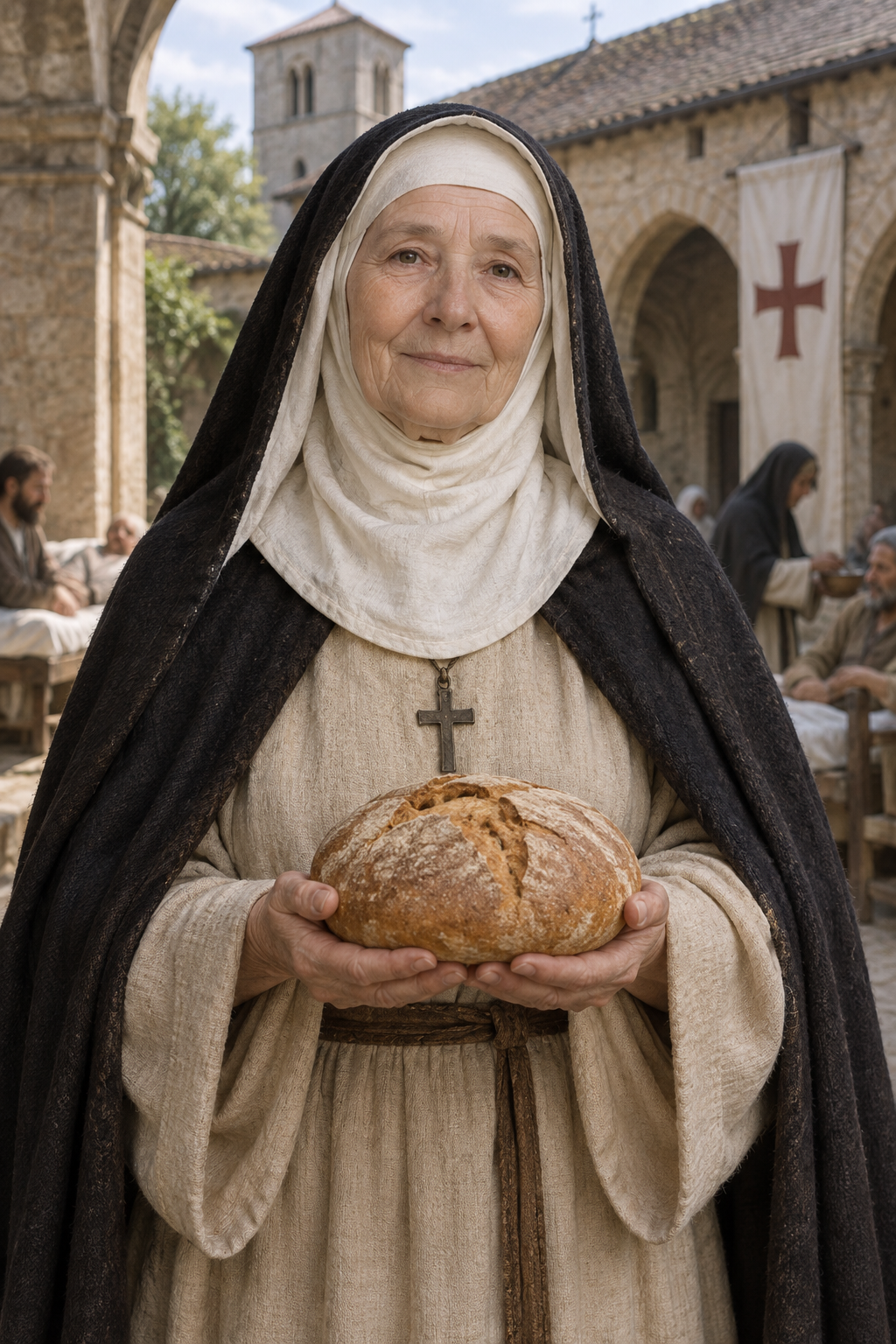
About Hedwig of Silesia
Hedwig of Silesia was born in the 1170s, probably at Andechs in Bavaria, into a family whose marriages reached across Europe's ruling houses. Her father was Berthold of Andechs and her mother Agnes. She married Henry of Silesia while young. Her position joined family obligations to the responsibilities of a duchess.
Her early education took place at the monastery of Kitzingen. The old biography cited by Johann Peter Kirsch puts her marriage at twelve, an age at which her future was largely decided by others. She moved into the world of Henry's Silesian court and became a mother. Several of her children died young; her daughter Gertrude eventually became abbess at Trebnitz. Her religious life developed within marriage and parenthood, rather than beginning with withdrawal from them.
Vatican News remembers a duchess who tried to close the distance between her rank and the people around her. It recounts that she learned Polish and wore used clothes and old shoes, refusing to make her appearance a display of privilege. Her generosity was directed toward the poorest people in her community. It describes daily faith and prayer as a comfort during her many bereavements and the responsibilities of family life.
With Henry she supported religious houses and hospitals. Their foundations included Trebnitz, the Hospital of the Holy Spirit at Breslau, and a hospital for women with leprosy near Neumarkt. Her care extended to widows, orphans, religious communities, and students.
Trebnitz became especially important to the family. Henry endowed the women's monastery at Hedwig's request in 1202, and the first sisters arrived early the following year. Gertrude's place there eventually brought mother and daughter together within a community that the ducal household had helped establish.
Hedwig also intervened when political conflict endangered her husband. Colmar Grünhagen's historical account describes her nursing Henry after he was wounded at Gonsawa. When Conrad of Masovia subsequently held him captive, she went to Płock herself and helped negotiate his release. The settlement included marriages between members of the rival families. Her response drew on personal presence and dynastic negotiation rather than leaving the crisis entirely to soldiers.
After Henry's death she lived at Trebnitz, but the distinction between residence and profession matters here. The Augsburg diocesan account says that Gertrude urged her to enter the community formally and that Hedwig declined. She wanted to retain control of her widow's property so that she could continue giving it to people in need. Her choice was not an abandonment of religious discipline. It kept the practical means of charity in her own hands while she lived close to the monastery's prayer.
In 1241 her son Henry II died fighting the Mongols, another loss before her own death.
The stories of her austerity do not preserve the only image of the duchess. Grünhagen contrasts descriptions of extreme deprivation with a surviving statue and her seal, which show rich clothing and ducal status. He notes that the seal was still used near the end of her life. Those objects preserve the public identity of a noblewoman alongside the severe ascetic remembered in her legend.
She died in 1243 and was canonized in 1267. Later generations preserved her memory in books as well as at her tomb. In 1353 Duke Ludwig of Liegnitz and Brieg and his wife Agnes commissioned an illustrated Latin life. Getty identifies it as the earliest surviving illustrated copy of her biography. Its pictures tell the story of a noblewoman remembered for austerity and charity. When Ludwig left the manuscript to her shrine, the book itself came to be treated as a relic.
The surviving pictures also show why that memory could speak to women who were not nuns. Getty's curators point to the importance of a married saint with children as a model for medieval readers. The manuscript pictures Hedwig with Henry and their family, alongside scenes of her religious discipline. One unusual episode even shows her discovering a hedgehog hidden in a nun's sleeve. As a story about the saint, it presents her as attentive to the community and its rules.
Her memory later acquired a particular place in Polish and German reconciliation. Speaking to Silesian pilgrims in 1979, John Paul II called her a patron of reconciliation between neighboring countries. He connected her feast on 16 October with the date of his own election and sent a votive offering to her shrine. His homily asked that honoring saints should accompany work for unity in families and between nations.
At Andechs, devotion took another form after the Second World War. Displaced Silesians found in Hedwig's birthplace a connection with the homes they had lost. The monastery records that a relic associated with her had been there since 1924. Her remembered life of service thus remained part of a living pilgrimage, carried forward by people seeking continuity after displacement.
Wondering how to weigh the stories and sources? Learn how to read a saint biography.
Prayers for Hedwig of Silesia
Petition from Hedwig's collect
ejus méritis et exémplo discámus peritúras mundi calcáre delícias, et in ampléxu tuæ Crucis ómnia nobis adversántia superáre