Biography
Helena of Constantinople
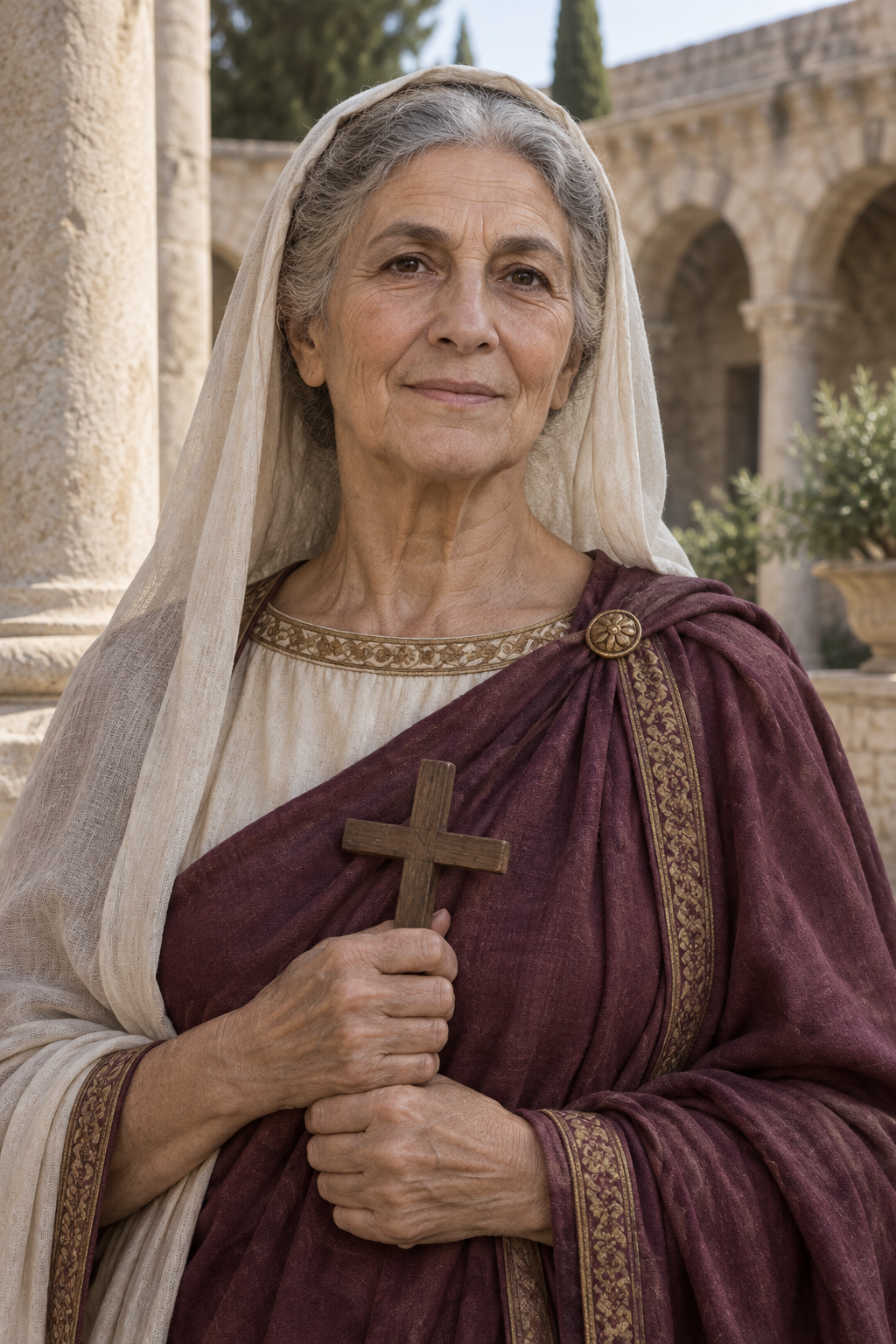
About Helena of Constantinople
Helena rose from an obscure background to a public place in the Roman imperial family. Born around 248 or 249, probably at Drepanum in Bithynia, she became the companion of Constantius and the mother of Constantine. Whether the couple had a legally recognized marriage remains uncertain. Constantius later separated from her and married Theodora. Helena's position changed as her son gained imperial power: she joined his court and eventually received the title Augusta. Her early life is much less clearly recorded than the honors and religious patronage of her later years.
Coins preserve evidence of that public position independently of the later stories told about her. A copper-alloy coin in the British Museum, minted in London around 324–325, shows Helena wearing a diadem, necklace, and mantle. Its reverse depicts Securitas, a personification of security, holding a branch. The small object places her image within the ordinary machinery of imperial coin production, far from the eastern Mediterranean. It is an official representation of status, not a record of her private appearance or a portrait drawn from the circumstances of her pilgrimage.
A different coin, a gold solidus catalogued in Berlin and dated to 324, names her as Augusta. It was struck at Thessaloniki and pairs her bust with another representation of Securitas. The Latin inscription identifies Helena directly, making the title more than a detail reported by later biographers. These coins show how her place in the ruling family was expressed through images and names issued under Constantine's authority.
Her religious patronage developed as Christianity acquired a new public position in the empire. Galerius had ended the official persecution in 311, and Constantine and Licinius subsequently supported religious toleration and the restoration of Christian property. Christian worship could now receive imperial resources and public recognition. Helena's later activities belong within this political change, not to a period when every Christian institution still operated outside the law. The churches associated with her were part of a wider transformation in the relationship between imperial authority and Christian communities.
Eusebius, a contemporary writer praising Constantine, describes Helena traveling east in old age. He credits her with honoring the sites of Christ's birth at Bethlehem and his ascension on the Mount of Olives through church building, with further support from her son. He also reports gifts of money and clothing, the release of prisoners, help for people condemned to the mines, and the return of exiles. In his account, imperial rank did not keep her apart from other worshippers: she joined them in prayer. These are specific claims of contemporary testimony, though they come from a work celebrating the emperor's household rather than an impartial record of its administration.
The building history at Bethlehem gives that patronage a lasting physical setting. UNESCO dates the completion of the original basilica to 339 and describes its eastern end as an octagon arranged around the cave revered as Jesus's birthplace. The present church is principally a sixth-century replacement, with surviving portions of the earlier building below it, including mosaics. The distinction matters: visitors encounter a place shaped by several periods, not an unchanged church that Helena herself saw completed. The continuing pilgrimage belongs to that long history of worship and rebuilding around a traditional sacred site.
The famous discovery of the True Cross belongs to a later layer of her story. In his fifth-century Church History, Socrates describes Helena finding three crosses and Bishop Macarius testing them by bringing them to a dying woman. The woman is healed when the third cross touches her, identifying it in the narrative as Christ's cross. Socrates also recounts the division and preservation of the relic. This is a later miracle tradition, not an episode established by Eusebius's contemporary account. It became central to Helena's religious memory, but its distance from her lifetime should remain visible when her life is told.
Helena died around 329; the place of her death is not securely known. Her burial was associated with the imperial mausoleum on the Via Labicana in Rome. Later devotion often represented her holding a cross, making the relic tradition recognizable in a single attribute. Vatican News notes her place among the figures represented around the great crossing of Saint Peter's Basilica. Such images show how later Christians remembered her, rather than providing contemporary evidence for the discovery itself.
The red porphyry sarcophagus associated with her burial is now in the Vatican Museums. Its reliefs show mounted soldiers and captives, imagery that has prompted the suggestion that it was originally intended for a male member of the imperial family. The museum presents that explanation as a possibility, not an established identification of the first intended occupant. The object also has a later history: it entered the Vatican collection in 1777 and underwent restoration. It preserves imperial funerary imagery alongside the history of Helena's commemoration.
Wondering how to weigh the stories and sources? Learn how to read a saint biography.
Prayers for Helena of Constantinople
Helena and Constantine: troparion petition for peace
always preserve it in peace