Biography
Isaiah of Scetis
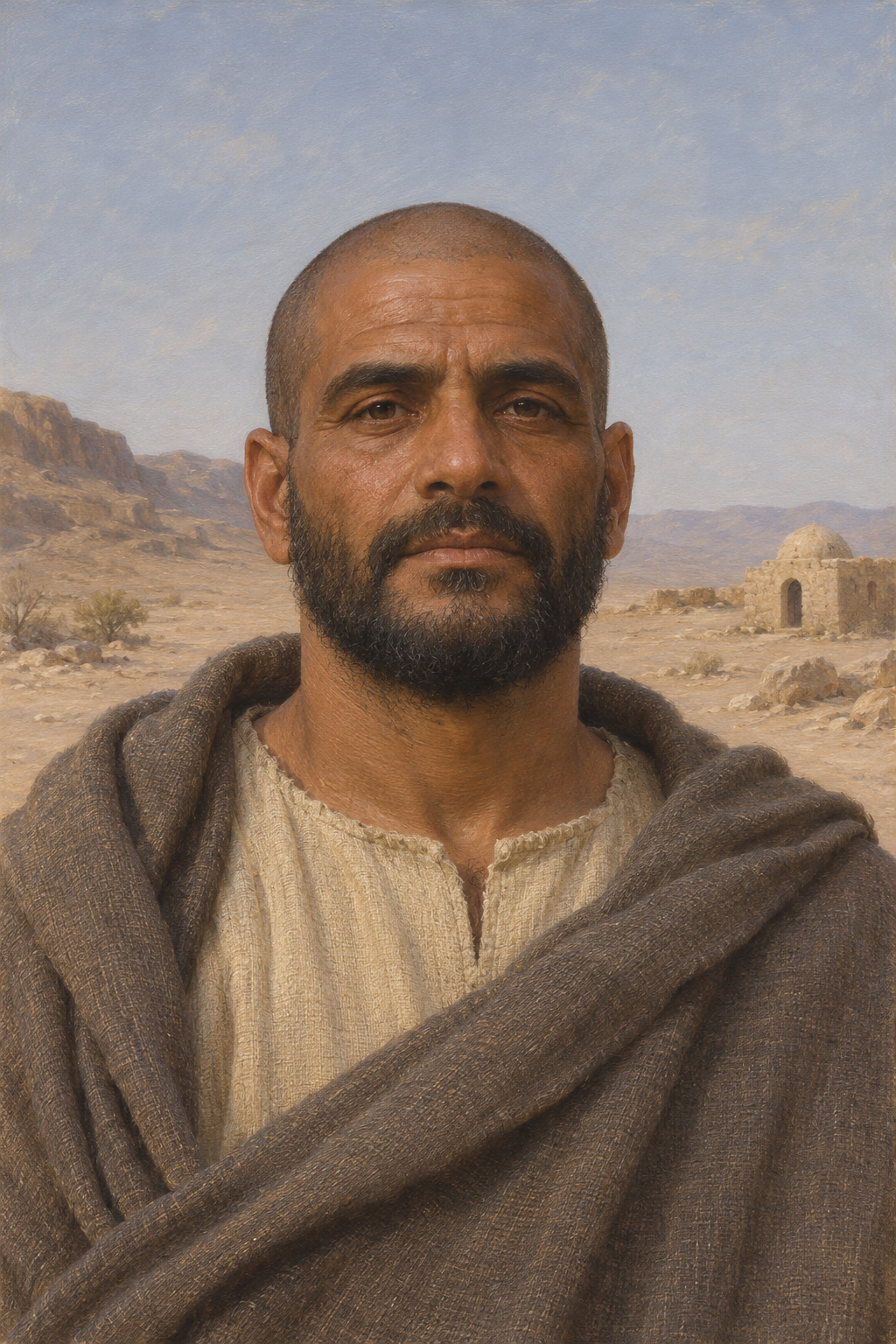
About Isaiah of Scetis
Isaiah of Scetis, also called Isaiah the Hermit, is remembered for counsel that traveled far beyond the Egyptian desert. His personal history is difficult to disentangle. Lucien Regnault notes that several monks named Isaiah appear in the sources, while the collection associated with this Isaiah contains sayings inherited from other elders. The writer may have begun monastic life at Scetis, but the exact course of his training is uncertain. The Asceticon offers a firmer record of what communities read under his name than a continuous account of his childhood, ordination, or journeys. Even its authorial boundaries require care.
A reconstruction identifies the Egyptian ascetic with Isaiah who later lived in Palestine and died near Gaza in 491. Damien Labadie’s study, summarized in its published abstract, follows a course from Egypt through Eleutheropolis to Gaza. It describes a wandering teacher whose relationships crossed the Egyptian and Palestinian monastic worlds and whose authority mattered in disputes following Chalcedon. That outline is evidence of an argued identification, not a dated travel journal. Scholars have disputed whether all the material belongs to one Isaiah, so the Palestinian episode should be read as a reasoned account of the teacher’s later setting rather than an undisputed biography. Labadie characterizes him as comparatively moderate between Gazan monks and the imperial court.
The Asceticon is a collection rather than one book composed at a sitting. Derwas Chitty compared Greek and Syriac recensions and found sayings, rules, letters, and homiletic pieces in varying orders. Some early Syriac manuscripts attribute material to unnamed Egyptian fathers; other witnesses place it under Isaiah’s name or assign portions to Moses, Macarius, and Ammonas. Peter, remembered as Isaiah’s disciple, probably helped preserve and arrange the collection, but the evidence does not make him the editor of every surviving recension. These variations warn against turning the whole corpus into a transcript of one man’s speeches.
Much of the teaching concerns the ordinary conditions of prayer. Regnault describes the Asceticon as addressing quietness of heart, the scrutiny of thoughts, reading Scripture, manual work, fasting, and relations with other monks. The goal is not to make hardship impressive. Isaiah asks for discernment about intention: whether a practice helps the monk become free from destructive passions and more attentive to God. His advice joins solitude to responsibility for brothers who share work, worship, and correction. That practical range helps explain why later readers could use the discourses as guidance rather than only admire an austere desert ideal.
The English translators’ introduction to the Ascetic Discourses describes Isaiah’s treatment of human nature in Discourse 2. He regards human nature as created good but altered by sin, so even desire has a possible direction toward love rather than being evil in itself. Their introduction also identifies “attention” as a recurring corrective to negligence and notes his warning not to measure oneself against others. This gives concrete shape to his counsel: watch the motive behind an action, repent when attention fails, and resist pride without despising the body. It is a demanding discipline, yet the translators stress its balance.
Isaiah also frames ascetic labor through the life of Christ. The translators discuss his image in Discourse 13 of bearing the cross and then ascending it. They distinguish the first as disciplined preparation and the second as a deeper silence. In that reading, fasting or vigilance has meaning because it leads toward participation in Christ’s life, not because deprivation is a mark of rank. The same introduction notes how often the discourses return to Scripture and the imitation of Jesus. Isaiah’s account of prayer therefore joins the practical work of a cell to a theological hope beyond it.
The corpus traveled widely through translation. Encyclopaedia Iranica records Greek or possibly Coptic beginnings, several later recensions, and a Syriac version divided into discourses. It also identifies a Sogdian fragment of the fourth discourse translated from Syriac, accompanied by part of a commentary on the fifteenth. The find shows readers in Central Asia working with teaching associated with Isaiah, not merely copying his name in a calendar. Its distance from Egypt also makes the limits of attribution important: translation and interpolation helped carry the collection abroad while changing the form in which it reached new readers.
Chitty finds no direct polemic over Chalcedon in the Asceticon itself, even though accounts of the Palestinian Isaiah give him a role among opponents of that council. He describes the collection as a practical guide to prayer and work, not a systematic exposition of doctrine or the settled teaching of one author. Its many voices are part of its history. Isaiah’s legacy is thus clearest where the evidence is strongest: in the desert instruction organized under his name, in its attention to Scripture, humility, and freedom of heart, and in the readers who continued to transmit it across languages.
Wondering how to weigh the stories and sources? Learn how to read a saint biography.