Biography
Isidore the Farmer
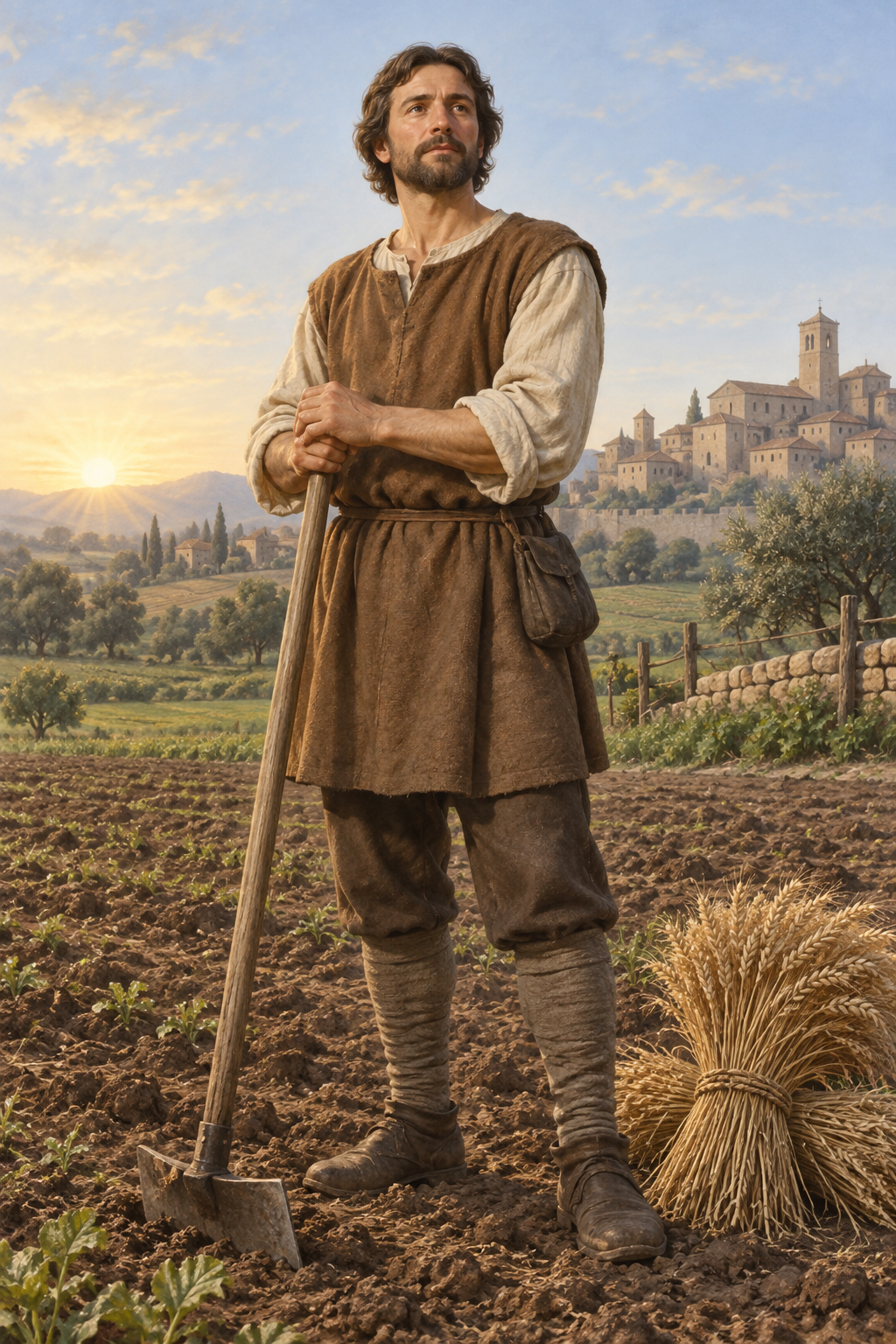
About Isidore the Farmer
Isidore the Farmer is one of Madrid’s most enduring saints. He is remembered as a lay agricultural worker whose holiness is associated with prayer, labor, and generosity to people in need. Yet a careful account must begin with uncertainty. The Madrid cultural guide on San Isidro states plainly that knowledge of his life and death is rooted more in popular legend and tradition than in documentary sources. That admission is not a defect to conceal; it is the right interpretive key for a medieval figure whose devotion became extraordinarily rich.
The Vatican City State’s saint-of-the-day entry calls Isidore a humble and very poor farmer and places his birth around 1080 in Madrid. Such wording should remain approximate. It supports the broad setting—a poor layman living from agricultural work in the Madrid region—without establishing a complete date-by-date biography. The same source presents his faith, participation in worship, and charity as central to the way the Church receives his life.
Later accounts connect Isidore with a wife, María Toribia, and with agricultural work outside Madrid; they also attach many miracle stories to his name. These stories have shaped devotion, especially traditions about water, drought, and help for farm workers. They should be valued as expressions of a community’s faith without being reported as documentary fact. A responsible biography can say that the tradition associates Isidore with rural labor, family life, prayer, and charity; it cannot present every detail as securely recoverable history.
His canonization offers a firmer historical marker. The Vatican City State records that Pope Gregory XV canonized Isidore on 12 March 1622 with Teresa of Ávila, Ignatius of Loyola, Francis Xavier, and Philip Neri. Pius XI later recalled the third centenary of the canonization of those five saints. The date and ceremony explain how a local Madrid devotion entered the universal Church’s public calendar and memory.
Isidore is patron of farmers, farm workers, and Madrid. The title is less a claim about occupation records than an expression of how believers have received his witness. It places the dignity of ordinary labor at the center of holiness. Agricultural work depends on land, weather, community, and patient effort; devotion to Isidore has often made those realities occasions for prayer rather than signs of spiritual insignificance.
The most trustworthy portrait is therefore deliberately modest. Isidore was remembered as a poor lay farmer of the Madrid region whose faith, prayer, and charity became a focus of local devotion; that devotion was canonically recognized in 1622 and continues in the Church’s celebration on 15 May. The many legendary details are part of the tradition’s cultural life, but this entry does not turn them into settled historical claims. Such restraint honors both the saint and the people who kept his memory alive.
The historical caution around Isidore has a positive purpose. It makes room for a real distinction between a medieval worker whose memory was cherished locally and the rich web of stories that later communities told about him. Devotional stories can show what people hoped for in a saint—rain in drought, help in danger, dignity for rural labor—without functioning as a dated record. A public account should allow readers to value that tradition while knowing what kind of source it is.
His association with Madrid also invites attention to place. The city and its surrounding agricultural world have changed dramatically since the period in which his life is conventionally located. Later devotion has preserved local sites, processions, and customs connected with his name. These are evidence of reception, not proof that every associated site can be identified with a documented event in his life. The distinction protects local memory from being misrepresented as archaeology.
Isidore’s patronage of farmers and farm workers has enduring moral meaning. It recognizes labor that is often physically demanding, vulnerable to weather and economic pressure, and essential to the life of communities. Prayer connected with farming need not deny scientific knowledge or fair labor policy. It can express gratitude, dependence, and solidarity with people whose work brings food from land to table.
The canonization of 1622 provides an important bridge between local devotion and the universal Church. It placed Isidore among a memorable group of saints and made his recognition visible far beyond Madrid. Canonization does not retroactively supply a complete medieval archive. It does show that the Church judged the devotion worthy of public veneration and that his example of humble faith had taken on a wider significance.
For readers today, Isidore’s story is best received through humility. He is remembered not for office, formal learning, or public power, but for a life linked with work, prayer, and generosity. The uncertain record does not allow a detailed biography, yet it permits a trustworthy portrait of the values his community received in him. That is sufficient to honor a saint whose legacy has long affirmed that ordinary labor can be a place of holiness.
Wondering how to weigh the stories and sources? Learn how to read a saint biography.