Biography
Jacinta Marto
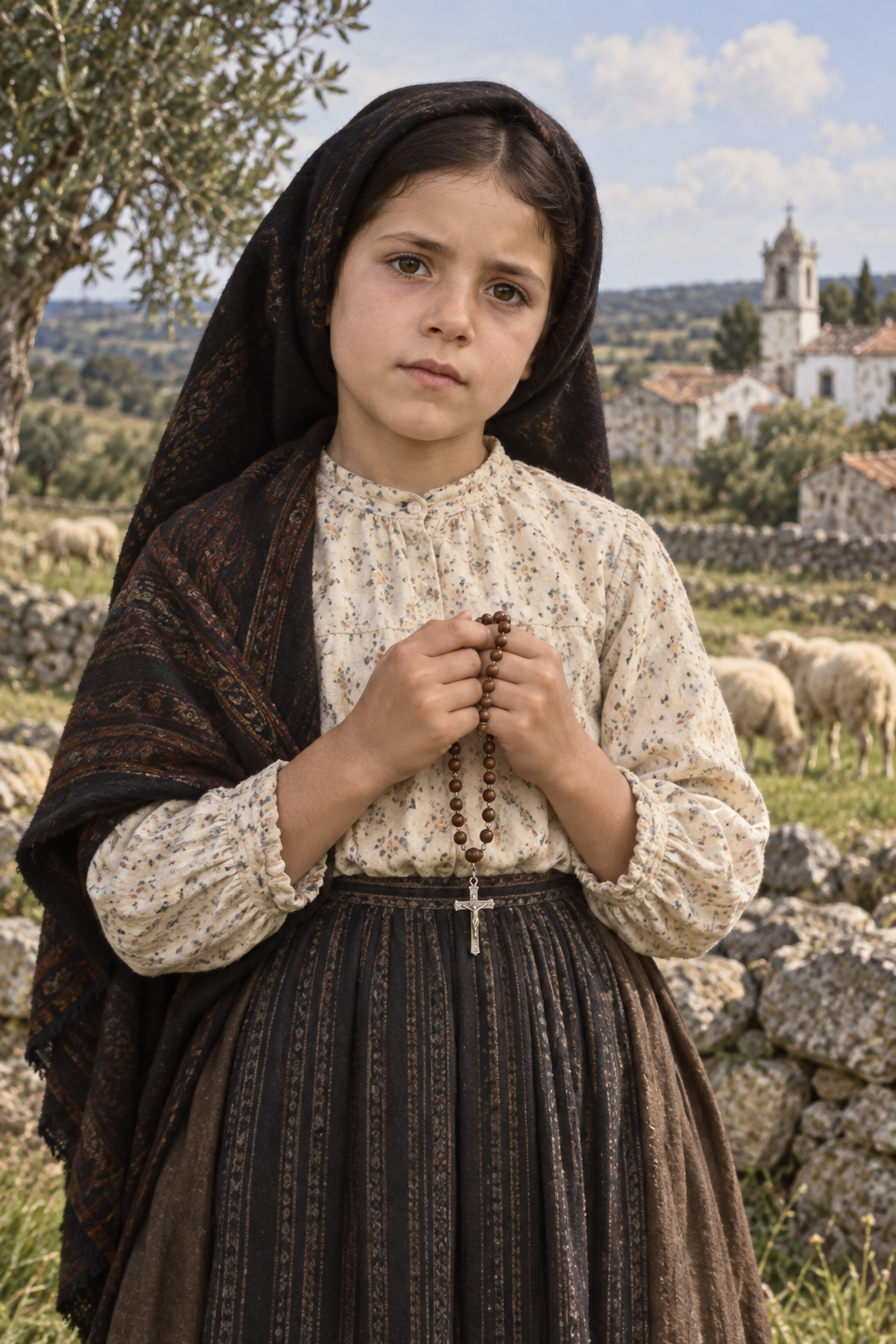
About Jacinta Marto
Jacinta Marto was born on 11 March 1910 at Aljustrel near Fátima, Portugal. She was the younger sister of Francisco and one of the three children associated with the Marian events at Fátima in 1917. Her childhood setting was rural and family-centered, and the official account places her early life among ordinary work, shepherding, and village religious practice. [FJ1]
The Fátima events changed how Jacinta was remembered. The Catholic cause record describes her as responding with unusual concern for sinners and for people who suffered. She devoted herself to prayer and accepted practices of sacrifice within the religious understanding of her time. These claims require careful language: they describe the testimony and devotional interpretation preserved by the Church, and should not be expanded into invented private motives or psychological certainty. [FJ1]
Jacinta's later life was marked by illness and separation. She was treated for the disease that followed the influenza pandemic and was moved away from her family for medical care. The official profile records that she died on 20 February 1920 at Hospital D. Estefânia in Lisbon. Her death place must remain separate from Francisco's death at Aljustrel, even though the siblings are commemorated together. [FJ1]
Jacinta and Francisco were beatified in 2000 and canonized on 13 May 2017. The canonization recognized the children together as the youngest non-martyr saints canonized at that time, but the catalog should use the exact juridical language of the source and not rely on superlatives unless a primary act supports them. Her feast observance, status, and any title should be verified independently before import. [FJ1]
Jacinta's significance is connected to the way a child became a public religious witness while remaining vulnerable to illness and institutional scrutiny. A careful account can describe her prayer, concern for sufferers, and final illness without celebrating suffering itself or implying that children should imitate medical danger. The profile should also distinguish the historical child from later images and devotional stories that may add details absent from the official cause record. [FJ1]
Jacinta's account should begin with the ordinary setting of her childhood. She was a young girl from Aljustrel, part of a family and village community, before the 1917 events brought unusual attention to her. The official source describes her religious response, but the profile should not erase the child who lived within that response: she had family relationships, responsibilities, fears, and a body vulnerable to illness. [FJ1]
The source presents Jacinta as especially concerned with suffering and with the conversion of others. Such language belongs to a devotional biography and needs careful attribution. The catalog can report that this concern shaped the way the Church remembers her without claiming direct access to every private motive or turning childhood sacrifice into a general prescription. [FJ1]
Her final illness also separated her from the village. Treatment in Lisbon meant that the last part of her life was spent away from the family setting in which the Fátima story began. The death at Hospital D. Estefânia should be retained as a precise historical event, while the medical details should remain limited to what the official source confirms. [FJ1]
Jacinta's canonization with Francisco recognizes a shared history but not a shared biography. Her record must retain the distinct birth and death dates, Lisbon death place, and claims about her own response to the Fátima events. A relationship to Francisco and Lúcia can be added only with citations that state the relationship and the relevant event. [FJ1]
Jacinta's significance lies in the way a child's religious witness became a public memory while her life remained short and medically fragile. A responsible profile should preserve the Catholic tradition, distinguish testimony from historical verification, and avoid treating illness or death as desirable in themselves. [FJ1]
Jacinta's account should preserve both her childhood and the historical setting of the Fátima cause. She was not an adult religious founder, and the profile should not project later institutional language onto her short life. The source supports a careful narrative of family life, the 1917 events as reported in the cause material, illness, hospitalization, and death in 1920. It does not support invented dialogue, unlocated visions, or a detailed chronology beyond what the official record states. [FJ1]
Her canonization with Francisco recognizes a shared witness while leaving room for distinct personalities and circumstances. Jacinta's biography should not be reduced to a duplicate of Francisco's, and Francisco's contemplative traits should not be assigned to her without evidence. The final record therefore keeps their shared source visible but writes separate passages, events, and uncertainties for each child. [FJ1]
The source presents Jacinta's life within the same family and village setting as Francisco's, but her account should not be reduced to a duplicate record. The biography retains her own chronology and the distinct details supported by the official cause material. It also keeps the limits of childhood visible: later devotional language must not be projected backward as though it were a contemporary diary or a verbatim account of every thought. [FJ1]
Her illness and death belong to the historical record and should be stated with the supported dates and places. The profile deliberately avoids unsupported medical detail, invented dialogue, and claims that turn suffering into a formula. The strongest account records her brief life, the Fátima context, her illness, and the Church's later recognition without pretending that the source answers every question. [FJ1]
Wondering how to weigh the stories and sources? Learn how to read a saint biography.