Biography
Jacob Riis
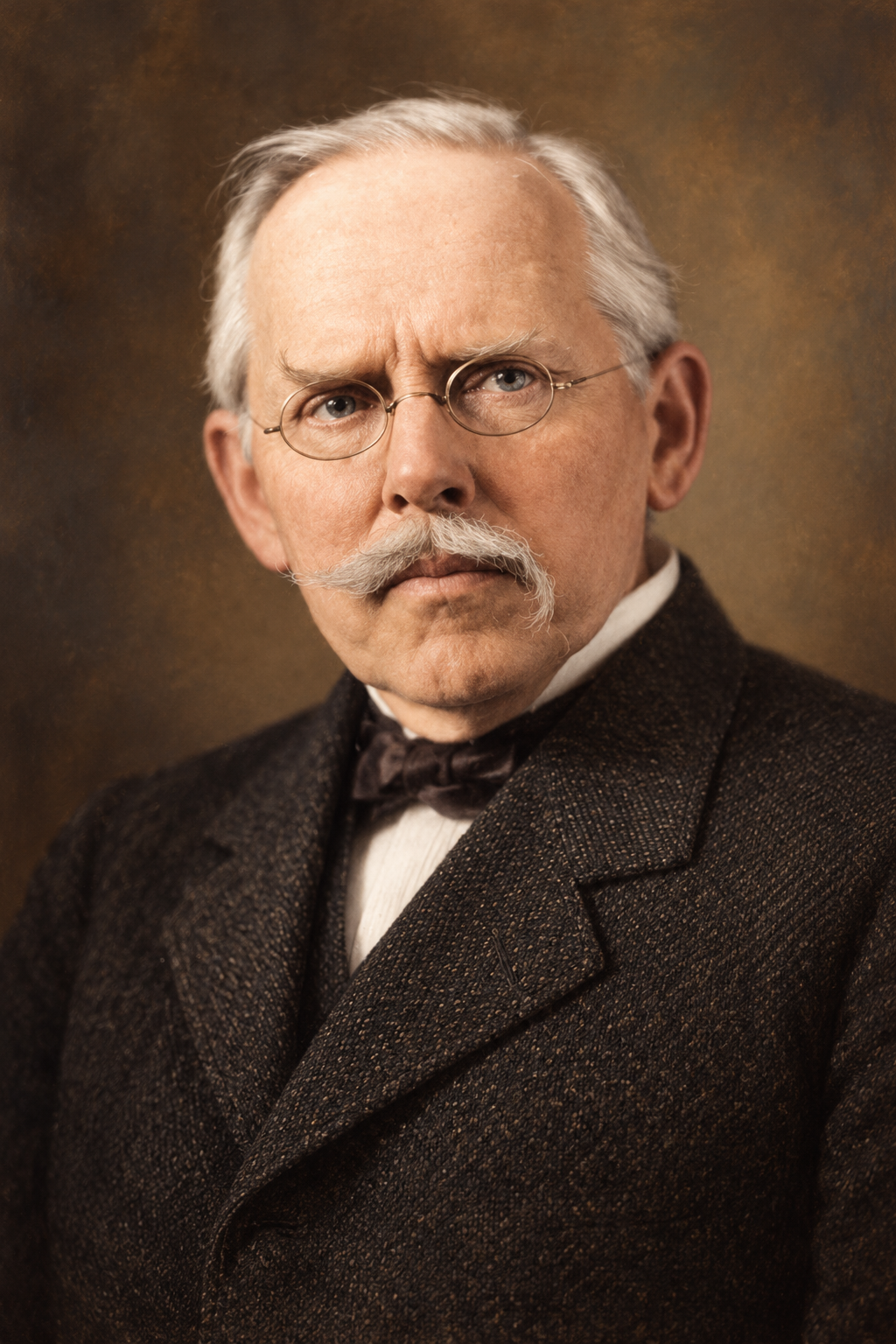
About Jacob Riis
Jacob Riis used reporting, photographs, and public lectures to bring the living conditions of New York’s poor before people who could help change them. His work grew from close acquaintance with immigrant neighborhoods and the pressures of crowded tenement life. He became a public advocate for housing, education, and social reform, presenting poverty as something that required attention beyond the households experiencing it.
Born in Ribe, Denmark, he reached the United States in 1870. His early years included a succession of manual jobs before he established himself in journalism. The Library of Congress chronology records work for the South Brooklyn News in 1874, followed by police reporting for the New York Tribune from 1877 and the Evening Sun from 1888. These assignments gave him sustained contact with the city’s streets and public institutions.
He returned to Denmark to marry Elisabeth Nielsen in 1876. They settled in New York and raised five children. His later autobiography made the hardships of immigration, his marriage, and his friendship with Theodore Roosevelt parts of a story about becoming American. That personal story also served his public campaign for reform.
Riis’s photography was collaborative as well as personal. Early experiments with flash involved Richard Hoe Lawrence and Henry G. Piffard. Riis later took pictures himself and used commercial services for developing them. The photographs helped carry his arguments to audiences through projected slides, while reproduction in print depended on engravings and halftones. His achievement lay partly in bringing words and images together as instruments of persuasion.
The images did not stand outside his judgments about their subjects. The Library of Congress identifies one early photograph as a posed encounter: Riis paid a man to sit for the camera, then described him dismissively as unwilling to work. The episode shows why the reforming purpose of the photographs must be considered alongside the attitudes expressed in their presentation.
How the Other Half Lives appeared in 1890. Its introduction blamed the conditions of tenement life on public neglect and private greed. Riis argued that the comfortable population could not remain separate from the consequences of unhealthy housing. He connected overcrowding with disease, crime, and damage to family life, urging readers to recognize responsibilities that reached beyond occasional charity. These were arguments intended to provoke action, not detached descriptions of a city.
The book also expressed serious prejudice. Its chapter on Chinatown portrayed Chinese residents through sweeping claims about greed, religious emptiness, and moral incapacity. Riis even questioned whether Chinese people could become sincere Christians. These judgments were his own, not merely quotations from hostile observers. His sympathy for some immigrants coexisted with an exclusionary picture of others. The book’s importance in housing reform does not make those descriptions reliable accounts of the people he depicted.
His campaigns reached beyond the appearance of individual buildings. The National Park Service describes his efforts for safer tenements, cleaner water, playgrounds, and better provision for children. He challenged the use of police stations as overnight shelters and supported the replacement of Mulberry Bend’s overcrowded buildings with a park. He believed that improvements in the environment were necessary for the personal effort and responsibility he also valued.
Roosevelt became an important ally while serving as police commissioner and remained his friend as his political career advanced. Riis’s reporting and books reached audiences beyond New York, making urban conditions a national subject. His use of flash photography gave visible form to places that were difficult to photograph in ordinary light, including dark interiors and crowded nighttime lodging rooms.
In The Making of an American, Riis recalled his anger over mistreatment at a police lodging house during his own homelessness. He described struggling with the desire to use his later influence to punish the officer involved. In his telling, he chose instead to attack the system that had made such treatment possible. He framed that decision in Christian terms, condemning shelter arrangements that degraded both those seeking help and those responsible for them.
The same account credited Roosevelt with the decisive action to close the police lodging rooms. Riis described inspecting them together and placed the closure order in February 1896. He also argued that policing and relief should not be combined in a way that confused poverty with criminality. These passages are retrospective testimony to how he understood his work and motives, rather than independent confirmation of every remembered conversation.
His reform methods included the spoken word as well as publication. The Riis Museum describes how illustrated lectures and storytelling drew middle-class audiences into debates about housing and education. His public image as a successful immigrant gave those appeals a personal dimension. That image remains part of his legacy alongside the photographs and books through which later generations encounter the neighborhoods he portrayed.
Riis died in Barre, Massachusetts, on May 26, 1914.
The Episcopal Church commemorates him on July 2.
Wondering how to weigh the stories and sources? Learn how to read a saint biography.