Biography
James Weldon Johnson
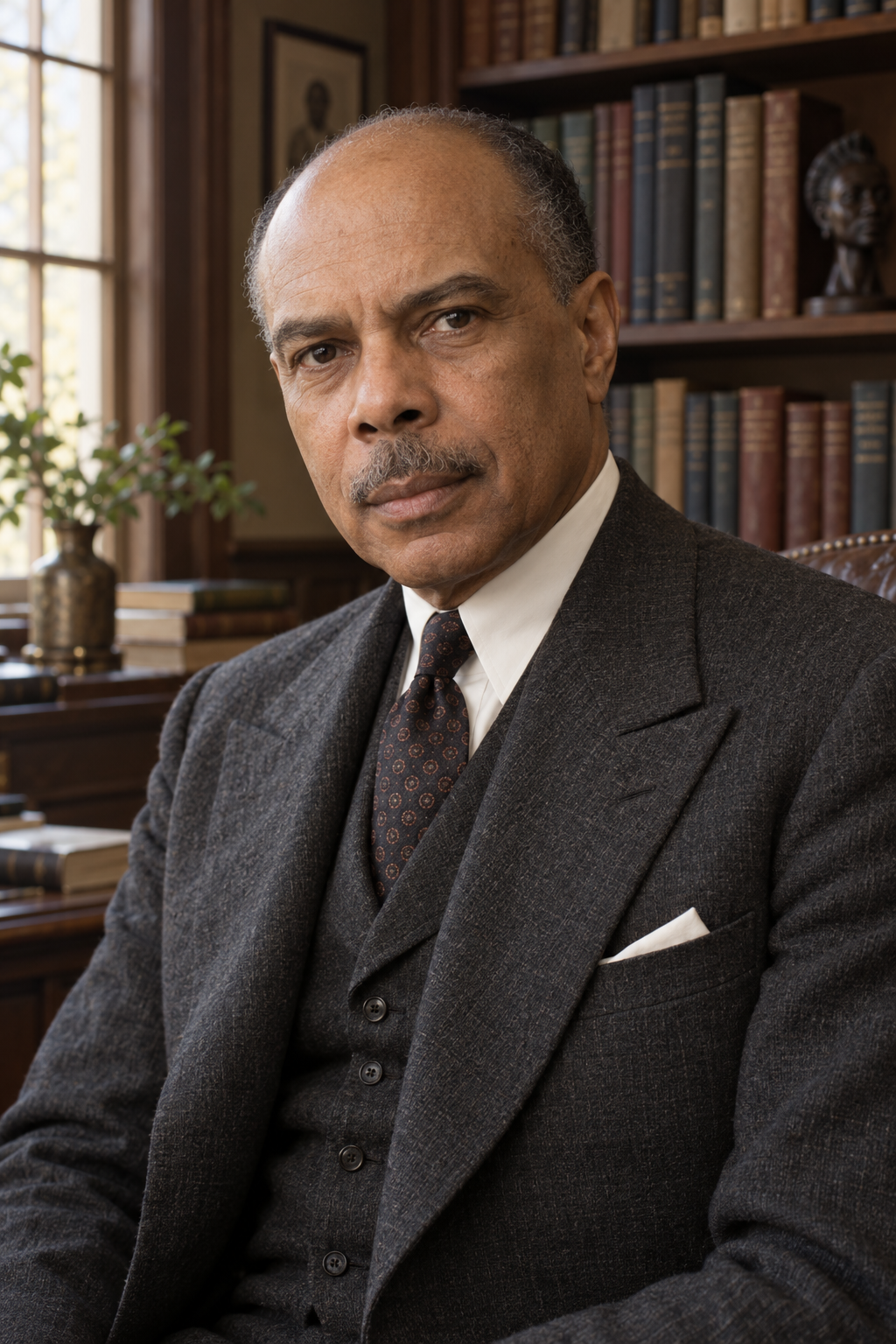
About James Weldon Johnson
James Weldon Johnson grew up in Jacksonville, Florida, in a family that encouraged learning and music. His father worked as a hotel headwaiter, and his mother was a teacher. After graduating from Atlanta University in 1894, he returned to Jacksonville as principal of Stanton School. He expanded its curriculum to include high school subjects. Education was only one part of his early public work: he also established the Daily American newspaper and qualified to practice law.
His best-known song began with a school celebration. In 1900 he wrote the words of Lift Every Voice and Sing for Abraham Lincoln’s birthday, and his brother John Rosamond Johnson supplied the music. The brothers later collaborated with Bob Cole in New York, writing songs for the stage. Their partnership joined James’s work with words to Rosamond’s musical gifts.
Johnson’s career also took him abroad. In 1906 he entered the United States consular service, serving first in Puerto Cabello, Venezuela, and then in Corinto, Nicaragua. During an uprising in Corinto, he negotiated with opposing sides and coordinated with the United States Navy. He continued writing during these years. In 1910 he married Grace Nail, whose interest in the arts and social welfare complemented his own. Grace learned French and Spanish in preparation for diplomatic life and dealt with publishers on his behalf while he was in Nicaragua.
His novel The Autobiography of an Ex-Colored Man appeared anonymously in 1912. Despite its title, it is fiction, not an account of Johnson’s own life. Its central character is a musician who chooses to pass as white, and the story explores racial identity and the costs of that choice. Johnson later wrote an actual autobiography, Along This Way, published in 1933. The distinction matters when reading the two books: the fictional narrator’s decisions cannot simply be treated as episodes in the author’s biography.
Civil rights organizing became another major part of his work. Johnson helped organize the 1917 Silent Protest Parade, in which thousands marched against lynching and racial violence. He became executive secretary of the National Association for the Advancement of Colored People in 1920. His organizing helped the association expand, particularly in the South.
The campaign against lynching required sustained political work as well as public protest. Johnson worked for federal legislation intended to hold perpetrators and complicit officials accountable. The Dyer bill passed the House of Representatives in 1922, but a filibuster by Southern Democratic senators prevented its passage in the Senate. The defeat showed the resistance facing the association’s campaign. Johnson also led an NAACP delegation to President Calvin Coolidge in 1924, presenting a petition for the imprisoned soldiers of the Twenty-fourth Infantry. The ensuing sentence reductions brought the release of some prisoners.
His concern extended to American actions abroad. In 1920 the NAACP sent him to investigate the United States occupation of Haiti. He reported abuses in articles for The Nation and brought the findings to political leaders. The association pressed for Haitian sovereignty. His work challenged the conduct of his own country, whose diplomatic service had earlier employed him. The occupation continued until 1934, so the investigation should not be mistaken for an immediate end to American rule.
Johnson continued publishing while carrying these responsibilities. The Book of American Negro Poetry appeared in 1922, followed by collections of spirituals prepared with his brother. God’s Trombones, published in 1927, drew on the preaching of Black folk ministers. These books brought poetry, music and the spoken traditions of churches into print. Black Manhattan, published in 1930, examined African American life in New York. His literary work preserved and interpreted forms of expression that were also part of the communities for which he organized.
In his later career he taught at Fisk University and New York University. Teaching provided another setting for his continuing work with literature. He remained active as a writer while passing on his knowledge to students. His books ranged across fiction, poetry, history and autobiography, reflecting a career that cannot be reduced to a single song or public office.
Johnson died on June 26, 1938, when a train struck his car in Wiscasset, Maine.
Grace helped preserve his legacy after his death. With Carl Van Vechten, she established the James Weldon Johnson Memorial Collection at Yale in 1941. She donated their papers and encouraged other African American writers and public figures to contribute their archives. Her work helped make the wider cultural world in which Johnson had participated available to later researchers. Grace also supported young authors through her own work as a hostess and mentor, continuing interests that she had shared with Johnson during their marriage.
Episcopal churches remember Johnson as a poet. Christ Church in Woodbury, New Jersey, announced Evening Prayer and a Eucharist for his commemoration on June 25, 2020. That observance supplies the calendar date used here.
Wondering how to weigh the stories and sources? Learn how to read a saint biography.