Biography
Jean-Bernard Rousseau
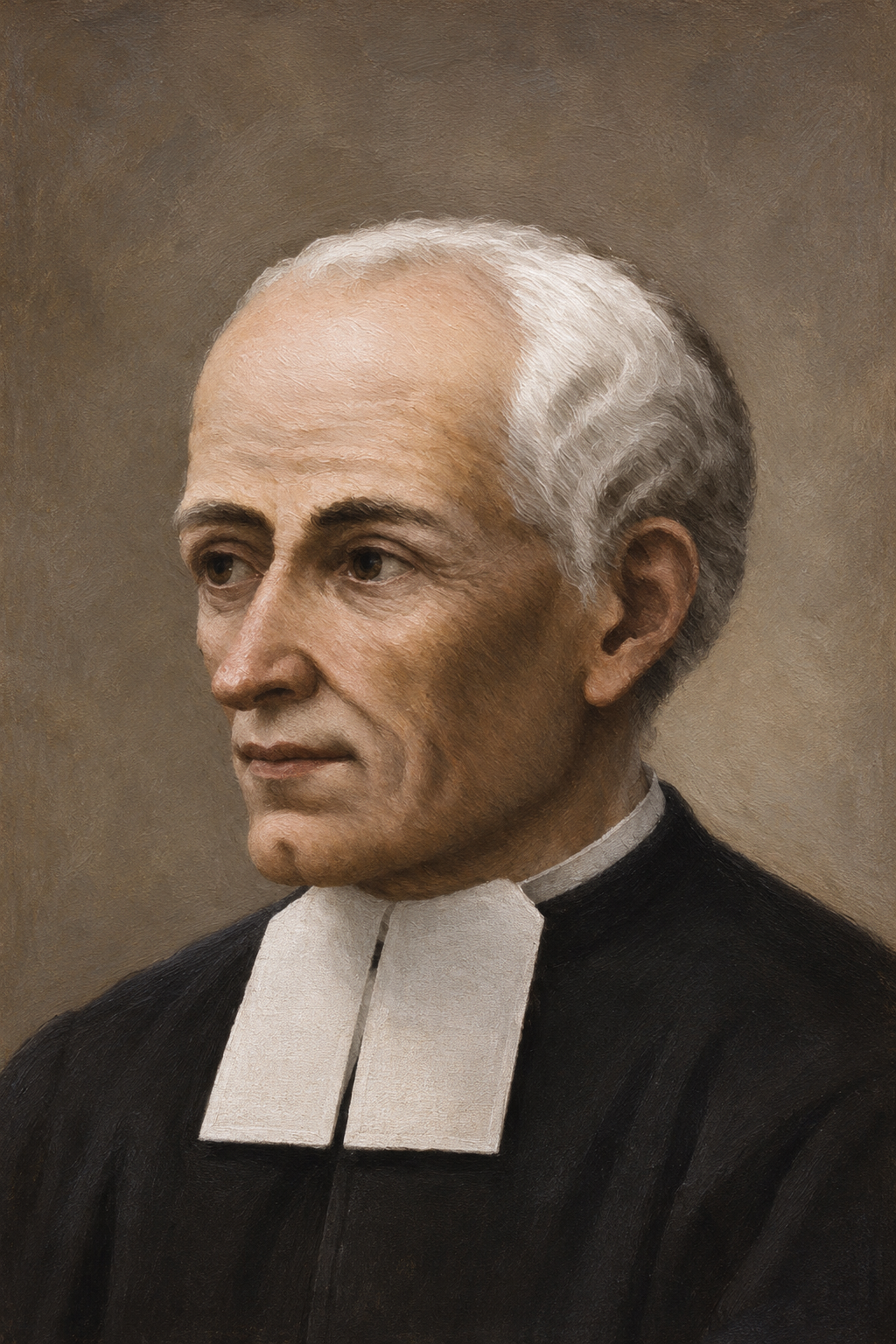
About Jean-Bernard Rousseau
Jean-Bernard Rousseau was born in 1797 at Annay-la-Côte, in Burgundy, France. His father was a stonecutter, and his family maintained a Catholic life during the disruption of the revolutionary period. As a young adult he became interested in the Brothers of the Christian Schools, whose work he encountered at Auxerre. He entered their novitiate in Paris in 1822 and received the religious name Scubilion. His vocation joined life in a religious community with the education of young people.
His early education came through his parents, a parish priest and a tutor. He began helping to teach when a village school reopened. That practical experience helped prepare him for the institute he later joined. During the next decade he worked in schools at Alençon, Poitiers and Chinon. His years in France were thus largely spent in elementary education. The later missionary was first a teacher learning to serve children within the educational tradition of John Baptist de La Salle.
Resch’s account describes training in the Brothers’ teaching methods alongside their rule of religious life. At Alençon, his work initially included domestic duties in the kitchen and garden. He obtained a teaching qualification in 1826 and made perpetual vows the following year. These details locate his preparation in both classroom work and the ordinary tasks of community living. The responsibilities he later carried overseas grew out of this combination of education, prayer and practical service.
In 1833 he volunteered for service on the island then known as Bourbon, now Réunion. He arrived in July and remained there for the rest of his life. His assignments took him to several towns, including Saint-Benoît, Saint-Paul, Saint-Leu, La Possession, Saint-Denis and Sainte-Marie. He taught children and young people while also developing work with adults. The island became the setting for thirty-four years of religious and educational service, through circumstances that changed significantly during his lifetime.
A central part of that work was religious instruction for enslaved people. He organized evening classes that people attended after exhausting days of labour. He adapted lessons and methods to the needs of his students and prepared them for the sacraments. The Brothers’ account emphasizes his kindness and respect toward those he taught. The timing of the classes also reveals the constraints under which education occurred: learners came when plantation work allowed, rather than enjoying control over the hours of their own day.
He worked within a wider network of Brothers who also taught enslaved adults. Bedel’s institutional history names other religious engaged in this work and places it within contemporary debates about slavery and emancipation. Slavery was abolished on Réunion in 1848, and the Brothers continued instruction among people who had become legally free. This wider setting matters because the achievement of freedom did not belong to a single teacher. Scubilion’s particular contribution was sustained educational and religious service before and after that change.
His work also included practical assistance. Accounts connect him with mutual aid, and his later assignments continued to combine teaching, catechism and service within the religious house. During the cholera epidemic of 1859, he helped care for sick people. His role therefore extended beyond delivering lessons. It brought him into the needs of households and communities facing illness, poverty and change. The religious brother’s daily service could include a classroom, an adult gathering, a sickbed or the tasks required to maintain his own community.
The mutual-aid tradition described by Bedel used small contributions to assist members who became ill and families who had lost someone. He records Scubilion taking charge of such work on Réunion. These arrangements gave assistance a regular, shared form, alongside the more immediate acts of charity remembered in biographies. They also made the participants contributors to one another’s security. Religious meetings and practical support could belong to the same network of relationships, especially where poverty made illness or a death financially dangerous.
John Paul II later recalled another side of his teaching: excursions with pupils from Sainte-Marie. They explored local heights, caves and paths, and some outings included visits to churches. The pope described a lively educator who could draw young people into learning through experience as well as through a lesson. These recollections give the schoolteacher a more particular presence than the title catechist alone. He worked with adults under severe constraint, but also with children whose education included curiosity, companionship and movement beyond the classroom.
He continued helping marginalized people and visiting the sick as his own health declined. He died at Sainte-Marie on 13 April 1867. The island’s Catholic community remembered him with strong affection, and devotion continued around his tomb. John Paul II beatified him at Saint-Denis on 2 May 1989. His liturgical remembrance has different dates in different settings, including the Lasallian family’s 27 September observance and Réunion’s commemoration associated with the abolition of slavery on 20 December.
At the beatification, the pope emphasized respect for the dignity of every person and compassion for people in distress. He also placed Scubilion beside Jacques-Désiré Laval in Mauritius and Victoire Rasoamanarivo in Madagascar, as witnesses within the Indian Ocean region. That Catholic remembrance connects his life with both local history and a broader call to fraternity. The figure honoured is a religious brother whose sustained teaching and care were exercised among people living through enslavement, emancipation and its aftermath.
Wondering how to weigh the stories and sources? Learn how to read a saint biography.