Biography
Jeanne Delanoue
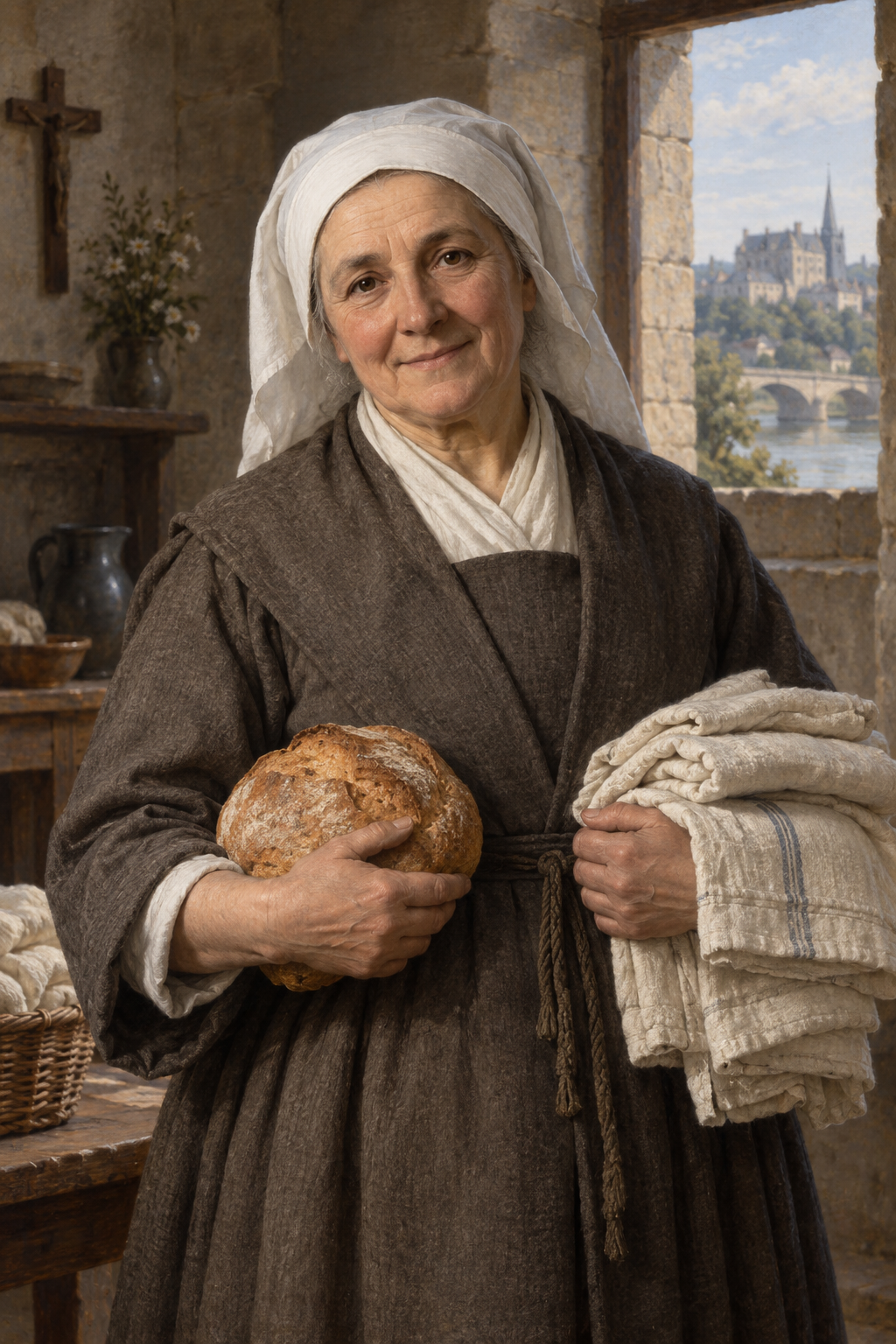
About Jeanne Delanoue
Jeanne Delanoue was born on 18 June 1666 in Saumur, a town on the Loire. Her family kept a haberdashery, and later accounts place her childhood among the shop's work and customers. The Holy See's short biography says she was the youngest of twelve children. Such a summary identifies her place in a large household, but it cannot show what each day of her childhood was like. The shop, however, remained central to her adult life before she established a religious community.
Her father Pierre died in 1672, and her mother Françoise Huneau died in 1692. Jeanne then carried responsibility for the business. Nicole Pellegrin's critical biography traces these family losses alongside the later accounts of Jeanne's changing commitments. Stories that describe her earlier self only as greedy come mainly through devotional retelling. The surviving outline supports a merchant responsible for a household and a shop; it does not license certainty about every private motive.
The city of Saumur locates the family business on rue Rabelais. It also records a meeting in 1693 with Françoise Souchet, a woman whose words encouraged Jeanne to turn toward people living in poverty. Local tradition places that encounter around Pentecost. It matters because later work drew on the resources and location of the shop, making the household a place of welcome. Exact conversations belong to the tradition, not to an independently preserved transcript.
The transformation was gradual. A scholarly study of the Servants of the Poor dates the decisive turn to Pentecost 1693, but it also shows that an organized congregation did not appear overnight. Jeanne's support for poor neighbors began as hospitality and grew into repeated service. The years before the 1704 community mattered: people in need could not wait for a formal rule. Her founding grew through practical responses.
A Dicastery biography says she welcomed a child into her house in 1700 and later extended care to sick and elderly people. This sequence describes a widening need rather than one single charitable act. The people were not an anonymous category; children, adults and older residents required different forms of attention. The account is retrospective, not a register of every guest or patient.
Pellegrin notes that Jeanne handed over the commercial business to a niece in 1702 and enlarged the sheltering work. On 3 July 1703 a landslip brought down the building used by the poor. The collapse could have ended a fragile effort, but the people and helpers continued it in other premises. That physical interruption gives a clearer picture of the work than an account of uninterrupted success: care required a usable roof, food, money, and other women's sustained labor.
On 26 July 1704 Jeanne and her companions received a grey habit. An institute record treats the day as the formal beginning of the community later called the Servants of the Poor. The number of companions matters. Even at this early stage the work was shared, with women committing themselves to live near the people they served. Their house was not merely a place where Jeanne gave alms from a distance. It became the base for a collective religious and social undertaking.
The Diocese of Angers identifies the Servants of the Poor as a congregation founded at Saumur in 1704. In local memory its members are often called the Sisters of Saint Jeanne Delanoue, a later name that reflects the canonized founder. The foundation brought together care and religious life in a particular place. It did not make poverty disappear from the town or remove the need for other networks of aid; it gave women a durable form for organizing their service.
Episcopal approval of the rule followed in 1709. A scholarly history describes the sisters and those they housed sharing a roof, food and linen, an arrangement more intimate than a separate charitable institution. The rule gave shape to common living, obligations and authority. Sources disagree over the precise September day of episcopal approval, so only the year is used here. The approval marked a new institutional stage, but the years of direct care before it remain part of the foundation story.
Space remained a problem. The Diocese of Angers' liturgical history describes an initial Providence in Jeanne's own house in 1698 and a larger Three Angels house in 1716. The city's heritage account dates a hospice at the former Three Angels inn to 1713, while the Holy See biography gives 1715 for a first home for poor people. The surviving summaries may refer to different moves and stages. The honest conclusion is that larger facilities emerged during the 1710s; these sources do not establish one uncontested opening day.
In his canonization homily John Paul II emphasized the sisters' willingness to share the living conditions of people they served. He spoke of children, women and older people in need, and of a refusal to sort the poor into worthy and unworthy classes. That is a papal reading of Jeanne's spiritual example, not a statistical account of everyone admitted. The homily also notes that her severity could provoke criticism. It offers a view of a demanding life that was admired and contested even within its religious setting.
The parish bearing Jeanne's name remembers Françoise Souchet's role and the help of other religious figures in the foundation. Such memory should not make Jeanne's companions invisible. They cooked, received strangers, nursed people and maintained the households long after the first decision to open a door. Later retellings naturally center on a founder, while the work itself depended on a community. The parish account is valuable testimony to what local Catholics continue to remember, alongside scholarly caution about the precise form of early visionary stories.
By the time Jeanne died on 17 August 1736, the congregation had spread. Guillerand-Champenier records twenty-four religious women in Saumur and eleven other foundations at her death. Those figures show both the scale of the undertaking and a limit to any one-person story. Each house needed members, resources and relationships with its own community. Jeanne's death did not end the service she had helped organize. The same scholarly work follows the congregation beyond 1736, showing the institution continuing through later upheaval.
Pius XII beatified Jeanne on 5 November 1947, and John Paul II canonized her on 31 October 1982. These ceremonies recognized a life already remembered by her congregation and region. The Dicastery gives both dates and names Pius XII in its biography. A Dicastery database label mistakenly says Pius VII for the 1947 event; that mismatch should not be copied into her record.
The congregation remembers her death on 17 August. A feast is an act of remembrance, not proof of every later legend. Delanoue can be remembered for practical welcome and the creation of a community that made care repeatable. Her life also shows how a shopkeeper's household, other women's commitment and local episcopal support came together over time. The evidence is strongest for those actions and institutions, while the words and visions sometimes attached to her remain traditions.
Wondering how to weigh the stories and sources? Learn how to read a saint biography.