Biography
Jeremiah
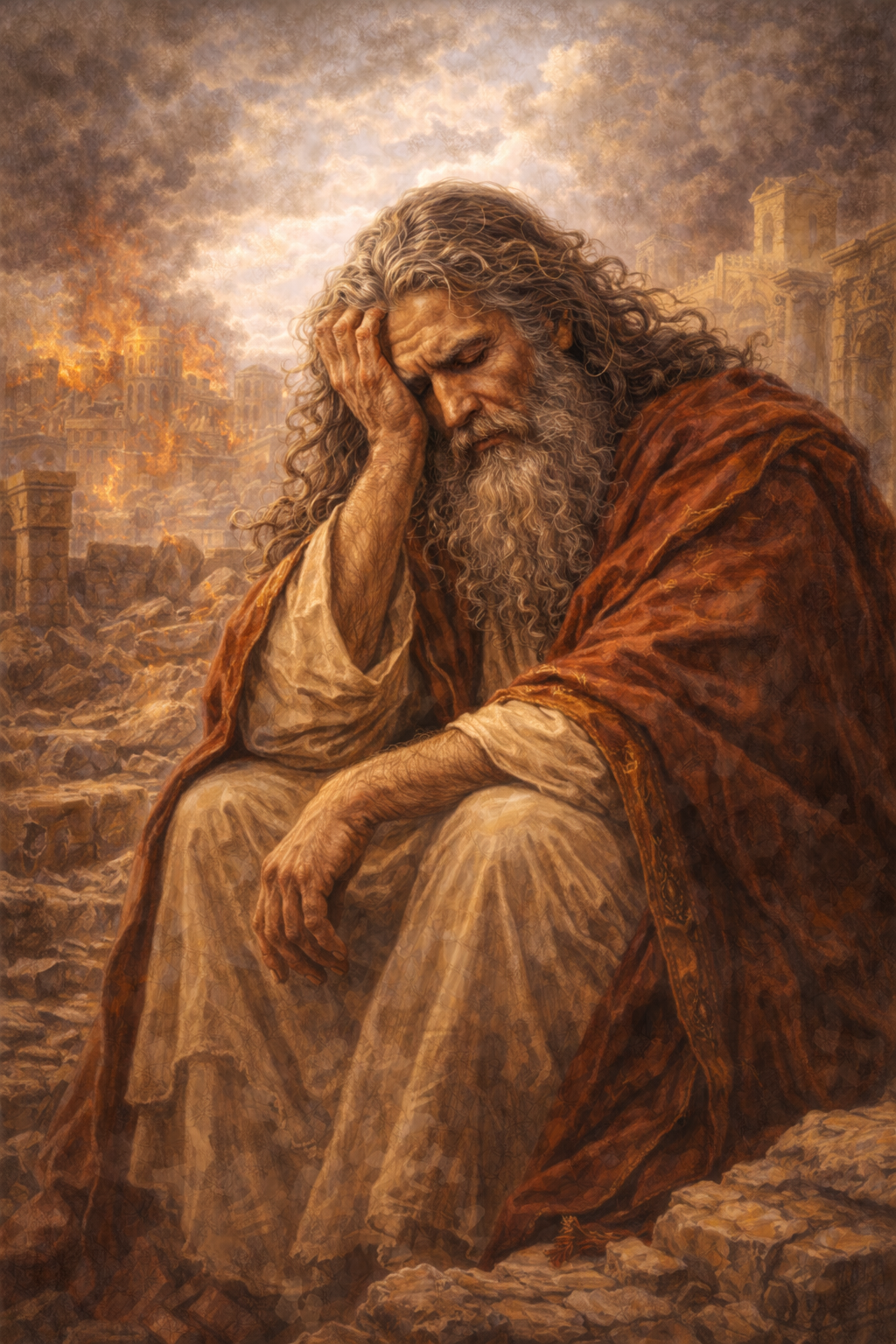
About Jeremiah
Jeremiah was a priest from Anathoth and a prophet in Judah during the kingdom’s final decades. The book bearing his name combines prophecy, narrative, and biographical material, and it circulated in more than one ancient edition. Its historical setting stretches from Josiah’s thirteenth year through the reigns of Jehoiakim and Zedekiah to Jerusalem’s destruction and exile. The USCCB introduction places Jeremiah’s birth perhaps about 650 BC, but neither it nor the book supplies a complete life chronology. This account therefore retains only that approximate year, leaves his death unknown, and distinguishes historical setting from episodes preserved in the scriptural narrative.
Jeremiah 1 identifies him as a son of Hilkiah, one of the priests at Anathoth in Benjamin. In the call narrative, Jeremiah objects that he is too young and does not know how to speak. God touches his mouth and appoints him to uproot and tear down, but also to build and plant. The chapter anticipates conflict with kings, officials, priests, and the people. It does not state that Jeremiah was fifteen, and its note says the call story may be patterned after Moses. The scene is received here as sacred tradition rather than a modern transcript of an independently witnessed encounter.
His preaching challenged confidence in religious institutions detached from conduct. At the temple gate, Jeremiah tells worshipers to amend their ways, practice justice, protect the resident alien, orphan, and widow, and cease violence and idolatry. He warns them not to treat the temple slogan as a guarantee of safety. Chapter 26 presents a related address and says priests and prophets demanded his death after he predicted that the sanctuary and city could become desolate. Officials and elders heard the case, and Jeremiah defended himself by repeating his commission and urging reform. The narrative reports that he was not executed.
The book also preserves Jeremiah’s anguish. After the temple official Pashhur has him beaten and put in stocks, Jeremiah laments ridicule and isolation. He says that suppressing the message feels like a fire confined in his bones, yet the same poem moves between trust, accusation, praise, and a curse upon his birth. These tensions should not be flattened into cheerful perseverance. Jeremiah’s confessions portray a speaker who continues his vocation while protesting its cost. They are poetic testimony within the book; they do not establish the modern nickname ‘weeping prophet,’ a diagnosis, or an unbroken emotional state across his life.
As Babylonian power grew, Jeremiah urged submission rather than revolt. He wore a yoke as a public sign and disputed Hananiah, who broke the wooden yoke and promised a rapid return of temple vessels and exiles. Jeremiah answered that peace could be known as genuine only when fulfilled and later announced an iron yoke. In a letter to deportees, he advised building houses, planting gardens, forming families, and seeking the welfare of the city where they lived. This was neither approval of imperial violence nor a promise of quick rescue. It was counsel for survival during a long displacement.
Jeremiah’s words also encountered royal suppression. He dictated earlier oracles to Baruch, who read the scroll publicly when Jeremiah could not enter the temple. Officials then had it read before King Jehoiakim. The king cut off sections and burned them despite objections from several officials. Jeremiah dictated a replacement with additional words. The episode shows a collaboration between prophet and scribe and presents preservation as resistance to censorship. It also warns against imagining the book as a single untouched document written at one sitting: the narrative itself describes dictation, destruction, rewriting, collection, and expansion.
During Jerusalem’s siege, officials accused Jeremiah of weakening the defenders and lowered him into a muddy cistern, where he faced starvation. Ebed-melech, a Cushite court official, protested to Zedekiah and organized a careful rescue using ropes and rags. Jeremiah remained under guard and continued privately advising the king to surrender. The scene preserves cowardice and courage within the royal administration: powerful officials sought the prophet’s death, an outsider acted to save him, and the king shifted between protection and capitulation. Jeremiah’s counsel was politically dangerous, but the text does not make every reported oracle a timeless program for public policy.
Even while confined, Jeremiah bought a field at Anathoth from his cousin Hanamel. The deed was signed, witnessed, and entrusted to Baruch for preservation. Within the narrative, the purchase embodies hope that houses, fields, and vineyards would again be acquired after catastrophe. Nearby restoration oracles speak of a renewed covenant written on the heart and of forgiveness. These promises stand beside, not instead of, the book’s judgment and grief. The land purchase is associated with Anathoth, but no surviving evidence identifies the parcel, so a future map should show only the settlement-level association rather than an invented site.
After Jerusalem fell, Jeremiah was released and remained with the community under Gedaliah. Gedaliah’s assassination brought renewed fear. Although Jeremiah counseled the survivors not to flee to Egypt, their leaders rejected his word and took him, Baruch, and the remnant to Tahpanhes. There he continued speaking against idolatry and announced danger from Babylon. The book’s biographical narrative ends in Egypt without describing Jeremiah’s death. Later Orthodox tradition says he was killed there and adds miracle and relic stories, but those claims cannot supply a historical death date, place, or martyr classification without stronger corroboration.
The Orthodox Church in America commemorates the Prophet Jeremiah on May 1, documenting a particular Christian reception of him. His importance reaches beyond that calendar. The book remembers a priest-prophet who criticized exploitation and false security, worked with a scribe to preserve contested words, endured confinement, and enacted hope by purchasing land during siege. It also transmits harsh judgments and intimate complaints that resist an idealized portrait. Jeremiah remains significant as a complex witness formed by national collapse: neither a predictor detached from history nor a flawless hero, but a public voice whose warnings, grief, and hope survived the institutions that tried to silence them.
Wondering how to weigh the stories and sources? Learn how to read a saint biography.