Biography
John Baptist de La Salle
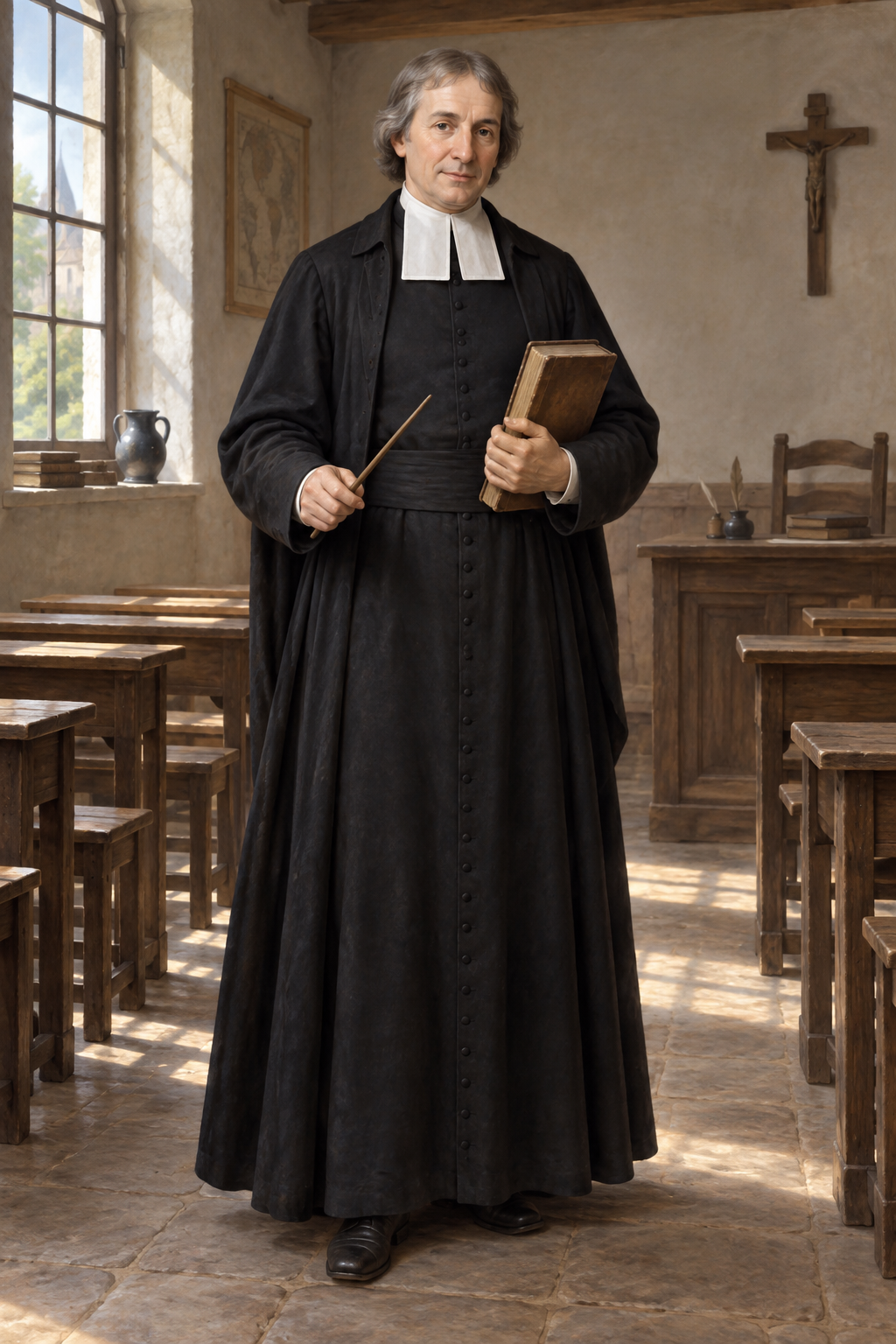
About John Baptist de La Salle
John Baptist de La Salle is remembered as founder of the Brothers of the Christian Schools and as a saint whose name is inseparable from education. Pope Francis, addressing the Brothers in 2019, described the Lasallian charism as an educational mission shaped by the Gospel and directed especially toward those made vulnerable by poverty. This is the reliable center of the biography: De La Salle helped form a community whose vocation was to teach, accompany, and serve young people.
The work associated with De La Salle was innovative not simply because it involved schools, but because it treated education as a matter of justice and pastoral care. Children who lacked wealth or social standing could be excluded from learning. A Christian school, in the Lasallian understanding Francis describes, was meant to be a place where the dignity of each pupil was recognized and where intellectual formation was joined with moral and spiritual growth.
The Brothers of the Christian Schools were organized as religious educators. Their communal character mattered: a founder’s work could continue because teachers prayed, lived, trained, and served together. This distinguishes the Lasallian tradition from a story of a single remarkable teacher. De La Salle’s legacy is institutional and relational, carried by generations of brothers and lay partners as well as by the students themselves.
Francis also calls Lasallian education attentive to contemporary forms of poverty. This does not make De La Salle a modern policy maker. It shows how the Church receives his charism: the educational mission must be renewed when young people face exclusion, displacement, economic hardship, or a loss of human accompaniment. The founder’s example is alive when education remains accessible and personal rather than merely efficient.
Pius XII named John Baptist de La Salle patron of teachers of children and youth, a fact John Paul II recalled in 2000. Patronage recognizes the particular service by which the Church remembers him. It also provides a spiritual lens for educators: teaching can be a vocation of patience, competence, justice, and care for the whole person.
The sources used here do not need a catalogue of private anecdotes to explain De La Salle’s importance. They establish a founder whose vision transformed schooling for poor young people, shaped a community of religious educators, and continues to challenge schools to put the vulnerable first. This packet defers unsourced detail while preserving the strongest documented account of his educational legacy.
The educational work associated with De La Salle also involved a particular view of teachers. They were not simply employees delivering information; the Brothers were formed as a community whose service involved prayer, discipline, shared responsibility, and an attentive presence among students. This account is supported by the later Church reception of the Lasallian charism, while the precise development of any individual school requires its own historical evidence.
Putting poor children at the center has consequences beyond enrollment. It raises questions about whether a school can welcome students who lack money, stable housing, family support, language access, or confidence that they belong. Pope Francis applies the Lasallian charism to these contemporary forms of vulnerability. That application is not a claim that De La Salle anticipated every modern condition; it shows why his educational legacy remains capable of renewal.
Human and Christian formation also belong together in this tradition. Intellectual development matters, but so do conscience, relationships, responsibility, and the ability to contribute to a community. This does not make religious education a substitute for sound teaching. The Lasallian vision described by Francis insists that learning should take seriously the whole person, especially where social exclusion reduces a child to test results or economic prospects.
The patronage of teachers of children and youth gives De La Salle’s name a continuing devotional role. Teachers can ask his intercession not because teaching is easy or sentimental, but because it requires patience, competence, fairness, and resilience. The patronage also directs attention to the dignity of students: a teacher’s vocation is fulfilled in helping young people grow, not in preserving adult authority for its own sake.
The long life of the Brothers of the Christian Schools illustrates the strength and responsibility of an educational charism. Institutions can extend a founder’s service across generations, but they must continually test whether their practices still serve the people the founder placed first. The sources used here support that principle of renewal. They do not need a collection of private stories to show why De La Salle remains a compelling witness for educators and communities.
This also explains why Lasallian education cannot be measured only by institutional scale. A school may have resources, reputation, and many students while still failing to notice those who are excluded or struggling. The founder’s received charism asks teachers and leaders to attend to the concrete young person before them. That attention requires structures, training, and accountability as well as kindness.
For a public saint record, the evidence supports a focused conclusion. John Baptist de La Salle founded a community of educators whose mission placed poor young people at the center, and the Church later named him patron of teachers of children and youth. The sources do not need to make every educational practice timeless to preserve their force. They show a spiritual tradition in which learning becomes a work of justice, care, and hope.
Wondering how to weigh the stories and sources? Learn how to read a saint biography.