Biography
John Eliot
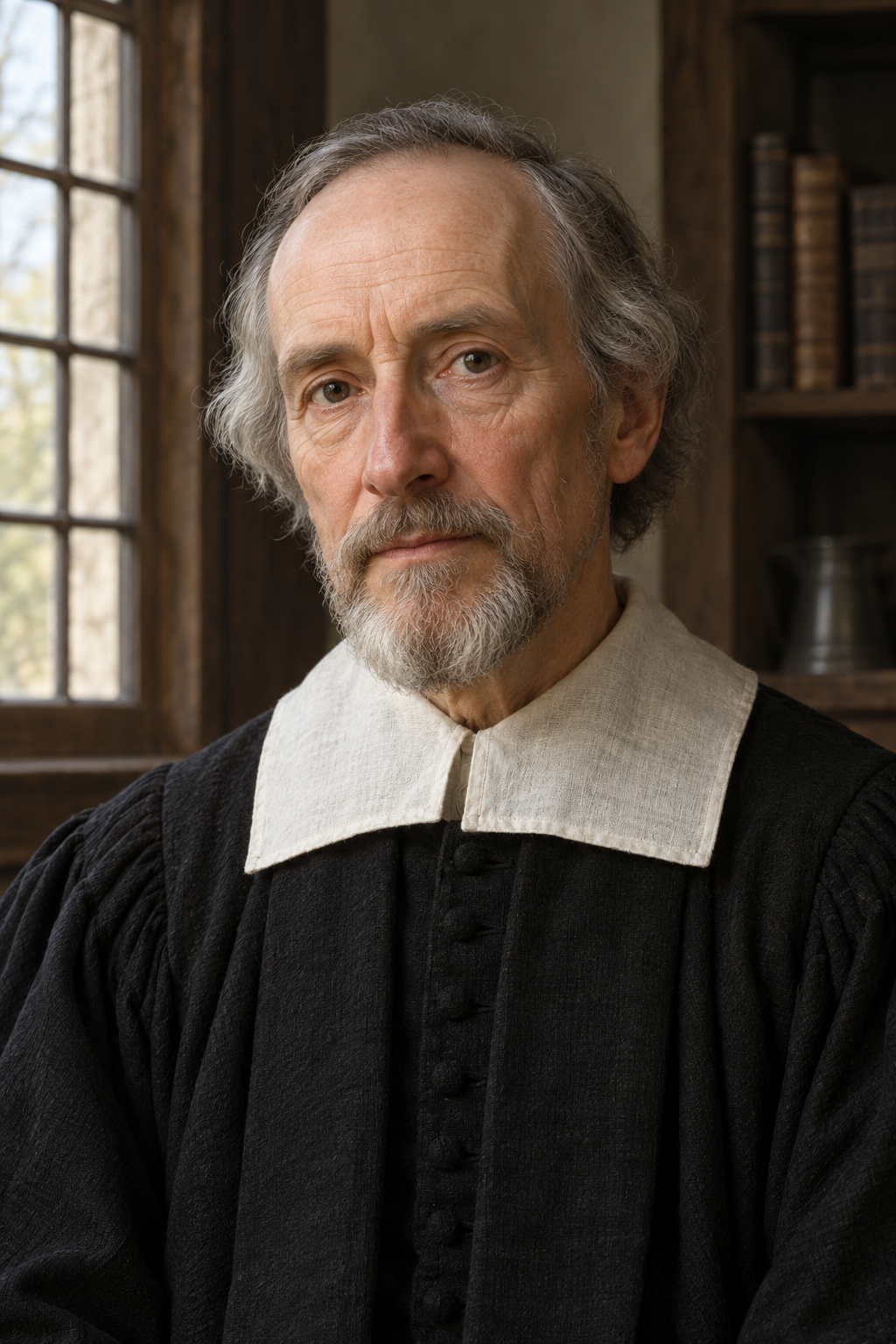
About John Eliot
John Eliot was a Congregational minister in colonial Massachusetts whose mission joined Christian teaching to the transformation of Indigenous life. He spent most of his ministry at Roxbury, near Boston. His work among Native communities became an influential model for later missionaries, including Eleazar Wheelock. It combined instruction in Christianity, the training of Native teachers, and a conviction that conversion required changes in social life.
Born at Widford in Hertfordshire in 1604, Eliot studied at Jesus College, Cambridge. He later taught at Thomas Hooker’s school in Little Baddow. Hooker’s Puritan convictions brought him into conflict with church authorities. Eliot sailed to New England in 1631, served briefly in Boston, and settled at Roxbury the following year. There he married Ann, also called Hannah, Mumford. Roxbury remained his home for the rest of his life.
Learning to preach beyond the English settlements required help. One of his first language teachers was Cockenoe, a Native man captured during the Pequot War who lived in an English household at Dorchester. Eliot depended on his knowledge of both languages. His linguistic work grew through this unequal encounter, rather than through solitary study.
In 1646 Eliot preached at the home of Waban at Nonantum. The people who gathered there sought security for their land as well as religious instruction. When that security could not be obtained at Nonantum, a community developed at Natick. Its daily affairs were led by Indigenous people; Eliot continued to live in Roxbury. John Speen and other Native leaders were central to its establishment, while Monequassun taught in the school. The settlement’s history cannot be reduced to the work of its English missionary.
The Massachusett Tribe at Ponkapoag tells a related history of displacement. Its account describes Neponset families forced from valuable planting grounds and access to the coast. Eliot advocated protection for the displaced community. In 1657 Dorchester agreed to set aside land for a praying town at Ponkapoag, but this also restricted land that had already belonged to Indigenous people. The arrangement offered protection within a colonial system that was taking control of their territory.
Protection came with demands. The tribe’s history describes requirements concerning Puritan law, clothing, hair, household arrangements, and religious observance. Eliot supplied tools, livestock, and cloth with support from England. These material provisions accompanied pressure to abandon established ways of living. His opposition to settler violence and his commitment to cultural change were parts of the same mission.
Eliot nevertheless recognized that Native congregations needed Native teachers. In his 1670 report he argued that an inexperienced English minister, struggling with the language, could offer less than a capable local preacher who understood both speech and customs. He proposed training teachers in methods of instruction and theology. The report names local leaders, describes the Natick congregation, and discusses the cost of sending teachers to other communities. It also shows the limits of his approach: schooling was compulsory, and neglect could bring both civil and church discipline.
The Bible associated with his name likewise depended on Native expertise. The Wôpanâak Language Reclamation Project identifies Cockenoe, Job Nesuton, John Sassamon, and other speakers as contributors to translation, and James Printer, a Nipmuc man, as an important typesetter. Their knowledge made a work possible that an English minister could not have produced alone.
Natick’s history also remembers Job Nesuton’s sustained assistance with the language and the contributions of Native students associated with Harvard. Their participation linked the mission’s teaching, translation, and printing with the knowledge of particular communities.
The New Testament appeared in 1661 and the complete Bible in 1663. Copies sent to England helped connect the mission with supporters across the Atlantic. After many copies were destroyed during the wars of the 1670s, Eliot helped finance and supervise another edition in his old age.
King Philip’s War brought devastation to the Christian Native communities. People who sought shelter at Natick and other settlements were removed to Deer Island in Boston Harbor. The historical account of the New England Company describes inadequate provisions and deaths from hunger, exposure, and disease. Christian affiliation did not protect them from English suspicion or confinement. Survivors returned to communities that had been badly diminished.
Eliot died at Roxbury in May 1690. Sources disagree between May 20 and May 21, so the exact day remains unsettled here.
Holy Women, Holy Men assigned his commemoration to May 21.
The 2009 General Convention authorized that calendar for trial use.
A 2024 bulletin from St. Paul’s Episcopal Church in Canton, Ohio, also listed his May 21 commemoration.
The surviving texts also belong to a history beyond his missionary intentions. Cofounded in 1993 by Helen Manning and Jessie Little Doe Baird, the Wôpanâak Language Reclamation Project has used religious texts alongside Native deeds, wills, petitions, and related languages to recover speech for new generations. Its account presents language as a living responsibility to ancestors and descendants. The Bible’s continued significance therefore includes the work of Indigenous people reclaiming their own language and cultural inheritance.
Wondering how to weigh the stories and sources? Learn how to read a saint biography.