Biography
John La Farge
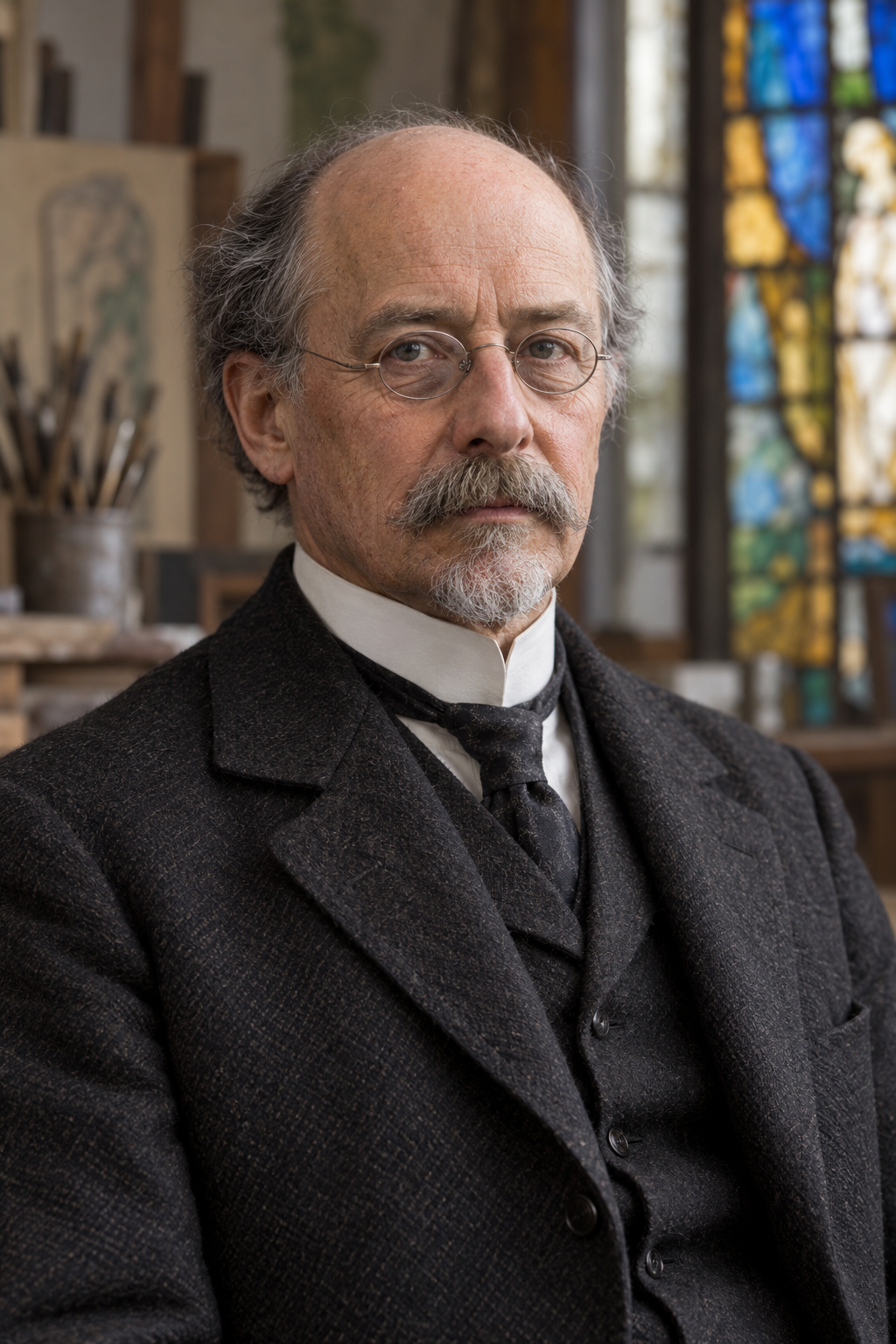
About John La Farge
John La Farge was an American painter whose religious murals and stained-glass windows brought new color and light into churches. Born in New York City to prosperous French parents, he received a Catholic education and later studied briefly with Thomas Couture in Paris. In Newport, Rhode Island, he worked with William Morris Hunt and met William and Henry James. His interests extended beyond a single medium: even after large decorative commissions became central to his career, he continued to paint. His large mural of Christ’s Ascension in the New York church of that name was completed in 1887.
An early self-portrait gives a glimpse of those beginnings. Painted in October 1859 at his family’s estate in Glen Cove, it shows him prepared to go out as a landscape painter. The Metropolitan Museum connects its broad tonal shapes with his teachers, its flattened space with Japanese prints, and its composition with a photographic source. These influences already crossed national traditions and different ways of making images.
During the 1860s, La Farge began religious paintings that mattered to his artistic development but brought little commercial success. A much larger opportunity came with the decorative program for Trinity Church in Boston. His work there combined murals and wall colors within the building’s interior. He later supplied stained glass, including the 1883 Christ in Majesty window, which became a model for another composition, Christ Preaching. Boston College’s account places these projects within his continuing experiments with religious imagery.
Glass offered particular possibilities. In the 1870s, both La Farge and Louis Comfort Tiffany experimented with opalescent glass, a light-diffusing material previously associated with tableware. The Morse Museum explains how its use in windows changed the appearance of American glasswork. Patrons welcomed its naturalistic effects, although the new approach divided practitioners. The resulting windows combined pieces of different glass held together by lead, and the term leaded glass helped describe work that went beyond older surface-applied stains and enamels.
La Farge’s own patent makes his intentions more precise. Granted in February 1880, it described windows that softened transmitted light while producing varied depth and color. He proposed combining ordinary colored glass with opal glass, sometimes in separate layers. Changes in thickness, opacity, and surface could suggest effects such as clouds across a blue sky. He explicitly disclaimed inventing an improvement in glassmaking itself. His claim concerned windows using the material, a distinction that broad descriptions of him as the inventor of opalescent glass can obscure.
The development also depended on skilled manufacturers. Stained-glass historian Julie Sloan describes La Farge ordering usable pieces from Brooklyn glassmakers. Her account distinguishes the artist’s ideas from the work of glassmakers and glaziers who executed them. Competition with Tiffany produced a lasting rivalry, but the surviving evidence does not settle every story told about its beginnings. Sloan notes that an alleged partnership arrangement rests partly on La Farge’s later recollections; no such agreement has come to light. She rejects explanations that treat him as the sole possessor of secret manufacturing knowledge. Sloan also distinguishes the competing patents: La Farge sought protection for using the material in windows, while Tiffany described a particular arrangement of layers separated by air. Their innovations were closely related.
A small panel in the Metropolitan Museum shows how he joined these experiments to religious design. Dating from about 1881–1882, it places a Celtic cross within branching vines whose patterns draw on Persian carpets or Islamic screens. A surviving watercolor study indicates that it was intended as the central part of a larger window. The panel illustrates his willingness to bring different visual traditions into a Christian subject.
La Farge’s curiosity also took him abroad. He traveled to Japan with Henry Adams in 1886 and later visited Samoa and Tahiti. His writings included An Artist’s Letters from Japan and a posthumous account of the South Seas. He lectured about painting as well as practicing it. These achievements did not ensure financial stability: Boston College’s biography records repeated bankruptcies alongside his artistic recognition. At the Paris international exhibition in 1889, his glasswork received a first-class medal and the Legion of Honor, bringing international recognition to experiments he had pursued in American churches.
His church commissions crossed denominational boundaries. Fordham’s account names work for Trinity in Boston, Saint Thomas’ and the Church of the Ascension in New York, along with private commissions for wealthy patrons. It describes him as a questioning person who nevertheless retained his Catholic faith and respected religious artistic traditions. In 1904, he became one of the first seven members of the American Academy of Arts and Letters, recognition of a career that included writing as well as visual art.
He died on November 14, 1910.
Trinity Parish in Newton, Massachusetts, lists him with Ralph Adams Cram and Richard Upjohn on December 16, documenting local Anglican remembrance.
Wondering how to weigh the stories and sources? Learn how to read a saint biography.