Biography
John Muir
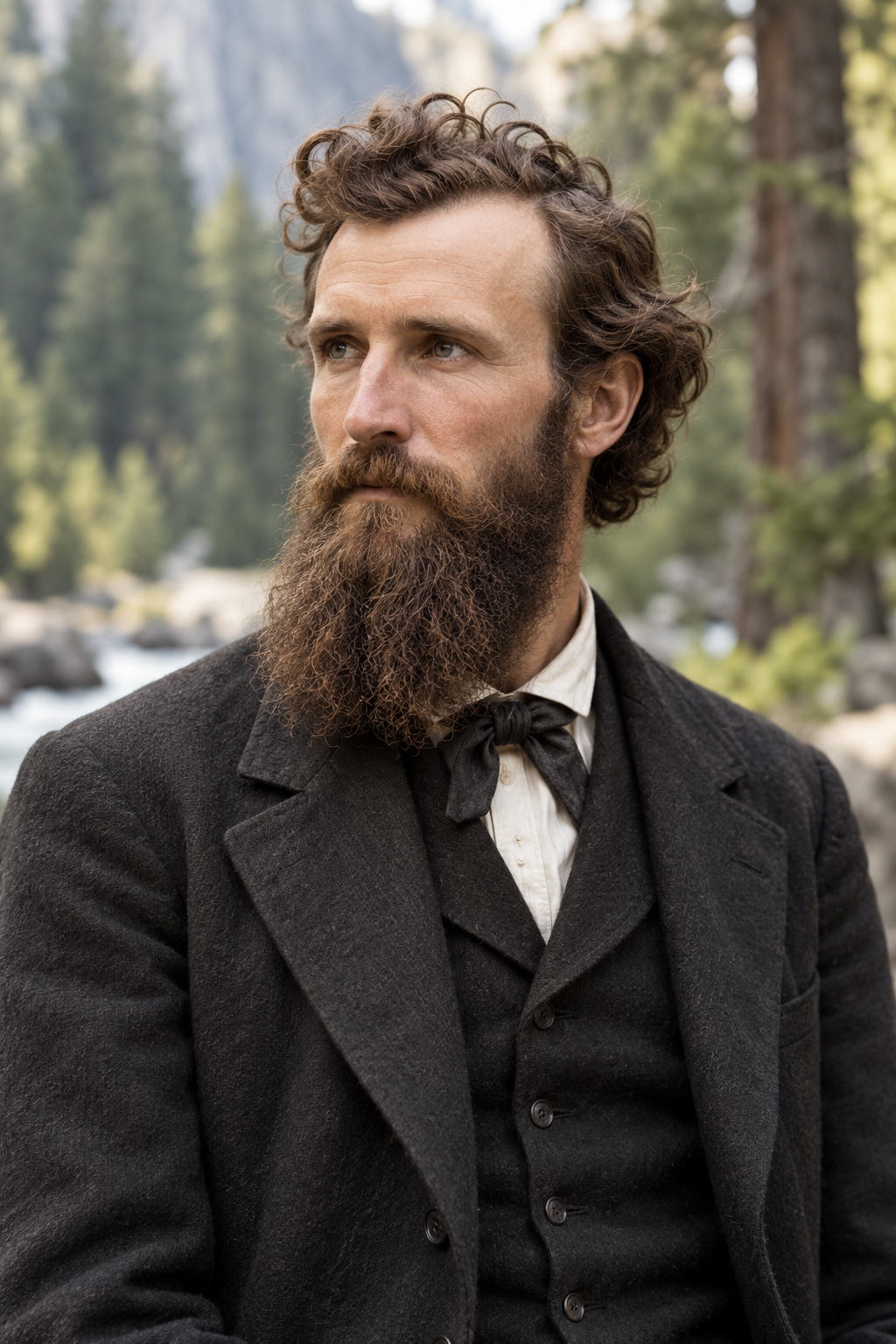
About John Muir
John Muir grew up in Scotland and moved with his family to Wisconsin in 1849. His interest in nature developed through childhood walks with his grandfather and continued on the family farm. As a young man he studied biology, botany and geology at the University of Wisconsin. He later walked from Kentucky toward the Gulf, carrying a plant press and collecting specimens. Travel became a means of learning directly from plants, rocks and landscapes, and the observations he made supplied material for the writing that would become his principal public work.
Muir first visited Yosemite in 1868 and returned to work in the region. As a shepherd he studied plants and animals and sketched the mountains. He then worked at James Mason Hutchings’s sawmill and built a cabin beside Yosemite Creek. His growing reputation brought conflict with Hutchings, and he left the mill in 1871. That September his article on glaciers appeared in the New York Tribune. Friendships with scientists, artists, educators and editors helped him reach readers beyond the valley.
His scientific curiosity extended beyond naming individual plants or describing impressive scenery. The John Muir Trust emphasizes his attention to relationships among living things and their surroundings. He challenged the assumption that land mattered only as a resource for human use. Wild places, in his view, deserved protection for their own value as well as for the pleasure and restoration they offered visitors. This conviction gave his descriptions a purpose beyond travel writing: he wanted personal encounters with nature to lead to lasting public protection.
In 1880 he married Louie Strentzel, whose family had a fruit ranch near Martinez. Their partnership complicates the familiar picture of a solitary wanderer. Louie was a business partner and a critic of his writing, and she managed the ranch during many of his absences. She encouraged his journeys and urged him to turn his experiences into books. Their letters connected his travels with the children and the work continuing at home. Louie also had interests of her own, including music and community activities. In 1884 she traveled with him to Yosemite; afterward she preferred to remain in Martinez. The family’s stability depended on work that continued while Muir was away, including the labor and judgment of the women in the household.
Muir made his conservation arguments through institutions as well as books. In 1889 he showed editor Robert Underwood Johnson the damage caused by sheep in Tuolumne Meadows. Their efforts helped build support for Yosemite National Park, established in 1890. Muir became the Sierra Club’s first president in 1892. A camping trip with Theodore Roosevelt in 1903 further advanced the case for protection, and the state’s Yosemite Grant returned to federal administration in 1906. Yet his campaign against a reservoir in Hetch Hetchy failed: Congress authorized the dam despite opposition from Muir and the club.
His argument against the dam used religious language deliberately. In The Yosemite, he described Hetch Hetchy as a place of prayer and compared its destruction to the misuse of a temple. He linked the desire for natural beauty with both a poor person’s small window garden and the public’s need for parks. He also disputed the claim that a reservoir would improve the valley, pointing to the exposed shores that changing water levels would leave. This was an advocate’s case, combining close observation, moral conviction and a forceful challenge to the project’s supporters.
His descriptions of wilderness also contained serious exclusions. The National Park Service identifies racist language about Indigenous people in his 1869 diary, later published in 1911, and notes that he ignored the genocide they had survived. Celebrations of untouched landscapes can likewise obscure the people who had long cared for those places. In revising its own interpretation at Muir Woods, the park service added Indigenous stewardship and dispossession to a story previously centered on white conservationists. Those histories cannot be replaced by an account of scenery preserved for later visitors. Muir’s influence deserves attention alongside the limits of the perspective from which he wrote.
Later assessments also describe changes in his outlook. The John Muir Trust records his growing admiration for Indigenous communities, their stewardship and their ways of living with the land. It also notes his sympathetic writing about colonialism and membership in the Sequoya League. These developments are part of the record, but do not erase his earlier derogatory language.
Writing remained demanding work. At his Martinez home, Muir labored in an upstairs office known as the Scribble Den, encouraged by family and friends. He was still working on a book about Alaska when he died.
Muir died in a Los Angeles hospital on December 24, 1914, and was buried beside Louie near their Martinez home. His books and preservation campaigns continued to influence the conservation movement.
His later Episcopal commemoration is distinct from his personal religious affiliation. St. Alban’s Church in Monroe, Louisiana, announced an April 22 Eucharist in 2015 remembering Muir together with Hudson Stuck.
Wondering how to weigh the stories and sources? Learn how to read a saint biography.