Biography
John Raleigh Mott
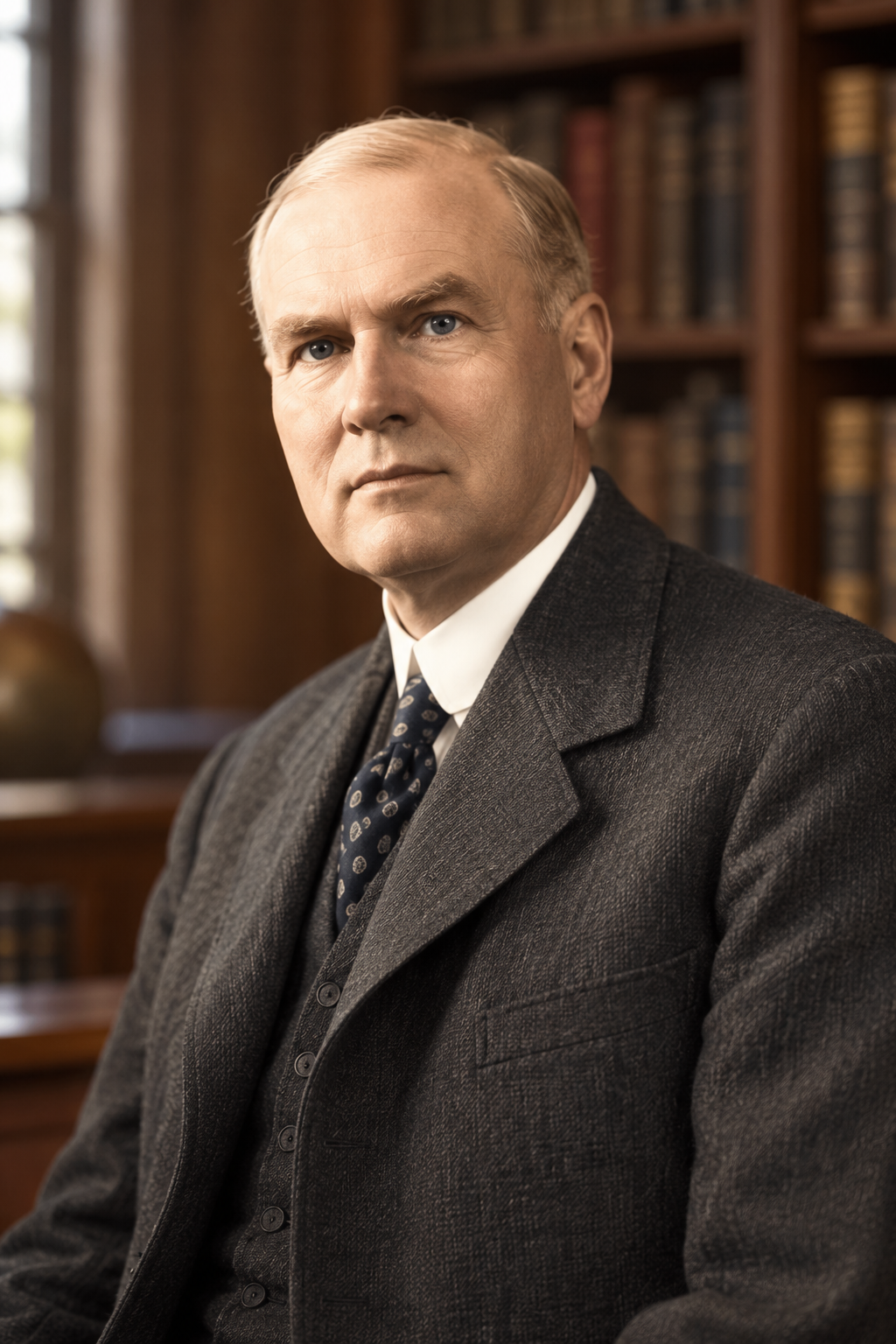
About John Raleigh Mott
John Raleigh Mott devoted his working life to bringing Christian students and missionary organizations into cooperation across national and denominational boundaries. A Methodist layman, he became a leader in the Young Men’s Christian Association, the Student Volunteer Movement, and the movement toward a World Council of Churches. His responsibilities included missionary policy and the continuing development of relationships among Christian communities.
Born in Livingston Manor, New York, on May 25, 1865, Mott grew up in Postville, Iowa. He studied at Upper Iowa University before transferring to Cornell. In 1886, while still a student, he heard a talk by J. Kynaston Studd that redirected his ambitions from law or business toward Christian service. That summer he attended a student conference where he joined others in pledging themselves to foreign missionary work. The Student Volunteer Movement took organized form two years later.
At Cornell he led the university YMCA and helped raise funds for a building. After graduating in 1888, he became a secretary for the intercollegiate YMCA in the United States and Canada. Visits to colleges and conversations with students became central to his work. In 1895 he and Karl Fries helped organize the World’s Student Christian Federation, extending cooperation among student movements internationally.
He married Leila Ada White in 1891, and they had four children. She contributed to his work as an editor and adviser, sometimes accompanying him abroad. When they traveled separately, he wrote regularly about his activities. The family correspondence preserved at Yale records this partnership alongside the public career.
The 1910 World Missionary Conference in Edinburgh brought Mott’s organizing skills to a larger gathering. He chaired the conference while Joseph Oldham coordinated extensive preparation. Its purpose was sustained study of missionary questions. Yet representation was unequal: of more than twelve hundred delegates, only nineteen came from the countries where missions worked. Indian and Chinese Christian speakers nevertheless made important contributions.
Afterward, Mott traveled through Asia to consult missionaries and emerging national leaders. The work encouraged national and regional councils. War then damaged these relationships. German participants distrusted his involvement in an American diplomatic mission to Russia, and the international continuation committee ceased functioning. Mott and Oldham helped convene a 1920 meeting at Crans to rebuild cooperation. The International Missionary Council followed in 1921.
His public responsibilities could complicate his international friendships. In 1916 he served on a commission addressing conflict between the United States and Mexico. The following year he joined Elihu Root’s mission to Russia. That delegation sought support for Russia’s provisional government and continued participation in the war; Mott’s particular task involved contact with religious leaders. His diplomacy was therefore tied to American wartime objectives as well as church relationships.
During the First World War, he directed the YMCA’s National War Work Council. He also helped maintain international contacts and supported relief for prisoners of war in several countries as wartime conditions allowed.
Historian Benjamin Hartley describes an organizer who stayed close to students but was slower to confront inequalities within his own circles. Mott acknowledged in 1914 that he had not opposed racism early or forcefully enough. His friendship with African American YMCA leader William Alphaeus Hunton and his experience in South Africa helped change his outlook. He later challenged segregation in student organizations, although discriminatory policies persisted in organizations with which he worked.
Women also pressed him to change. Ruth Rouse criticized the attention he gave the YMCA at the expense of the wider student federation. Rouse, Leila Mott, and other colleagues pushed him to take women’s leadership more seriously. These relationships complicate a history centered only on his achievements: the international movement also depended on people who questioned his priorities.
Mott shared the 1946 Nobel Peace Prize with Emily Greene Balch. In his acceptance speech, he welcomed being honored alongside her and looked back on decades of repeated visits to countries around the world. His emphasis remained on younger generations. He expressed hope that students preparing to meet in Norway would work together for peace and goodwill.
His Nobel lecture developed that hope into an argument about leadership. He called for thought, prayer, moral character, and cooperation. He identified poverty, disease, economic exploitation, and racial antagonism as urgent problems. Gandhi’s commitment to guiding principles served as one example; other examples came from political and imperial administrators. The address combined criticism of injustice with assumptions inherited from his own era. It ended by presenting service to others as the foundation of Christian leadership.
When the World Council of Churches was established in 1948, Mott became an honorary president. He remained a Methodist, even as his work helped Christians across traditions sustain relationships and common institutions. After his death in 1955, he was buried in Washington National Cathedral.
An October 3 commemoration appears in Holy Women, Holy Men. The Episcopal Church authorized that calendar for trial use in 2010–2012.
Wondering how to weigh the stories and sources? Learn how to read a saint biography.