Biography
John Vianney
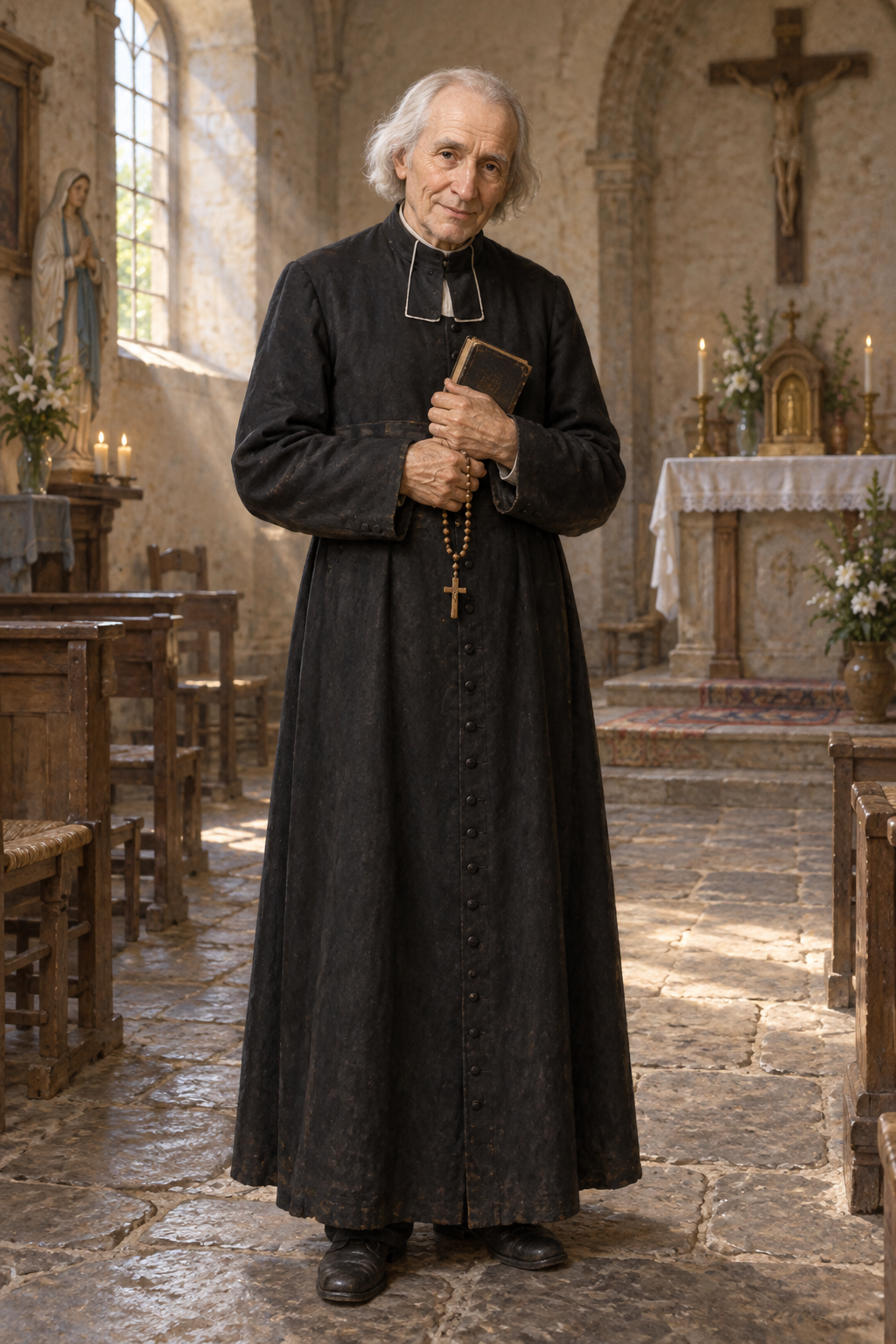
About John Vianney
John Vianney is known as the Curé of Ars, a parish priest whose ministry became a lasting point of reference for Catholic pastoral life. John XXIII’s encyclical *Sacerdotii Nostri Primordia* presents Vianney as a priest whose service in Ars showed the Church what faithful parish ministry can look like. The source’s interest is not in novelty or public influence. It is in the patient work of a pastor who prayed, preached, celebrated the sacraments, and remained available to the people entrusted to him.
Ars is central to his identity because it was the place of his sustained pastoral work. A parish is not merely a building or administrative unit; it is a community of people with ordinary burdens, divisions, hopes, and spiritual needs. John XXIII reads Vianney’s ministry through that reality. His holiness was exercised in the routine and demanding forms of pastoral care rather than apart from them.
The encyclical emphasizes prayer and the Eucharist as sources for a priest’s service. In Vianney’s case, this spiritual center was not an escape from people. It was what enabled teaching, reconciliation, and attentive care. A priest’s life is credible, the encyclical suggests, when worship and service belong together. This theological reading is the appropriate way to receive his example without turning it into a collection of unsupported anecdotes.
Vianney died on 4 August 1859. John XXIII places his death within a continuing ecclesial reception that led to canonization and to his designation as patron of parish priests. The historical details of those processes should be sourced separately before they become structured catalog claims, but the source establishes the essential point: the Church recognized in his life a model for pastors.
The title “Curé of Ars” can obscure the complexity of a parish priest’s vocation if it is treated as a decorative label. The source portrays a man whose pastoral responsibility required perseverance, personal discipline, and attention to the spiritual needs of many people. It therefore has significance beyond clergy: parish life depends on prayer, reconciliation, teaching, and mutual care.
This entry deliberately does not assert exact dates for Vianney’s birth or ordination, descriptions of his childhood, or numerical claims about his ministry. The evidence used is sufficient for a clear and trustworthy account: John Vianney was the parish priest of Ars, he died in 1859, and the Church has received him as a patron and model for parish priests. That is a substantial legacy, grounded in the ordinary faithfulness of pastoral service.
The Curé of Ars is remembered through a parish, not through a distant title. That matters because parish life is built through repetition: people return for worship, seek counsel in sorrow, bring children for formation, ask forgiveness, and learn to serve one another. John XXIII’s reception of Vianney gives these ordinary rhythms theological weight. The pastor’s task is not simply to organize them but to be present within them with prayerful attention.
Preaching and sacramental ministry were not separate activities in this portrait. The word proclaimed, the Eucharist celebrated, and reconciliation offered all belong to the Church’s care for people. The encyclical uses Vianney as an example for priests because his service joined these elements rather than treating any one of them as sufficient. This remains an interpretive reception of his life, not a claim that the packet has documented every sermon or pastoral encounter.
Availability is also a demanding form of charity. A parish priest cannot remove every burden from a community, but he can refuse to treat people as interruptions. The sources describe Vianney’s ministry as attentive and persevering. That description has meaning for all Christian communities: care requires structures and boundaries, yet it also requires a willingness to notice the person who arrives with a need that cannot be scheduled neatly.
The patronage of parish priests is a later Church recognition of this witness. It does not imply that clergy should imitate every circumstance of a nineteenth-century French parish. It identifies a spiritual pattern: prayer, humility, teaching, sacramental service, and attention to people. Those elements can be renewed in different cultures and pastoral settings without losing the heart of the example.
Vianney’s death in 1859 gives a firm chronological point to an otherwise intentionally restrained record. The source connects his life with canonization and patronage, but additional biographical sources would be required before adding detailed childhood, education, or ordination claims. This limitation is useful: it keeps the catalog focused on the ministry by which he is best documented and most widely remembered.
For readers who are not priests, the Curé of Ars can still be a witness to faithfulness in ordinary responsibility. His legacy suggests that spiritual life is not proved by novelty or public fame. It grows through prayer, service, and a repeated decision to remain present to the people one has been given to love. That is the pastoral vision this source packet can responsibly preserve.
Wondering how to weigh the stories and sources? Learn how to read a saint biography.