Biography
Jonah
About Jonah
Jonah son of Amittai appears in two distinct biblical settings. Second Kings names a prophet from Gath-hepher whose word concerned Israel’s border during the reign of Jeroboam II. The Book of Jonah takes that name and builds a compact story about prophetic resistance and mercy toward Nineveh. The USCCB introduction says the book is difficult to date, almost certainly postexilic, and variously classified as parable or satire. It is not a modern life record. This biography therefore treats identification with the Kings prophet as probable and the book’s episodes as traditional literary events, while leaving Jonah’s birth and death dates unknown.
The story opens with a command to go to Nineveh and preach against its wickedness. Jonah instead travels down to Joppa and boards a ship bound for Tarshish, a name representing the far west; its precise identification is uncertain. His movement away from the commission drives the book’s irony. A violent storm threatens the ship, and frightened sailors pray, discard cargo, and discover Jonah asleep below deck. When questioned, Jonah identifies himself as a Hebrew who worships the God who made sea and land, yet acknowledges that he is fleeing. The narrator exposes the contradiction between his confession and conduct.
Jonah tells the sailors to throw him into the sea. They do not act immediately: they row hard for land and then pray not to be charged with innocent blood. Only when their effort fails do they cast him overboard, after which the sea becomes calm. The sailors’ fear, sacrifice, and vows contrast with Jonah’s refusal. The scene includes threatened death and the loss of cargo; it should not be romanticized as an adventure or used to praise self-destruction. Within the story, Jonah accepts responsibility, but the foreign sailors display restraint and reverence before the named prophet does.
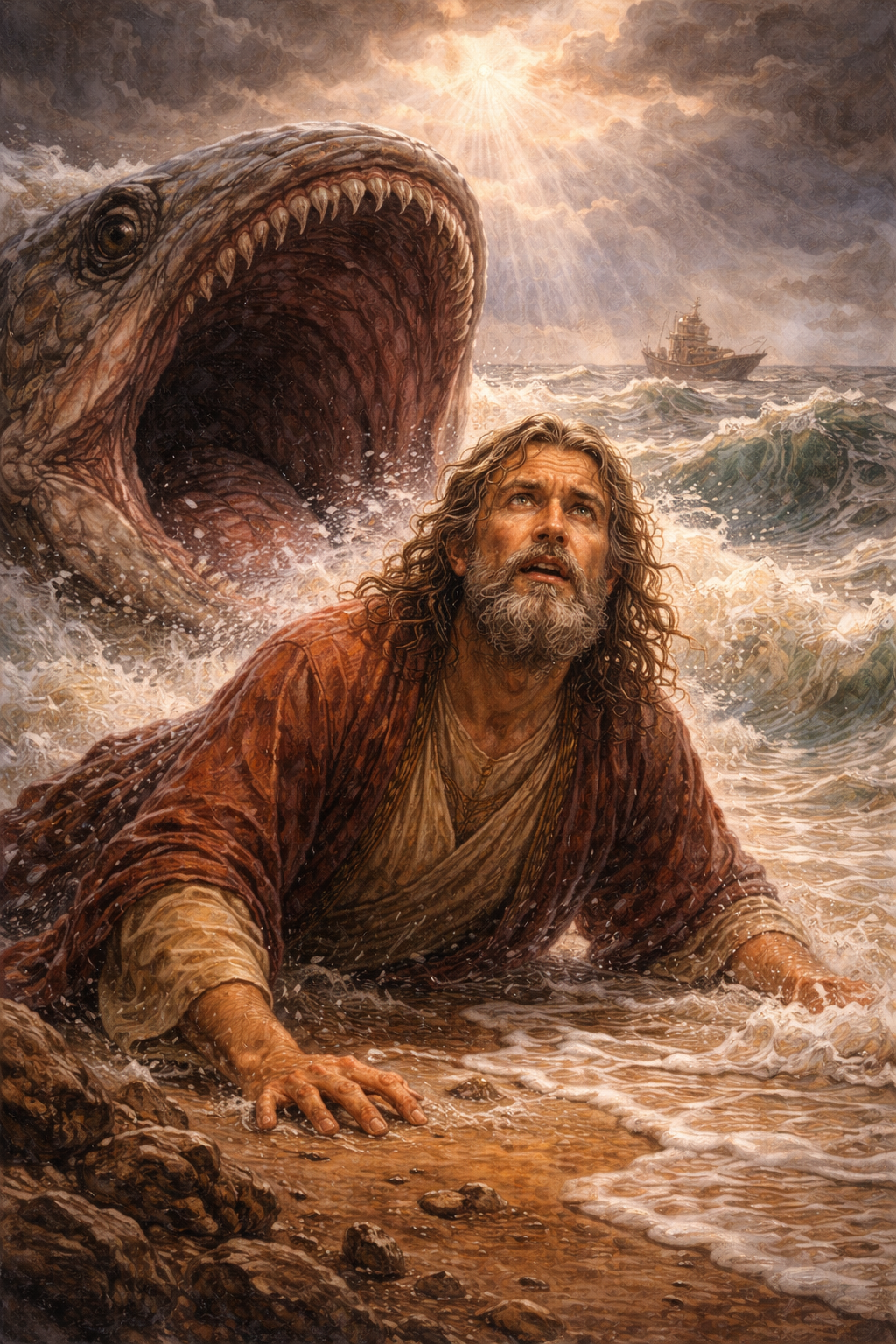
The Lord appoints a great fish to swallow Jonah, who remains within it for three days and nights. Scripture says neither that the creature was a whale nor where Jonah entered or left the water. Chapter 2 places a thanksgiving psalm in Jonah’s mouth. Its imagery recalls drowning and descent, while its ending promises sacrifice and declares that deliverance belongs to the Lord. A note observes that the poem may once have circulated independently. At a command, the fish expels Jonah onto dry land. These are claims of a theological narrative, not independently documented zoological or medical events, and no landing point can responsibly be mapped.
The commission comes a second time, and Jonah goes to Nineveh. He announces that the city will be overthrown in forty days. The book portrays a response that is immediate and total: people believe, fast, and wear sackcloth; the king leaves his throne and orders humans and animals alike to participate. He also commands an end to violence. God sees their changed conduct and does not carry out the announced destruction. The scale and speed are part of the book’s deliberate exaggeration and satire. The episode teaches through narrative reversal rather than furnishing an Assyrian civic chronicle or a securely dated missionary itinerary.
Nineveh’s reprieve makes Jonah angry. He admits that he fled because he knew God to be gracious, merciful, slow to anger, and rich in clemency. He would rather die than watch an enemy city spared. This is the book’s moral center and its sharpest indictment of the prophet. Assyria’s remembered violence gives his resentment historical emotional force, but the narrative refuses to let injury become a warrant for indiscriminate destruction. God asks whether Jonah is right to be angry. Jonah does not answer; he leaves the city and makes a shelter east of it, waiting to see what will happen.
A plant grows over Jonah and gives shade, bringing him great joy. A worm attacks it the next morning, and a scorching east wind leaves him faint and again wishing for death. God compares Jonah’s concern for a plant he did not cultivate with divine concern for Nineveh’s many inhabitants and animals. The final question remains unanswered. Readers, rather than Jonah, must decide whether compassion can extend to enemies. The ending offers no conversion scene for the prophet and no account of his later life. It preserves him as morally unfinished—capable of obedience and prayer, but still narrowed by resentment.
The Gospel of Matthew receives Jonah within Christian interpretation. Jesus speaks of the prophet’s three days in the fish as a sign related to the Son of Man and contrasts Nineveh’s repentance with the response of his own generation. This is documented New Testament reception, not evidence that every narrative feature can be reconstructed as modern history. Eastern Orthodox tradition likewise honors Jonah as a prophet and commemorates him on September 22. Such liturgical memory shows the story’s continuing place in Christian worship while remaining distinct from proof of an exact eighth-century itinerary or lifespan.
Jonah’s importance lies partly in the book’s refusal to provide a polished hero. He eventually delivers the warning entrusted to him, but outsiders repeatedly act with more openness than he does: sailors resist killing him, and Ninevites abandon violence. His prayer recognizes rescue, yet his anger resists mercy. The narrative faces storm, threatened drowning, imperial cruelty, and desired mass destruction without calling them good. Its final question invites honest self-examination: whether religious conviction serves compassion or protects grievance. Jonah can therefore be remembered as prophet and caution, a figure through whom scripture presses beyond tribal sympathy toward responsibility for neighbors, enemies, and vulnerable creation.
Wondering how to weigh the stories and sources? Learn how to read a saint biography.