Biography
Joshua
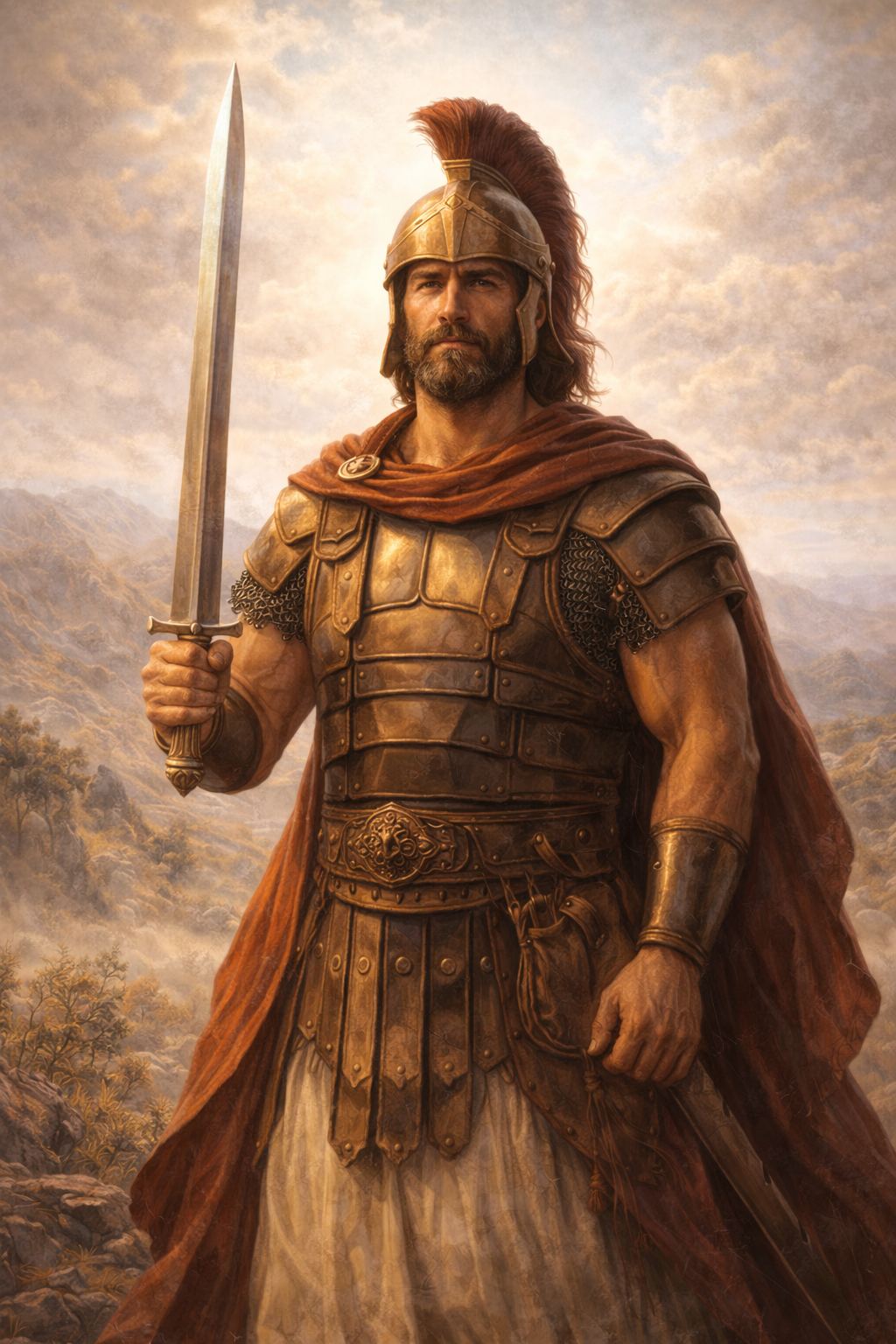
About Joshua
Joshua appears across Exodus, Numbers, Deuteronomy, and the book bearing his name as Moses' aide and eventual successor. The sources present theological history rather than a modern, independently documented biography. No secure evidence supplies Joshua's birth year, and the biblical age at death cannot anchor a modern chronology. The catalog therefore leaves his birth and death dates unset rather than preserving fabricated ancient years.
His first narrative role is military. At Rephidim, Moses chooses Joshua to lead fighters against Amalek while Moses, Aaron, and Hur take positions above the battle. The account gives Joshua responsibility in the valley but makes the outcome depend on the larger communal action. Soon afterward Joshua accompanies Moses partway toward Sinai and waits during Moses' ascent. These scenes establish him as a trusted assistant before he becomes Israel's principal leader.
Numbers names him first as Hoshea son of Nun, from the tribe of Ephraim, and says Moses called him Joshua. He is one of twelve men sent to explore Canaan. When the group returns, most emphasize fortified cities and danger; Joshua and Caleb oppose the people's refusal to proceed. They tear their garments and urge the assembly not to rebel or fear. Numbers then distinguishes Joshua and Caleb from the generation sentenced to die in the wilderness. The episode presents courage as dissent from a frightened majority, not as confidence that avoids danger.
Near the end of Moses' life, Numbers describes a public transfer of responsibility. Moses lays a hand on Joshua before Eleazar and the community and gives him part of his authority. The passage also limits Joshua's authority by requiring consultation through Eleazar. Deuteronomy records Moses charging Joshua to be strong and steadfast. The book of Joshua repeats that charge after Moses' death and joins it to careful observance of the law. Leadership in these texts combines courage, continuity, law, and accountability.
Before crossing the Jordan, Joshua sends two spies to Jericho. Rahab hides them, negotiates protection for her household, and helps them escape. Joshua 3 then depicts the community crossing the Jordan after the priests carrying the ark enter the water. The narrative deliberately echoes Israel's earlier passage through the sea and establishes Joshua as Moses' successor. Its place-names support regional mapping, but neither a supernatural claim nor a traditional crossing site should be assigned modern coordinates without separate evidence.
At Gilgal, Joshua oversees circumcision and Passover before the campaign begins. Near Jericho he encounters a figure identified as commander of the Lord's army and removes his sandals. Joshua 6 narrates processions around Jericho, the collapse of its wall, and the city's destruction under the ban, while Rahab's household is spared. The violence must not be softened into an uncomplicated adventure. The USCCB introduction describes the book's conquest as highly idealized and theologically programmatic, and compares it with the slower, piecemeal emergence reflected in Judges.
The next campaign exposes failure within Israel. After defeat at Ai, Joshua responds with grief and questioning. The narrative identifies Achan's taking of banned goods and concludes with the killing of Achan and his household. Joshua 8 then recounts Ai's capture through an ambush and a public reading of the law at Mount Ebal. These chapters are part of the book's ancient theology of corporate responsibility and warfare. A responsible biography reports them without treating every narrated act as a timeless moral model.
The Gibeonites obtain a treaty by deception, and Joshua 9 says Israel's leaders fail to consult the Lord. Once the oath is discovered, Joshua does not permit the community to kill them, although the text assigns them subordinate labor. In the following coalition war, Joshua honors the treaty by marching to Gibeon's defense. Joshua 10 includes the poetic command for sun and moon to stand still and attributes victory to divine action. The episode belongs to the received narrative; it is not independent astronomical documentation.
Later chapters portray Joshua supervising the allocation of land, cities of refuge, and Levitical towns. This administrative work is as central to his leadership as battle. At Shechem he gathers Israel, rehearses the ancestral story, and calls the people to choose whom they will serve. The assembly renews the covenant, and Joshua sets up a witness stone. The chapter reports his death at 110 and burial at Timnath-serah, but these details do not establish a modern calendar year or an exact tomb coordinate.
The book says Israel served the Lord during Joshua's lifetime and during the elders who survived him. Eastern Orthodox tradition commemorates Righteous Joshua son of Nun on September 1. The official OCA life repeats biblical chronology, including specific ancient years, but those devotional dates are not independently verified and are not entered as historical dates here. Joshua remains significant as a remembered assistant who accepted succession, challenged communal fear, organized a people, and renewed covenant commitments. His legacy also requires honest engagement with narratives of conquest, collective punishment, and land—texts whose own editorial introduction warns readers against simplistic historical and moral conclusions.
Wondering how to weigh the stories and sources? Learn how to read a saint biography.