Biography
Justus Falckner
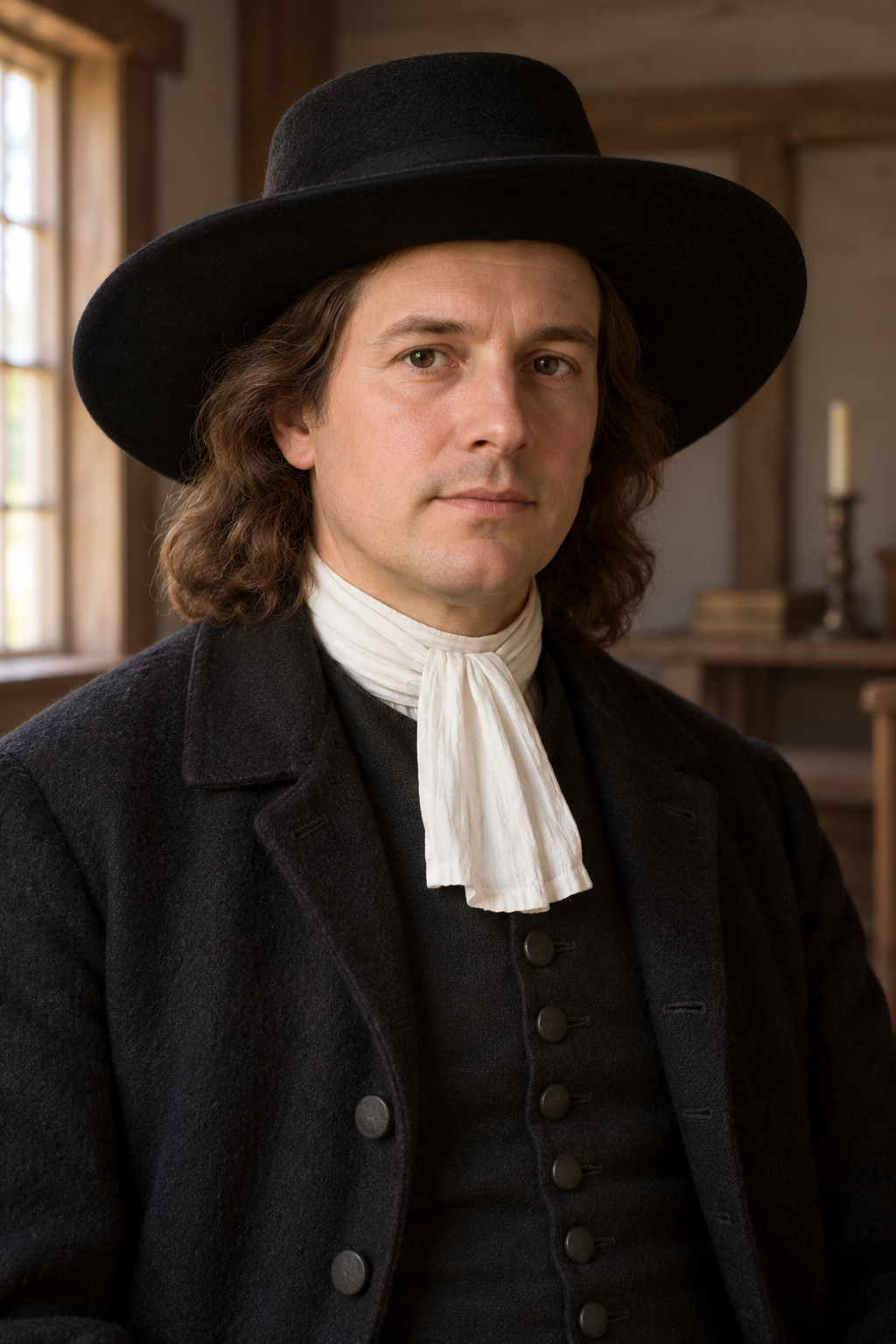
About Justus Falckner
Justus Falckner was a Lutheran pastor whose ministry connected communities in colonial New York and New Jersey. Born in Langenreinsdorf, Saxony, the son of a Lutheran minister, he studied theology at Halle under August Hermann Francke. He initially hesitated to enter the ministry. Instead, he joined his brother Daniel in work involving the sale of Pennsylvania land. That work brought him into contact with the Swedish pastor Andreas Rudman.
His earlier correspondence reveals the religious concerns he brought to Pennsylvania. Writing from Germantown to Heinrich Muhlen in August 1701, Falckner described living alone in a small log house after his arrival. He acknowledged that his limited contact with others had restricted his knowledge of local conditions. He was now going among people more often and intended to leave that solitude behind. He and Daniel attended the Swedish church despite understanding little of its language. He welcomed Rudman’s willingness to preach in German while German Lutherans lacked a church of their own.
Falckner also asked Muhlen to help obtain an organ for the Swedish church. He hoped music would encourage attendance, particularly among young people who faced a long journey after a week of heavy work. His appeal included hopes of attracting Indigenous listeners and people from other denominations. The letter’s disparaging descriptions of Indigenous people and Quakers show the limits of his outlook: his interest in reaching different communities did not amount to respect for all their beliefs.
On November 24, 1703, Swedish pastors ordained Falckner at Gloria Dei Church in Philadelphia. A German theological student was entering ministry to Dutch Lutheran congregations: his ordination brought together several languages and church communities. It is remembered as the first Lutheran ordination in America.
In a letter sent from New York in 1704, Falckner told his former teacher Francke how his ministry had begun. Persuasion from others and his own conscience had led him to accept the work he had previously avoided. He reported receiving permission from the English governor, Lord Cornbury, as well as ordination from the Swedish ministers. He had learned Dutch quickly enough to preach sometimes three times a week.
The same letter describes the practical demands of serving people across languages. Falckner planned to visit the small Lutheran church in Albany and preach in both Dutch and English because members of the English church also attended. His own listeners mostly spoke Dutch, yet came from several European backgrounds, including German, Swedish, Danish, Norwegian, Polish, Lithuanian, and Transylvanian communities. He asked Francke for advice and prayers and offered to continue the correspondence.
His work extended beyond a single congregation. He served New York and Albany and traveled to communities in New Jersey and along the Hudson. He also wrote for worship and Christian instruction. His Dutch catechism appeared in New York in 1708. A hymn first printed in a Halle collection in 1697 later circulated in English as “Rise, ye children of salvation,” through Emma Frances Bevan’s translation.
Church records preserve some of the ordinary work behind this broad ministry. Historian Julius Sachse described Falckner’s register as recording baptisms, marriages, communion, and church officers across the places he served. Its early entries include baptisms in a barn at Hackensack. The surviving record thus reaches beyond church buildings to the homes and working spaces where scattered communities gathered.
His congregations included people of African descent. Julius Carroll’s history of African American Lutherans, drawing on Michael Lee Cobbler’s research, records Falckner baptizing and marrying Black people in New York and northern New Jersey. It also describes the beginnings of Zion Lutheran Church, now in Oldwick, in the home of Aree Van Guin, a formerly enslaved man who had purchased his freedom. Van Guin and his family were participants in the congregation’s life, not simply recipients of a visiting pastor’s attention: they provided a place for worship and served as baptismal sponsors.
The register also records Falckner’s marriage to Gerritge Hardick in 1717. They had three children. In a letter that year, he and fellow church leaders thanked the Lutheran consistory in Amsterdam for financial assistance toward a church in New York. Their correspondence shows a local ministry sustained partly through relationships across the Atlantic.
The later history of his life remains incomplete. Sachse reproduced a baptismal entry from September 1723 and a later pastor’s note recording Falckner’s death that year. The evidence presented here does not establish the precise day or place of his death.
Three centuries after his ordination, Lutherans and Episcopalians gathered at Philadelphia Cathedral to remember him. The 2003 service included his hymn and a dramatization of the ordination. The occasion emphasized cooperation across national church traditions and the diverse congregations he had served.
The Evangelical Lutheran Church in America commemorates him on November 24 alongside Jehu Jones and William Passavant as pastors in North America. His remembrance belongs specifically to that Lutheran calendar.
Wondering how to weigh the stories and sources? Learn how to read a saint biography.