Biography
Karl Augustus Menninger
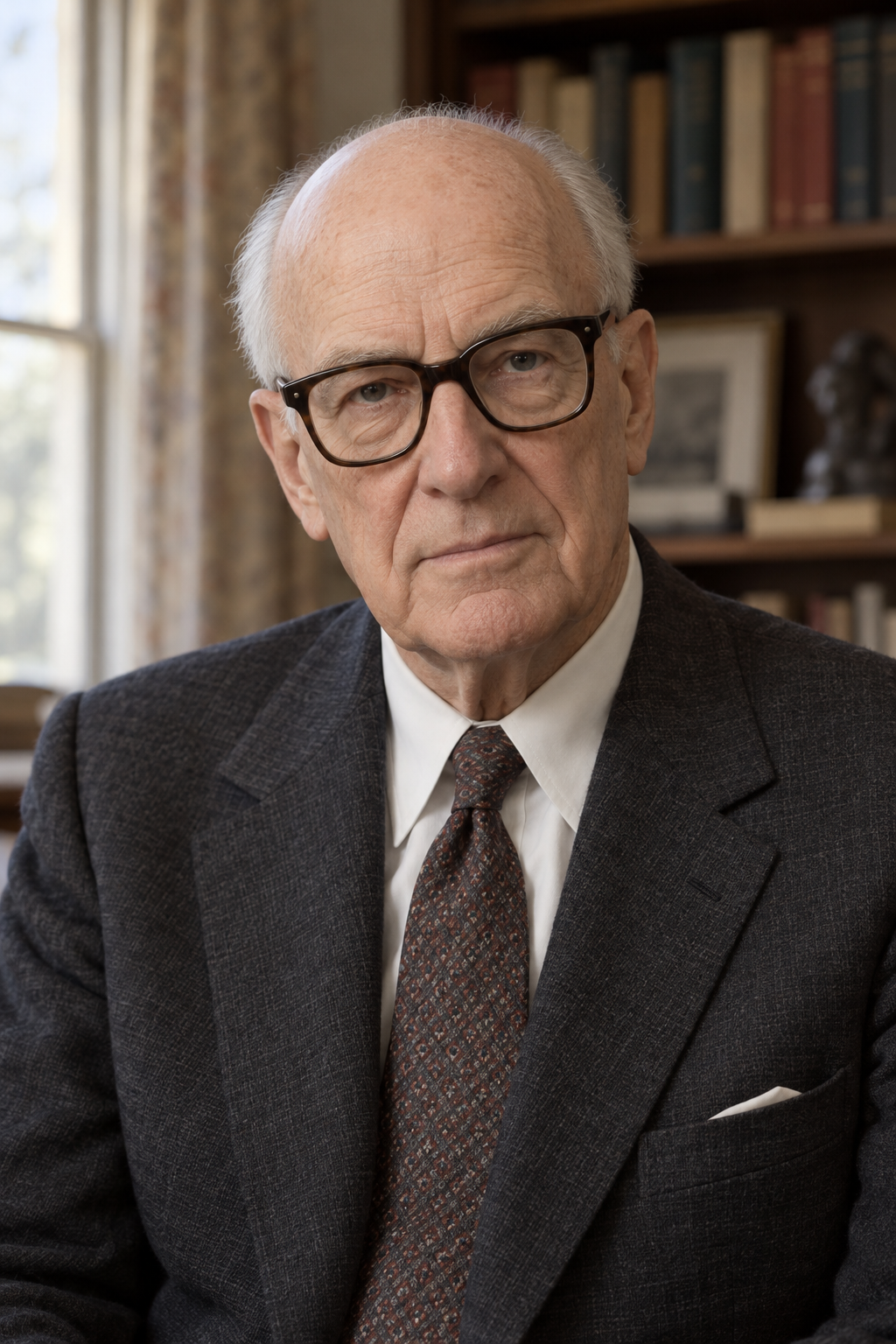
About Karl Augustus Menninger
Karl Augustus Menninger was born in Topeka, Kansas, on July 22, 1893. His father, Charles Frederick Menninger, practiced medicine there. Karl studied at several universities before completing his medical degree at Harvard in 1917. During his internship at Boston Psychopathic Hospital, Elmer Ernest Southard became his mentor and helped direct his attention toward psychiatry.
In 1919 Karl returned to medical work with his father in the Menninger Diagnostic Clinic. Their aim was cooperation among doctors and attention to mental health alongside physical illness. The practice grew to include his younger brother William. It also developed services for children and training for psychiatric nurses. The family established the Menninger Foundation in 1941, bringing its work into an institution that could continue beyond the original partners.
The work included a private psychiatric hospital, opened in 1925 as an alternative to state hospitalization. After the Second World War, Karl helped preserve and develop the Winter Veterans Administration Hospital in Topeka. Its value as a place to train psychiatrists contributed to the establishment of the Karl Menninger School of Psychiatry in 1946. Treatment and the education of future practitioners thus became closely connected parts of his career.
His approach drew increasingly on Freud. He underwent analysis with Franz Alexander in Chicago and later with Ruth Mack Brunswick in New York. In 1942 he and William established the Topeka Institute for Psychoanalysis. During the war he traveled to Europe to assess military psychiatric needs. These activities connected the Kansas institution with wider professional debates and the care of people affected by war.
Menninger also wrote for readers outside medicine. The Human Mind, published in 1930, explained psychiatric ideas in everyday language. Other books included Man Against Himself, Love Against Hate and The Vital Balance. Writing gave him an audience beyond the people who could visit a clinic. He also advocated nuclear disarmament and supported the rights of prisoners, Native Americans, and children who had experienced abuse or neglect.
Advice could also carry the limitations of his clinical assumptions. In a letter dated May 2, 1931, he classified homosexuality through a distinction between constitutional and psychologically distorted development. He claimed that psychoanalysis could change the latter. This letter records his pathologizing view of same-sex attraction; it is historical evidence of his position, not a diagnosis or a treatment recommendation.
His public writing extended to child-rearing columns in Household and the Ladies’ Home Journal. In 1946 he chaired a panel investigating conditions in Kansas mental hospitals. He also examined the place of psychiatry in legal proceedings. The scope of these activities moved beyond individual consultations to institutions whose decisions shaped people’s lives.
In The Crime of Punishment, he challenged vengeance as a basis for responding to crime. He argued for prevention and constructive responses, including treatment in some cases and restraint in others. His argument connected public safety with a refusal to make offenders into scapegoats. These passages present a reformer’s moral and social case, rather than proof that psychiatric treatment could prevent every crime. They also show his willingness to question the purposes of established institutions.
His concern for children took organizational form in the Villages movement. In the 1960s he established homes for neglected young people in Kansas, Michigan and Indiana. The emphasis was on stable family life and a loving environment for children who had experienced abandonment, neglect or abuse. The Indiana organization traces its beginnings to this work, followed by support from the Lilly Endowment in 1978. Its first family-model group home opened in Bedford in 1980 on land donated by John Pless. That later development depended on local supporters and staff as well as on Menninger’s earlier initiative. The history of the organization should not be reduced to the work of one founder.
His family life included two marriages. He and Grace Gaines married in 1916 and had three children before divorcing in 1941. Later that year he married Jeanetta Lyle, who collaborated with him on Love Against Hate. They adopted a daughter in 1948.
In 1978 he became co-director of a federal project concerned with programs and housing for five Native American tribes in the Southwest. This work continued his advocacy beyond psychiatric hospitals.
His surviving papers document interests in religion, gardening, violence, grief and prison reform, alongside professional correspondence.
He died in Topeka on July 18, 1990, after a career that included books, articles, lectures and direct clinical work.
His life ended in Topeka, the city where his medical work had taken root. His legacy includes both institutions for care and public arguments about the treatment of people often pushed to the margins of society.
He received the Presidential Medal of Freedom in 1981.
Trinity Episcopal Church in Asbury Park commemorates him on March 6 with the other Menninger and Mayo physicians. This recognition belongs to an Episcopal calendar, rather than a Catholic canonization.
Wondering how to weigh the stories and sources? Learn how to read a saint biography.