Biography
Kateri Tekakwitha
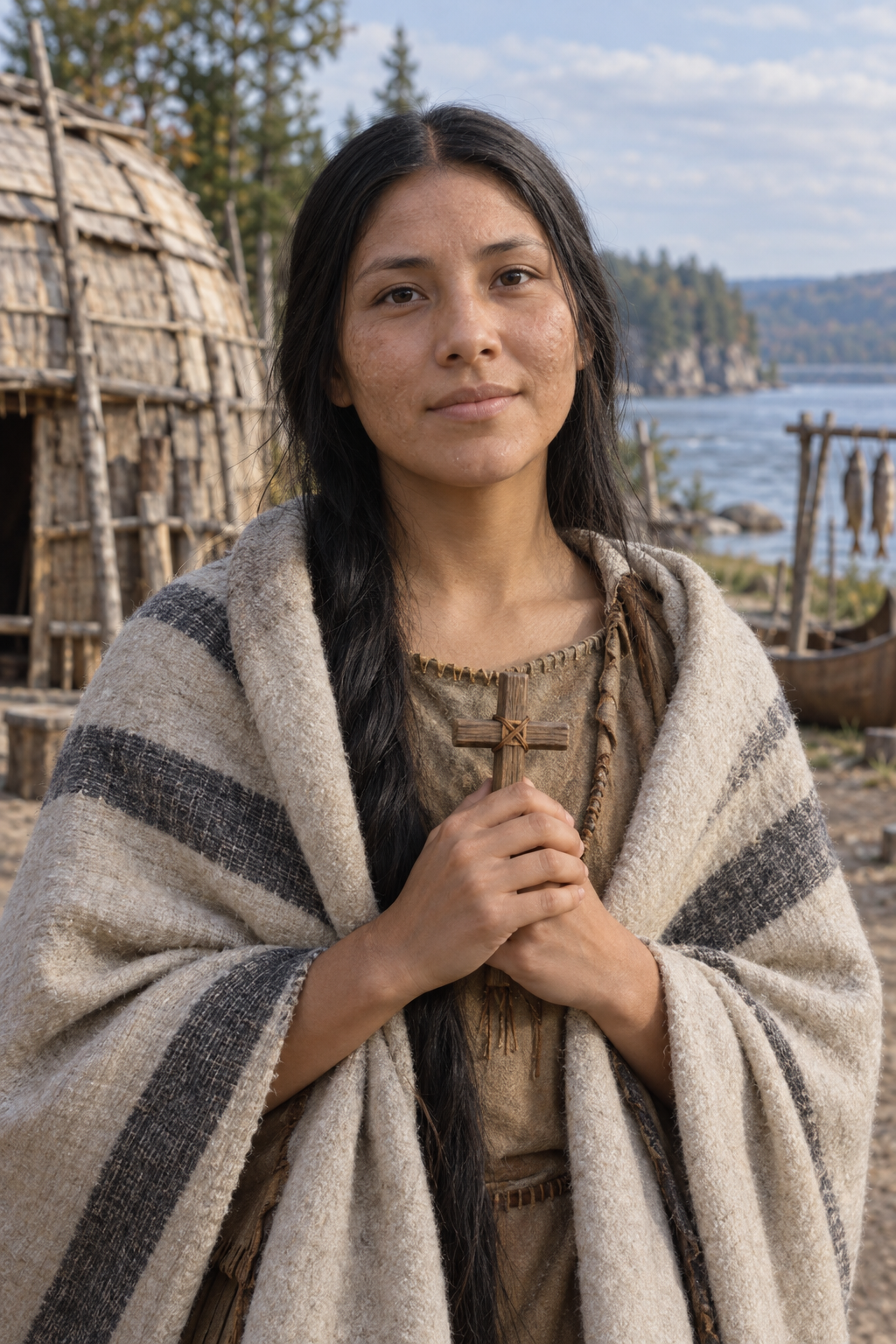
About Kateri Tekakwitha
Kateri Tekakwitha grew up in the Mohawk country of what is now New York, in a family already connected to different peoples and religious traditions. Her father was Mohawk; her mother was an Algonquin Christian who had been taken captive. Born around 1656, Tekakwitha lost her parents and brother in a childhood smallpox epidemic that also scarred her face and impaired her sight. An uncle's household took her in. As she grew older, she resisted relatives' plans for her marriage. Her eventual baptism was not the beginning of Christianity's presence in her family, and her choice cannot be reduced to a simple division between Indigenous life and an entirely unfamiliar religion.
War changed the landscape of her childhood. In 1666, French forces burned Mohawk villages, and the inhabitants sought refuge in the woods. Peace the following year opened the way for Jesuit missionaries. Tekakwitha received baptism at Easter in 1676, taking the name Catherine. Her decision had social and political consequences: some Iroquois supported conversion and migration toward the French settlements as a way to strengthen alliances, while others opposed them. She moved in 1677 to the Saint-François-Xavier mission at Sault-Saint-Louis. The disagreement was real, but it did not mean that every member of her people opposed her faith.
At the mission, an older woman, Anastasie Tegonhatsiongo, helped guide her religious life. Anastasie had known her mother; this mentorship connected Catherine's new community with an earlier family relationship. Catherine received her first Communion at Christmas 1677 and later joined the Confraternity of the Holy Family. She also accompanied the household on winter hunting expeditions.
Her days included work with her hands: making moccasins and collars, beadwork, harvesting, gathering wood, and preparing food. Prayer took place within that working life, including the seasonal hunting camps. After visiting the Hospital Sisters in Montreal, she and other Indigenous women considered forming a religious community on an island. Marie-Thérèse Tegaiaguenta and a Huron woman called Skarikions shared in the proposal. The community was never established, but the plan shows women imagining a form of religious life together rather than merely accepting arrangements made for them. On March 25, 1679, Catherine made a private vow of perpetual virginity. Her ascetic practices could be severe, and spiritual advisers urged moderation. Those practices should not be confused with the ordinary service, craft, and household labor that also occupied her life.
On a winter hunt, she made a place for prayer near a creek, marking a tree with a cross. The camp did not have a chapel, but she maintained her practice of prayer there.
The proposal also met resistance from clerical authority in 1678. A Jesuit superior discouraged it, judging the women too new to Christianity. That objection placed limits on the kind of religious community they could establish for themselves.
Catherine died on April 17, 1680, at the mission. The Catholic account of her life remembers her care for sick people alongside prayer and work in the household and chapel. Her recognition as a saint came much later: John Paul II beatified her on June 22, 1980, and Benedict XVI canonized her on October 21, 2012. The formal canonization document uses the name Catharina Tekakwitha and identifies Kateri as the familiar form. These acts recognize her within the Roman Catholic Church; they do not settle historical questions about every episode transmitted by her early biographers.
Even the name most familiar today has a history. Robert Derome's study traces the popularization of Kateri to the nineteenth-century writer Ellen Walworth, rather than treating that spelling as an unproblematic record of her baptismal name. Earlier texts preserve numerous spellings of Tekakwitha, and proposed interpretations of the name differ. The familiar modern name therefore belongs both to the woman remembered and to the later history of that remembrance. Keeping Catherine, Tekakwitha, and Kateri in view helps readers recognize that transmission without replacing her life with an invented certainty about how she spoke or what her name must have meant.
Historian Allan Greer describes such women as actively drawing on Catholic mystical traditions and adapting them to their own lives. In a BackStory interview, he emphasizes their pursuit of religious knowledge and authority, including forms of life associated with priests and nuns. The same program includes Kahnawake scholar Orenda Boucher, who describes differing responses to Kateri within her community. For some, her story had become associated with colonial pressure; for others, she remained a valued figure. Boucher's own effort to recover the story treats Indigenous identity and Catholic experience as a history to be understood together, not as identities that must automatically cancel each other out.
One modern organization, the Saint Kateri Conservation Center, invokes her patronage in work connecting Catholic faith, ecological care, and Indigenous knowledge. That institutional devotion is a particular expression of her continuing reception, not evidence of a universal patronage decree.
Wondering how to weigh the stories and sources? Learn how to read a saint biography.
Prayers for Kateri Tekakwitha
Kateri: Prayer over the Offerings excerpt
we ask the grace to do always what is pleasing to you.