Biography
Lambert of Maastricht
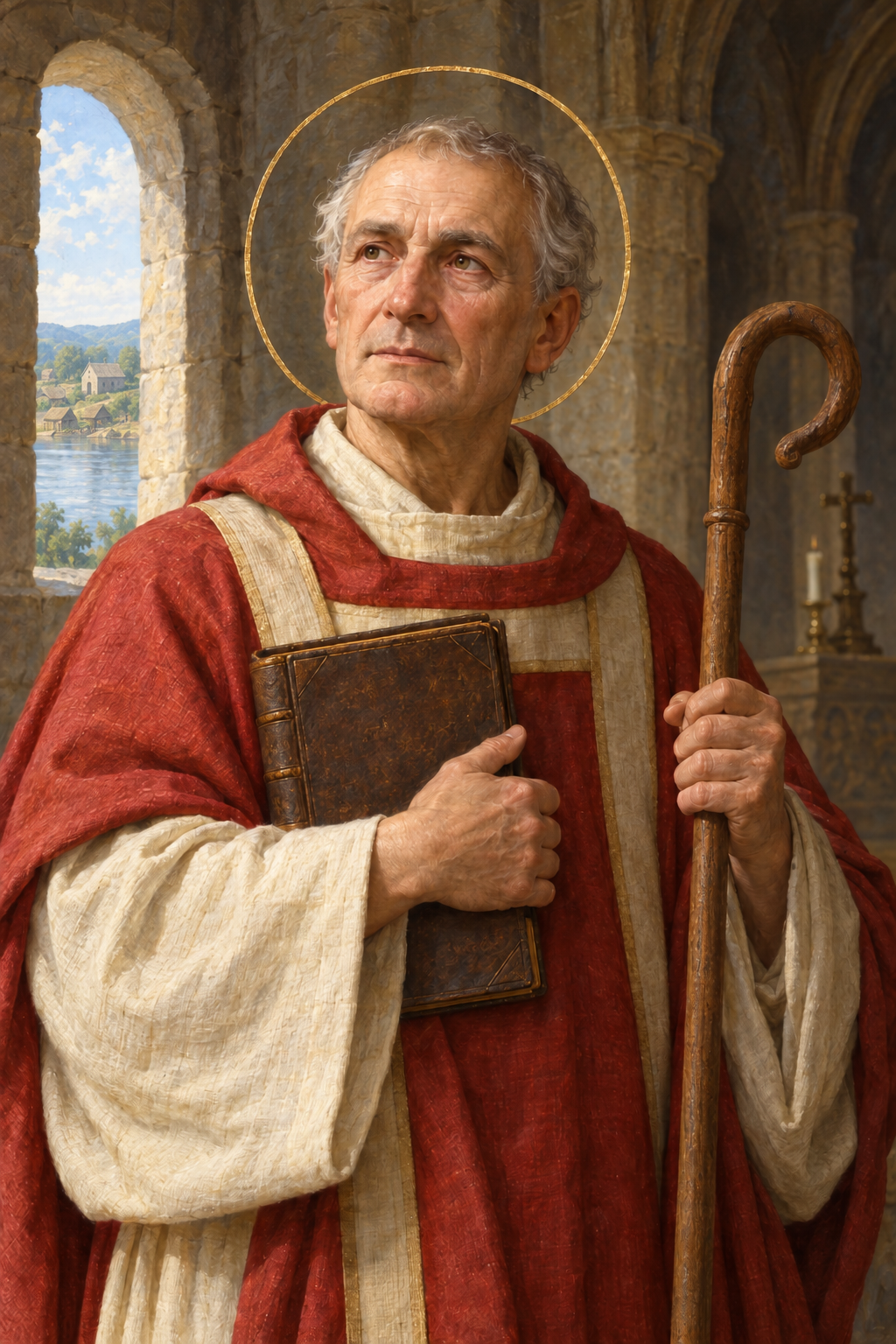
About Lambert of Maastricht
Lambert of Maastricht was a bishop whose violent death became closely connected with the growth of Liège. Born around 635, he belonged to a Frankish aristocratic family and received his education under Bishop Theodard. He succeeded his teacher as bishop of Maastricht, but his responsibilities drew him into the political struggles of the Frankish kingdom.
The surviving accounts do not offer a simple, continuous record of his life. The earliest anonymous biography brings together episodes of his childhood, ministry and exile. The scholarly catalog Narrative Sources describes it as a work intended for liturgical reading and for the promotion of his cult. Its date and author remain debated. It is an important witness to his early reputation, but its purpose was religious remembrance rather than modern biography.
After the murder of King Childeric II in 675, Lambert lost his episcopal position and withdrew to Stavelot, where he remained for seven years. The political explanation is disputed. Philippe George, following Matthias Werner, challenges the familiar claim that Ebroin drove him out: the bishop may instead have been removed because of his association with Ebroin. The exile itself is better established than the precise alignment of the factions behind it.
A story preserved in the early Life illustrates how that exile was remembered. Lambert accidentally disturbed the monastery’s nighttime silence by dropping a sandal. The abbot, unaware who had made the noise, ordered the offender to do penance at a cross. The account describes the bishop obeying in the winter cold until the mistake was discovered. George examines the narrative alongside monastic rules and later images; it belongs to the portrayal of Lambert’s humility, rather than a practice proposed for imitation.
After returning to Maastricht, Lambert worked to deepen Christianity among rural communities. His ministry followed the Meuse and extended to settlements including Huy, Namur and Dinant. Marie Dewez’s account also associates him with the foundation of Munsterbilzen. The bishop’s work developed within the interests and rivalries of the ruling families, which also shaped the circumstances of his death.
Lambert was killed at Liège around 705. In the earliest accounts, his death arose from a family feud involving Dodo. Senger’s account emphasizes that Lambert chose not to defend himself. The bishop was soon honored as a saint and was already described as a martyr in the first half of the eighth century.
A different explanation became influential later: Lambert was said to have rebuked Pepin of Herstal for his relationship with Alpaida and to have been killed in retaliation. The Catholic Encyclopedia presents that interpretation as a defense of marital fidelity.
Senger dates the appearance of this interpretation to the tenth century, alongside the older account. It should therefore be distinguished from the earliest explanation of the murder.
Lambert was first buried at Maastricht. His successor Hubert brought his remains to Liège and established a church at the place of his death. Pilgrimage to the martyr’s shrine contributed to the settlement’s development. The later cathedral dedicated to Mary and Lambert stood there until its destruction after the Revolution; Saint-Paul became the cathedral in 1803.
The cathedral treasury preserves a striking witness to his later cult: a large silver and gilt reliquary bust made by Hans von Reutlingen before 1512. It represents Lambert as a bishop above six scenes from his life. The work was associated with Prince-Bishop Érard de la Marck, whose figure appears on its base. Its ornate appearance belongs to late medieval devotion, many centuries after Lambert’s lifetime.
A 1653 engraving by Michel Natalis helped circulate the image of the bust beyond Liège. The object itself also records later interventions: its pastoral staff was remade in the nineteenth century, and the painted face probably dates from the eighteenth. These changes show how successive generations maintained and adapted an inherited image of their patron.
His patronage also spread beyond Liège. Hans Georg Wehrens traces Freiburg’s devotion through a skull relic associated with Bishop Rudolf of Zähringen and later kept in the castle chapel. After the castle’s destruction in 1366, it was moved to Freiburg’s minster. Wehrens considers the honors paid to Lambert evidence that his civic patronage had developed by the later fourteenth century. The exact moment of its establishment is uncertain.
The history of the relics requires similar care. In 2023, the Diocese of Liège reported a visual examination of the remains attributed to Lambert. The examiner identified, among other findings, a bone from a second person. The containers were subsequently resealed, and a written record was deposited with them. This report documents the treatment of the relics; it does not establish every bone’s identity.
Liège continues to honor Lambert as patron of its diocese, with his liturgical feast on September 17. The celebration joins remembrance of an early bishop with the continuing life of a community shaped by his shrine.
Wondering how to weigh the stories and sources? Learn how to read a saint biography.